
Unit 2 : Worked Problems#
Problem - Elastic Scattering Nickel
Explain where the dips come from in the elastic scattering data for nickel shown in the lecture notes. If the nucleus is assumed to be a solid uniform density sphere with a form factor given by
with \(b=qR/\hbar\), determine the momentum transfer of the first dip in the graph and use this to estimate the nuclear size.
Core Knowledge
In this example we use Figure 2.1 of the notes which is from the textbook by Martin to estimate the radius of the 58-Ni nucleus.
The figure shows the differential cross section for the scattering of electrons of energy \(E_{e}\) = 450 MeV of a Nickel target as a function of the scattering angle. The plot shows a few dips that are not consistent with the scattering off a point-like particle, as the scattering off a point-like particle is described by the Mott formula, which is a monotonic function of the angle. This dip behavior is attributed to the presence of a form factor defining the nuclear structure.
Method
For the estimate of the nuclear structure we make the following assumption.
The scattering is elastic, e.g. the energy of outgoing electron is equal to the energy of the incoming electron.
This is justified, as the energy of the electron (450 MeV) is much smaller than the rest mass of the nucleus (around 55 GeV). Because of this the momentum transfer \(q\) is written as
where we’ve assumed that the initial and final momenta magnitude, \(p\), is constant due to elastic scattering.
This can be rearranged to get
We can therefore write that
The momentum transfer in a collision can be related to the scattering angle using the formula above
The first minimum can be read off the plot and corresponds to \(θ ≈ 24^{◦}\). Which means
Application
The shape of the nucleus is approximated as a solid sphere with uniform density. Using this approximation the form factor \(F(q)\) is written as
with \(b=qR/\hbar\). This standard formula is derived in the Martin textbook.
Under this approximation the form factor and the cross-section will be zero for a few values of \(b\). The fact that we do not observe a vanishing cross section means that the uniform density approximation is not exact. We can, however, take the position of the first minimum in the cross section as an indication of where the form factor would go to zero if the distribution was perfectly uniform. The first zero of the form factor corresponds to the value \(b_{1} = 4.49\).
Using the definition of b we have
Note that if we use the empirical formula for the nuclear radius we would have
which is remarkably close.
Problem - Nuclear Density Estimate
Considering measurements of the charge distribution of nucleons for several nuclei shown in the graph below, determine an estimate of the mean nucleon density in nuclei.
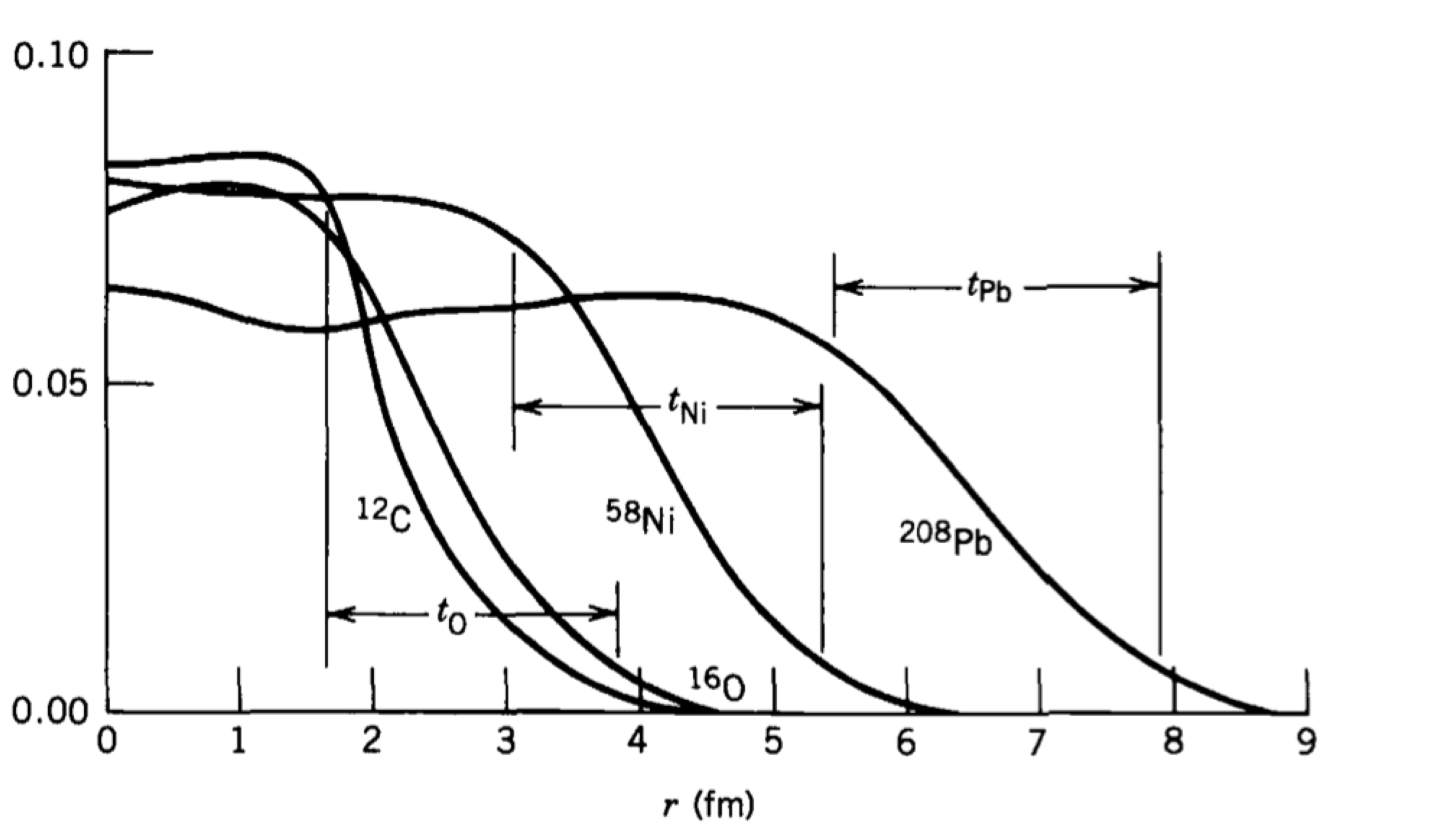
Considering measurements of the charge distribution of nucleons for several nuclei shown in the lecture notes, determine an estimate of the mean nucleon density in nuclei.
The graph presented in the lectures shows the Saxton-Woods distribution of the charge inside the nucleus. In this example we evaluate the density of nucleons inside the nuclear region for two nuclei: 12C and 208Pb.
We assume that the density of nucleons is proportional to the charge density and is given by
where we indicated with \(ρ_{nucl}\) the density of nucleons and with \(ρ_{ch}\) the charge density. We can read the plateau value of ρch off the graph for the two elements under consideration.
For 12-C we have \(ρ_{ch} ≈ 0.08~e\) which gives
For 208-Pb we have \(ρ_{ch} ≈ 0.06~e\) which gives
Problem - Coulomb Repulsion
Based on classical mechanics assuming a coulomb repulsion that occurs inside the nuclear medium, estimate the form of the coulomb repulsion term in the liquid drop model energy for a nucleus of given charge \(Z\).
Based on classical mechanics assuming a coulomb repulsion that occurs inside the nuclear medium, estimate the form of the coulomb repulsion term in the liquid drop model energy for a nucleus of given charge \(Z\).
Core Knowledge
Recall first that the electric potential energy of a charge \(q_{1}\) in the potential of \(q_{2}\) distance \(r\) away is:
The Charge Density (it is uniform remember) is given by :
Method
Based on this we see that the Electrostatic Energy in the shell \(dr\), we call \(dE_{e}\), is given by:
which reduces to
Integrating this out to the maximum radius of the nucleus, \(r=0\rightarrow R\), gives the total Electrostatic Energy:
Finally, if we substitute in the charge density given earlier we get
If we remember that the nuclear size is given by \(R=r_{0}A^{1/3}\) where \(r_{0}\) is the Nucleon Effective Radius and we gather the constants out we get
and
Application
This is close to our contribution we showed in the equations above, however the analysis includes a slight approximation. As charge is quantized the integration over \(r\) should really only start once a single charge has been enclosed. If this is accounted for the Total Electrostatic Energy is usually given by
Problem - Nuclear Cutoff
Based on the idea of a hard nuclear cutoff derive the expression that relates the radius of the nucleus with the total nucleon number.
Based on the idea of a hard nuclear cutoff derive the expression that relates the radius of the nucleus with the total nucleon number.
The graph presented in the lecture of the root-mean-square (RMS) of the nuclear matter as a function of the atomic mass number \(A^{1/3}\) shows a fit to the data gives a parameterization
Under the assumption that the nucleus is a sphere or radius \(R\) and uniform density, the density would be
and
The quantity \(< r^{2} >\) is calculated as
where the integration over the angular coordinate was carried out to give a factor of \(4\pi\). Substituting the expression for \(ρ_{M}(r)\) we have
Therefore the nuclear radius is
Problem - Mirror Nuclei SEMF
Consider the nuclei 15-O and 15-N. Evaluate the difference in mass energy between the two nuclei using the SEMF and comment on why you would expect such a difference.
We note that for each nuclei we have \(A=15\), it is just the number of protons or neutrons that are swapped as Oxygen has 8 protons, and Nitrogen has 7. These are therefore Mirror Nuclei.
If we want to evaluate the difference in mass energy between the two nuclei we can simply subtract the mass calculated for each one using the SEMF. Before we do this however it’s worth evaluating which terms in the liquid drop model for binding energy actually contribute. The volume term and surface tension term only depend on \(A\) so both these terms cancel out if we take the difference as \(A\) is constant. Both nuclei are also Even-Odd (as \(A\) is odd) so that means the delta term also goes to zero. Therefore only the Asymmetry and Coulomb correction term contribute.
We can take this one step further because a quick evaluation of the Asymmetry term gives us
15-O : \(a_{a} (15 - 2 \times 8)^{2} = a_{a} (-1)^{2} = a_{a}\)
15-N : \(a_{a} (15 - 2 \times 7)^{2} = a_{a} (1)^{2} = a_{a}\)
The result is therefore that the asymmetry term will also cancel out, so any differences between the nuclei will mainly be down to the Coulomb term.
If we evaluate the difference in binding energy we get
Rearranging this it becomes
We expect our binding energy terms to just be dominated by the difference in coulomb terms we therefore get
Substituting this in with the difference in mass between protons and neutrons we get
So we find that actually there is an increase in overall mass energy (so a lower binding energy) for oxygen compared to nitrogen despite the fact that there are more protons (which are lighter than neutrons). This is because our Coulomb repulsion term contributes much more than the mass difference of a proton and neutron reducing the overall stability of the nucleus as we add protons.
Note that its also possible to do this assuming the \(Z^{2}\) instead of \(Z(Z-1)\) Coulomb term that is sometimes considered in the literature instead. If you do so you’ll end up with a different energy (by around 7%) but the conclusions are still the same.