
Semester 1 Solutions#
Chapter 1#
Numbers and fractions revision#
1. Here is the completed table, so you can check your answers:
101 |
105 |
1111 |
3939393 |
427000 |
3456552 |
8585 |
9999 |
|
|---|---|---|---|---|---|---|---|---|
Divisble by 2? |
𐄂 |
𐄂 |
𐄂 |
𐄂 |
✓ |
✓ |
𐄂 |
𐄂 |
Divisble by 3? |
𐄂 |
✓ |
𐄂 |
✓ |
𐄂 |
✓ |
𐄂 |
✓ |
Divisble by 5? |
𐄂 |
✓ |
𐄂 |
𐄂 |
✓ |
𐄂 |
✓ |
𐄂 |
Divisble by 9? |
𐄂 |
𐄂 |
𐄂 |
𐄂 |
𐄂 |
𐄂 |
𐄂 |
✓ |
Divisble by 11? |
𐄂 |
𐄂 |
✓ |
𐄂 |
𐄂 |
✓ |
𐄂 |
✓ |
Note 101 is actually a prime number, so only divisible by 1 and 101. This means we could have completed the 101 column without doing any of the divisibility tests.
2. (i) By Question 1, 105 is divisble by 3 and 5, and 9999 is divisible by 3, 5, 9 and 11. In fact, \(105=3\cdot 5\cdot 7\), and \(9999=3^2\cdot 11\cdot 101\). So
(ii) Similarly,
Before expanding out again, we should check whether \(7\) divides \(427\). In fact it does, and \(427=7\cdot 61\), so
There are no factors of 3 in the numerator, and so the fraction is in lowest terms.
(iii) From Question 1, \(3456552\) is divisible by 2, 3 and 11. In fact, \(3456552=2^3\cdot 3\cdot 11\cdot 13093\).
Using the rules from Q1, 29700 is divisible by 100, 9 and 11, and in fact \(29700=2^2\cdot 3^3 \cdot 5^2 \cdot 11\).
Hence, \(\displaystyle\frac{29700}{3456552}=\frac{2^2\cdot 3^3 \cdot 5^2 \cdot 11}{2^3\cdot 3\cdot 11\cdot 13093} = \frac{3^2 \cdot 5^2}{2\cdot 13093} = \frac{225}{26186}\).
(iv) Using the prime factorisation from (ii),
3. We have the following solutions.
(i) \(\displaystyle \frac{2}{4} + \frac{3}{4} = \frac{5}{4}\).
(ii) \(\displaystyle\frac{2}{4} - \frac{3}{4} = - \frac{1}{4}\).
(iii) \(\displaystyle \frac{2}{4} \times \frac{3}{4} = \frac{2\times 3}{4\times 4} = \frac{1\times 3}{2\times 4} = \frac{3}{8}\).
(iv) \(\displaystyle \frac{2}{4} \div \frac{3}{4} = \frac{2}{4} \times \frac{4}{3} = \frac{2}{3}\).
(v) \(\displaystyle \frac{2}{3}- \left(-\frac{-2}{3}\right) = \frac{2}{3} - \frac{2}{3} = 0\).
(vi) \(\displaystyle\frac{1}{5} \times \left(\frac36 - \frac{2}{5}\right) = \frac{1}{5} \left(\frac{1}{2} - \frac{2}{5}\right) = \frac{1}{5}\left( \frac5{10} - \frac{4}{10}\right) = \frac{1}{5}\times \frac{1}{10} = \frac{1}{50}\).
(vii) \(\displaystyle \frac{9}{7}-\left(\frac{4}{-3}\right) = \frac{9}{7} + \frac{4}{3} = \frac{9\times 3+7\times 4}{7\times 3} = \frac{27+28}{21} = \frac{55}{21}\).
(viii) \(\displaystyle \frac{3}{8}\times\frac{7}{4}\times\frac{5}{2} = \frac{3\times 7\times 5}{8\times 4\times 2} = \frac{105}{64}\).
(ix) To calculate \(\frac{1}{3}-\frac{1}{4}-\frac{1}{5}\), use common denominator \(3\times 4\times 5\). We have
(x) To calculate \(\frac{8}{9}+\frac{3}{7}\times\frac{4}{3}-\frac{2}{5}\), according to BIDMAS, we should deal with the multiplication first. We have
We can then use a common denominator — we use \(9\times 21\times 5\):
4. (i) We have \(\displaystyle\frac{1}{1+\frac{1}{1+\frac{1}{2}}} = \frac{1}{1+\frac{2}{3}} = \frac{1}{\frac{5}{3}} = \frac{3}{5}\).
(ii) Therefore,
and,
5. We have the following answers.
(i) \(\displaystyle \frac{1}{p} + \frac{1}{q} = \frac{q + p}{pq}\)
(ii) \(\displaystyle \frac{1}{p}-\frac{1}{q}=\frac{q -p}{pq}\)
(iii) \(\displaystyle \frac{1}{p+1} + \frac{1}{q-1}=\frac{q + p}{(p + 1)(q - 1)}\)
(iv) \(\displaystyle \frac{1}{p+1} - \frac{1}{q-1}=\frac{ q - p - 2}{(p + 1)(q - 1)}\)
(v) \(\displaystyle \frac{p-q}{p+q} - \frac{pq}{q-1}=\frac{-q^2 - pq^2 - p^2q + pq + q - p}{(q + p)(q - 1)}\)
(vi) \(\displaystyle \frac{p}{q(p+1)} - \frac{5p}{q-1}=-\frac{p(5pq+ 4q + 1)}{q(p + 1)(q - 1)}\)
(vii) \(\displaystyle \frac{3}{(p+1)^2} + \frac{p}{p^2-1}=\frac{p^2 + 4p - 3}{(p^2 - 1)(p + 1)}\)
(viii)
(ix)
(x)
6. (i) As written, this work is not mathematically meaningful, although hopefully you can see some hints of appropriate steps taken.
Here is how it might be marked.
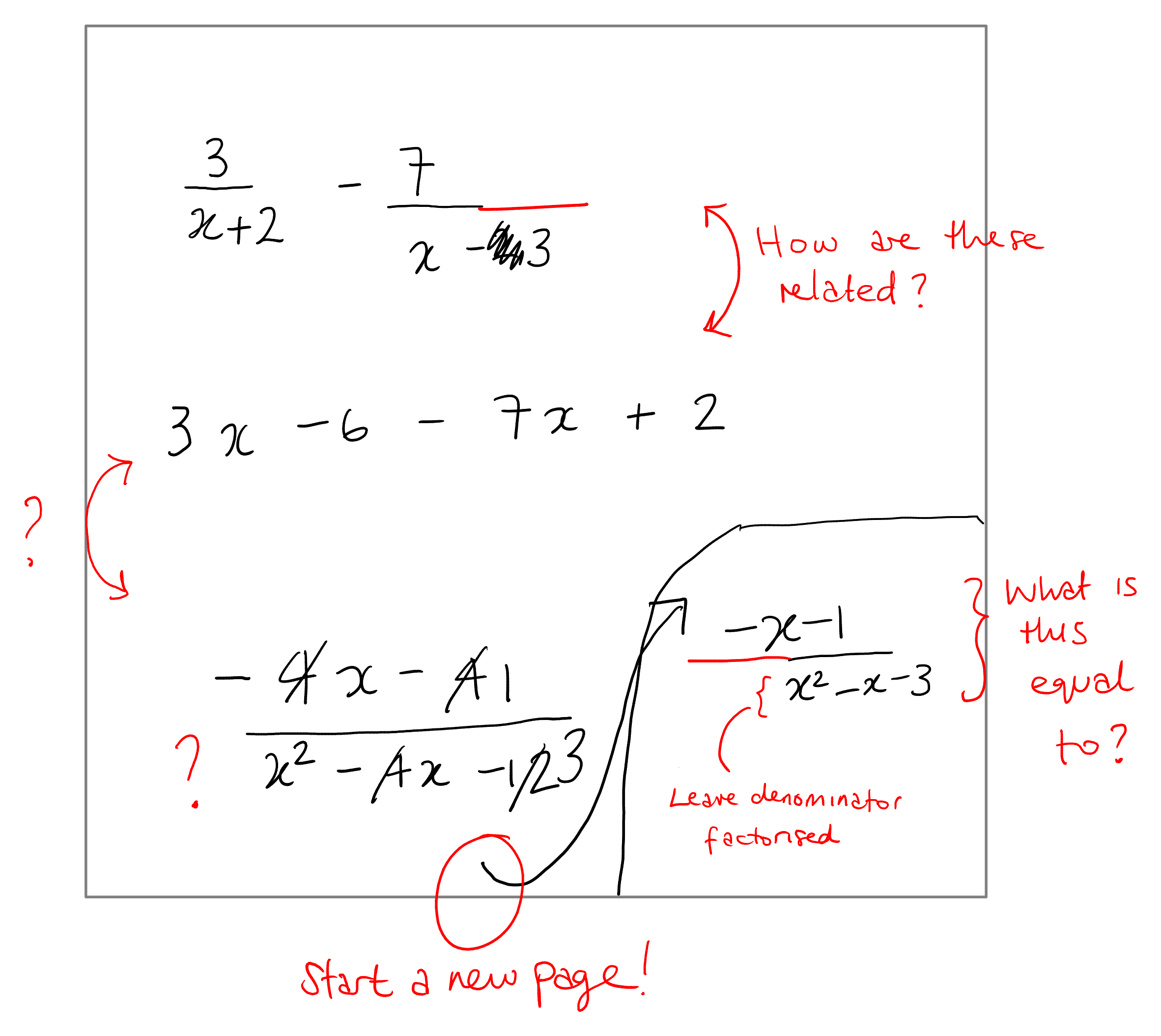
The key points are:
Currently, it is not clear how each mathematical expression connects to the whole, and there is no real “flow of ideas”’ happening on the page. Use of equal signs would help, as would writing in the denominator \((x+2)(x-3)\) in line 2.
Avoid multiple columns of working or arrows to boxes, as this nearly always obscures meaning. Instead, use a bit more space and remember to connect your final answer to the expression you started with.
Take care to make your fraction lines long enough, especially when there are minus signs in the mix.
There are numerous mathematical inaccuracies, but these are harder to spot among the chaos.
Scribbles, messy handwriting and crossings out are all fine, so long as what you write is readable to others.
(ii) Here is an improved version.

Note how the inclusion of equal signs and full mathematical statements means that every line is now actually saying something (namely, that it is equal to the original expression).
In particular, the final answer is \(\displaystyle -\frac{4x+23}{(x+2)(x-3)}\).
Warning: What you practice is what you learn! Try to get into good presentational habits now in your own practice, even if it’s just ‘for you’ and you aren’t handing it in to anyone.
We find that in the exams, people default to what they’re in the habit of doing. Improving your presentation takes time and practice.
Setting out your own solutions clearly will also help you spot your own mistakes, and make it easier when you come to revise.
7. (i) We have
(ii) Note
so we can use \(x^2-1=(x-1)(x+1)\) as a common denominator and save some cancellation effort.
We have
(iii) We have
(iv) \(\displaystyle \frac{1}{x+1} - \frac{2x-3}{x-1} - \frac{3x-4}{x+2} = \frac{x(2x+9-5x^2)}{(x+2)(x^2-1)}\).
(v) \(\displaystyle \frac{1}{x^2+1} - \frac{1}{x^2+2} = \frac{1}{(x^2+1)(x^2+2)}\).
(vi) \(\displaystyle x^2 - \frac{3x+4}{(x-2)(x+1)x^2} = \frac{x^2(x-2)(x+1)x^2 - (3x+4)}{(x-2)(x+1)x^2} = \frac{x^6-x^5-2x^4-3x-4}{(x-2)(x+1)x^2}\).
(vii)
Note
If you weren’t able to spot first time that \(2x^3-3x^2+5x-4 = (x-1)(2x^2-x+4)\), don’t worry. In Chapter 3 we will look at concrete methods for factorising higher degree polynomials, including cubics, that don’t depend on “having a clever idea”. See sections on the Factor Theorem and polynomial long division for details.
Observe that
\[ x^2-x+3 - \frac{-x^3+x^2-x+1}{x-1} = x^2-x+3 + \frac{x^3-x^2+x-1}{x-1}, \]and
\[ x^3-x^2+x-1 = (x^2+1)(x-1) \]is perhaps an easier factorisation to spot. So a faster/more elegant solution is
\[\begin{align*} x^2-x+3 - \frac{-x^3+x^2-x+1}{x-1} &= x^2-x+3 + \frac{(x^2+1)(x-1)}{x-1} \\ &= x^2-x+3+x^2+1 \\ &= 2x^2-x+4. \end{align*}\]
(viii) \(\displaystyle x^2-x+3 - \frac{-x^3+x^2-x+1}{x+1} = x^2-x+3 + \frac{x^3-x^2+x-1}{x+1}\).
This time, the factorisation \(x^3-x^2+x-1 = (x^2+1)(x-1)\) shows that \(x+1\) is not a factor of \(x^3-x^2+x-1\), and so we cannot apply the same kind of simplification as in the last question and “Note 2”.
We have
8. The answer is (C).
You can work this out the hard way, but that would be not efficient.
For easier explanation, let’s call
and \(RHS(X)\) the possible answers.
First look at the denominators:
(D) must be wrong as when we bring the fraction on the common denominator, then we need the denominator to consists of the denominators of the separate fractions. I might be able to cancel some out, but I would not get the factor of \(2p - q\) in the denominator as it needs to be \(2p + q\).
This leaves us with three choices. Now we put some values for \(p\) and \(q\) into the original question (\(LHS\)) and all three remaining possible answers, \(RHS(A)\), \(RHS(B)\) and \(RHS(C)\).
If \(LHS \neq RHS(X)\) then these two expressions cannot be equal as two expressions with unknowns are only equal is they are equal for all possible values of the unknowns. Sadly, if \(LHS = RHS\), we can not conclude that the are definitely equal, but given that this is a MCQ with exactly one right answer, it should rule out the wrong answers which leave us with the correct one. This method is known as a plausibility check.
Note that if we chose badly, we might need to try another set of numbers, but that is still faster than working this out the long way. And the chances of making mistakes is also reduced.
We cannot use \(p = q = 0\) as the fraction is then not defined. We could go for \(p = 0\) and \(q = 1\) (or the other way around), but I would struggle to remember which is which. So I would try \(p = q = 1\). Then
while
which means that the answer needs to be (C).
If I had time, I would double check that (C) fullfils the trick to ensure I made no obvious mistake:
Equations in one variable#
9. (i) We have
(ii) We have
(iii)
(iv) For \(x \neq 0\),
(v) For \(x \neq 0\) we have
(vi) For \(x \neq -1\),
10. The answer is (D).
Again, we could work it out, but as exactly one of the answers needs to be correct, we can just put the possible given values into our equation. This is how we would normally check our answer anyway.
So let \(LHS = \displaystyle\frac{7x-1}{x+3}\) and \(RHS = -1\).
For (A): well, that cannot be an answer as the denominator of the \(LHS\) is 0 when \(x = -3\).
For (B): \(LHS = \displaystyle\frac{7\times\frac{1}{7} -1}{\frac{1}{7} +3} = 0 \neq RHS\), so that is not the answer either.
For (C): \(LHS = \displaystyle\frac{7\times \frac{1}{4} -1}{\frac{1}{4}+3} = \displaystyle\frac{\frac{3}{4}}{\frac{13}{4}}>0\) so this cannot be right either as \(RHS < 0\).
This leaves (D) as the only option.
We can check:
11. (i) \(x=-1\)
(ii) For \(x\neq 2\), we have \(\displaystyle \frac{x+1}{x-2} = 0\), and so we can multiplying both sides by \(x-2\) (which is non-zero), to get \(x+1=0\), and hence \(x=-1\).
(iii) For \(x \neq 4\), we have
(iv) \(\frac{1}{3} = 2x \), hence \(x=\frac{1}{6}\).
(v) For \(x\neq \frac{3}{2}\),
(vi) For \(x\neq \frac{3}{4}\),
(vii) We have \(x+4 = -1\), so \(x=-5\).
(viii) For \(x\neq 2\),
(ix) For \(x\neq \frac{3}{2}\),
(x) We are given that \(\displaystyle \frac{ax+b}{cx+d} = 1\), where \(cx+d\neq 0\).
Therefore,
and so
The next step depends on whether or not \(a=c\).
If \(a=c\), then by (1), \(d-b=0\), and so \(d=b\). Substituting this back into the original equation gives \(\frac{ax+b}{ax+b}=1\), which of course is true for all \(x\).
In fact \(a=c\) contains two cases: if \(d=b\), there are infinitely many solutions: any \(x\in\mathbb{R}\) with \(x\neq -\frac{a}{b}\) satisfies the equation. If \(d\neq b\), then the equation is inconsistent and there are no solutions.
If \(a\neq c\), then we can divide both sides of (1) by \(a-c\) to get \(\displaystyle x=\frac{d-b}{a-c}\).
Changing the subject of an equation#
12. We get the following solutions.
(i) We have
(ii) We have
For \(x\neq 1\), we can divide both sides by \(x-1\) to get
that is,
(iii) For \(3y-2\neq 0\), which is to say for \(y\neq \frac{2}{3}\), we have
For \(x\neq \frac{2}{3}\), we divide by \(3x-2\) to get \(\displaystyle y= \frac{2x + 5}{3x-2}\).
(iv) We have \(x=1-y\), so
(v) For \(x \neq 0\) and \(y \neq 0\) we have
(vi) For \(x, y, z \neq -1\) we are given that
Subtracting \(\frac{1}{z+1}\) from both sides,
Putting the RHS over a common denominator,
and so
We can now take reciprocals of each side to get
noting that we need \(z\neq x\) for this to be valid.
Then, subtracting 1 from both sides,
and so
provided \(x, y, z\neq 1\) and \(z\neq x\).
13. (i) The main problem with this work is they are claiming things are equal when they are not. This is quite a common habit picked up in school, but as you progress into more advance maths topics, it becomes essential that notation is used accurately.
Here is how the example might be marked.
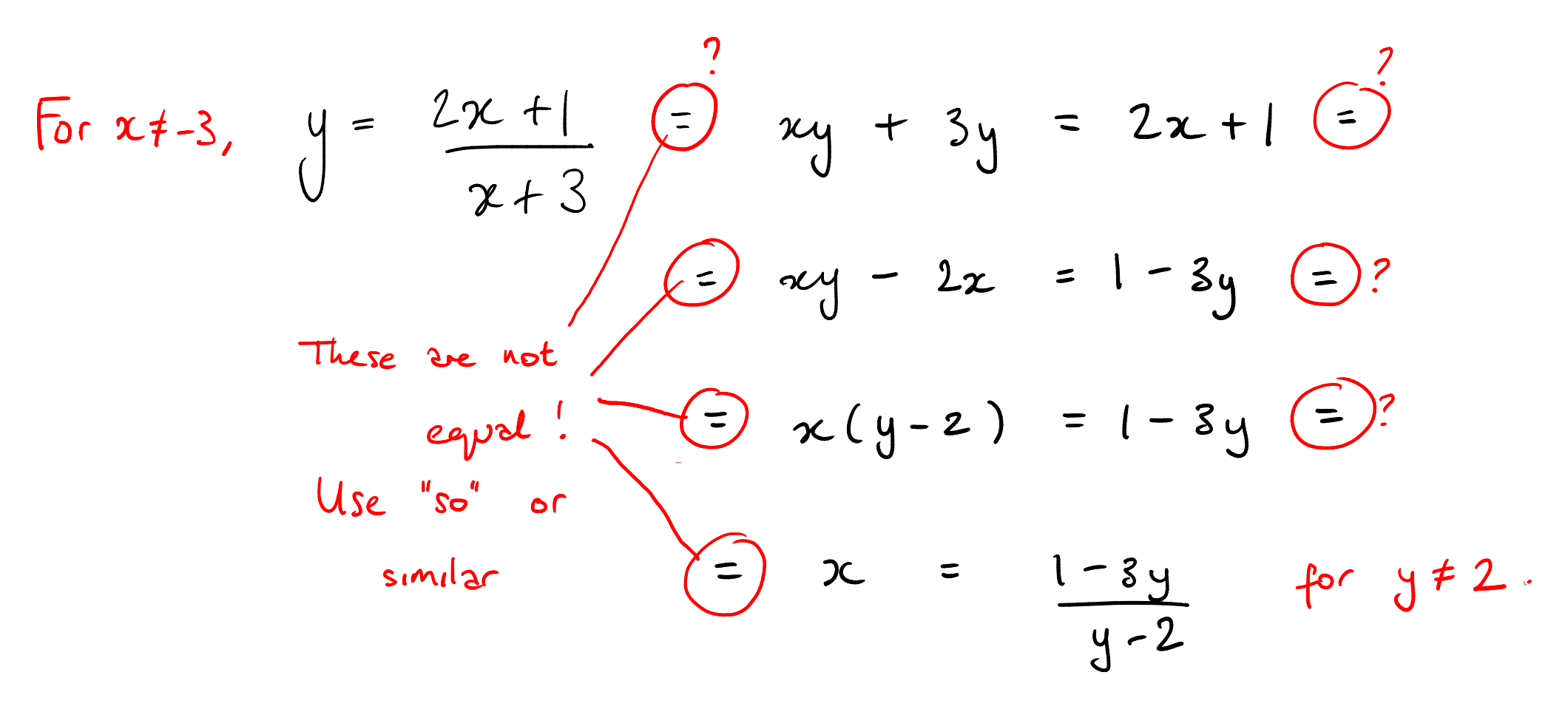
Fig. 4 Question 13 marked#
In addition to erronious equal signs, this person has not indicated anywhere the values of \(x\) and \(y\) that must be avoided for the calculations to be valid. This can lead to incorrect conclusions, especially as problems become more complicated.
(ii) Here is an improved version.
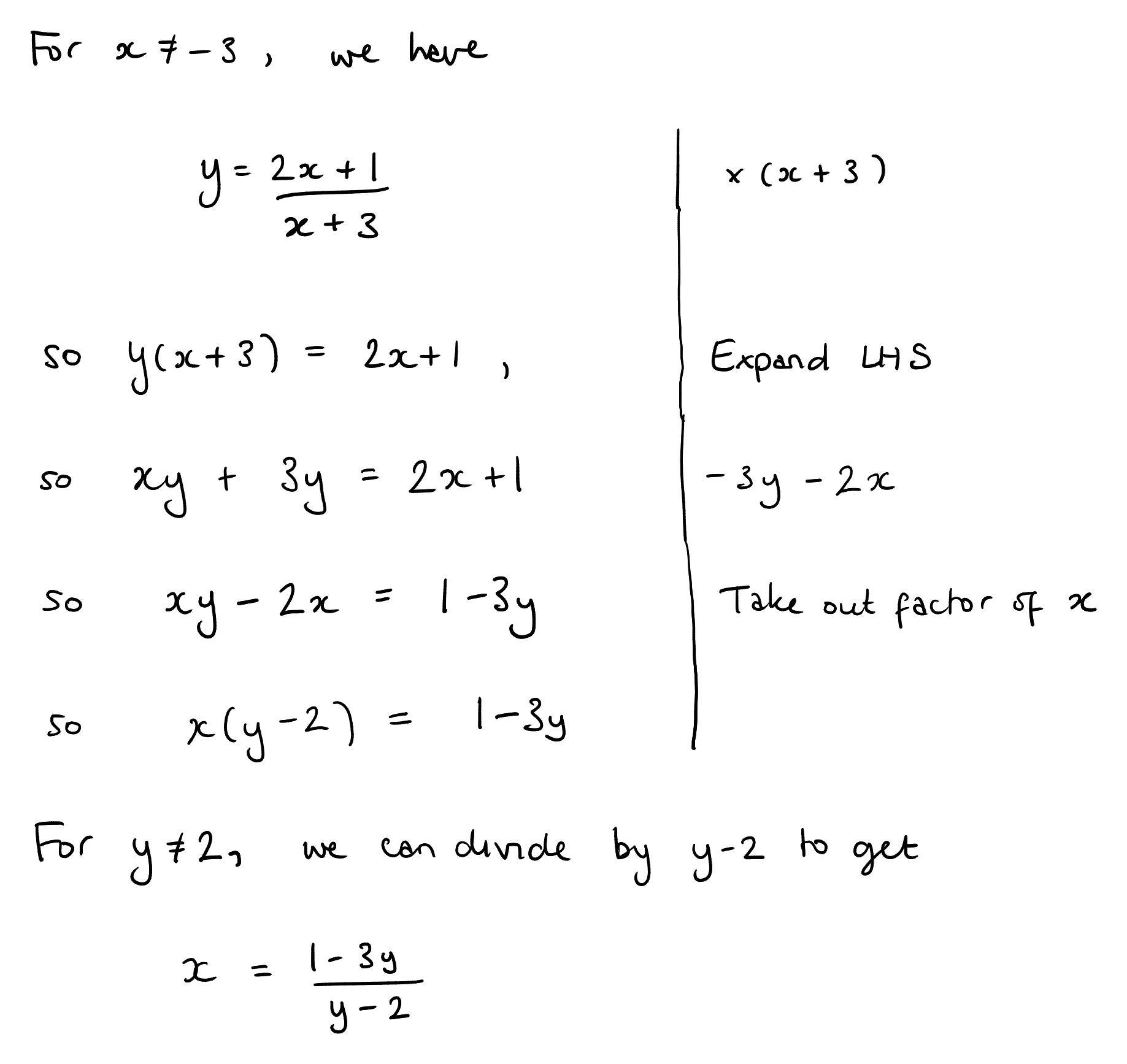
Fig. 5 Question 13 improved answer#
Note how the inclusion of equal signs and full mathematical statements means that every line is now actually saying something (namely, that it is equal to the original expression).
In particular, the final answer is \(\displaystyle x=\frac{1-3y}{y-2}\).
14. Solving the equation for \(x\) gives, in each case,
(i) \(x = y - 4\).
(ii) For \(x\neq 2\), we have \(y=\frac{x+1}{x-2}\).
Multiplying both sides by \(x-2\),
so
To make \(x\) the subject, move terms with \(x\) to the LHS and all other terms to the RHS. For this equation this means performing \(+2y-x\) to both sides. We get,
that is,
Taking out the factor of \(x\) now on the LHS,
Hence,
for \(y \neq 1\) and \(x \neq 2\).
(iii) We have, for \(x\neq 4\),
for \(y \neq -3\) and \(x \neq 4\).
(iv) \(x = \displaystyle \frac{1}{2y}\) for \(y \neq 0\).
(v) \(x = \displaystyle \frac{2(3y + 2)}{4y - 1}\) for \(y \neq \frac{1}{4}\) and \(x \neq \frac{3}{2}\).
(vi) \(x = \displaystyle \frac{2y - 9}{y - 6}\) for \(y \neq 6\) and \(x \neq 2\).
(vii) \(x = -y - 4\).
(viii) \(x = \displaystyle \frac{40y - 11}{2(10y + 1)}\) for \(y \neq - \frac{1}{10}\) and \(x \neq 2\).
(ix) \(x = -\displaystyle \frac{4(3y - 2)}{15y - 2}\) for \(y \neq \frac{2}{15}\) and \(x \neq -\frac{4}{5}\).
(x) We are given that \(\displaystyle y= \frac{ax+b}{cx+d}\), where \(cx+d\) must be assumed.
For this question, it makes a difference whether \(c=0\) or \(c\neq 0\).
Case \(c=0\). Then, we require \(d\neq 0\) also. We get
\[ y=\frac{ax+b}{d}, \]and so
\[ dy=ax+b. \]Hence
\[ ax=dy-b, \]and provided \(a\neq 0\),
\[ x=\frac{dy-b}{a}. \]Case \(c\neq 0\). Then we require \(x\neq -\frac{d}{c}\), to ensure that \(cx+d\neq 0\). We have
\[\begin{split} \begin{array}{rcl} & y = \displaystyle\frac{ax+b}{cx+d} &|\times(cx+d) \\ \text{ so, }& y(cx+d) = ax+b &|\ \text{T} \\ \text{ so, }& cxy+dy = ax+b &|-dy-ax \\ \text{ so, }& cxy-ax = b-dy &|\ \text{T} \\ \text{ so, }& x(cy-a) = b-dy. \end{array} \end{split}\]Now, since \(c\neq 0\), we can demand that \(y\neq \frac{a}{c}\), and hence ensure \(cy-a\neq 0\). Dividing through by \(cy-a\) then gives
\[ x=\frac{b-dy}{cy-a}, \]which is valid for all \(x\neq-\frac{d}{c}\) and \(y\neq \frac{a}{c}\).
15. The answer is (B). Again, we could work it out, but as exactly one of the answers needs to be correct,we can use a short cut.
Let’s label the equation as
and consider the possible answers (A), (B), (C) and (D). Pick a value for \(x\) and put this into (2) to find the corresponding y-value.
I would go for \(x = 0\) which gives me \(y = \frac{-1}3 - 7 = -10\). A correct answer to the question must be true for this point \((x, y) = (0, -10)\); that is putting these values into equations (A), (B), (C) and (D) must be true to be correct.
For (A): that is just nonsense, this equation cannot have a number as a solution, so we can rule this out.
For (B): \(\displaystyle -\frac{-10+10}{2(-10+5)} = 0 = x\), so that could work.
For (C): \(\displaystyle\frac{-10+10}{2(-10+5)} = 0 = x\), so that could work, too.
For (D): \(\displaystyle\frac{-10+10}{2(2+10)} = 0 = x\), so that could work, too.
Which means I made a bad choice for my \(x\)-value. Let’s try it with \(x = -1\) so the \(y\)-value will be an integer. This gives \(y = 7 - 7 = 0\).
For (B): \(\displaystyle-\frac{0+10}{2(0+5)} = -1 = x\), so that could work.
For (C): \(\displaystyle\frac{0+10}{2(0+5)} = 1 \neq -1 = x\), so that is not the answer.
For (D): \(\displaystyle\frac{0+10}{2(2-0)}\neq -1 = x\), so that is not the answer either.
This means the answer has to be (B).
Simultaneous linear equations#
16. (i) We first label the equations, to help express our reasoning.
Multiplying equation (2) by 3,
Then, summing equations (1) and (3) gives
and hence \(\displaystyle y=\frac{9}{23}\). Substituting back into (1),
and so
Check: We know (1) is satisfied since we just used it to find \(x=-\frac{10}{23}\). Substituting \(x=-\frac{10}{23}\) and \(y=\frac{9}{23}\) into (2) gives
Hence \( x = -\frac{10}{23}\) and \(y = \frac{9}{23}\) are indeed the solutions to the simultaneous equations.
(ii) \(x = 1\) and \(\displaystyle y = \frac{4}{3}\)
(iii) \(x =\displaystyle \frac{6}{5}\) and \(y =\displaystyle \frac{8}{5}\)
(iv) \(x = 0\) and \(y = 0\)
(v) \(x = -2\) and \(y = -1\).
(vi) Here we have infinitely many solutions, since the second equation is just 3 times the first. Given any value for \(x\), say \(x=k\), we have \(y = -3k\).
17. The answer is (C).
You can again just do the check and see which of the answers is correct. But this will here give you one problem as you need to read this more carefully.
It cannot be (A) or (B) as the answer to the simultaneous equation needs to be a pair \((x_0, y_0)\).
The difference between C and D is the choice of word. Remember that ‘and’ means ‘at the same time’ while ‘or’ means ‘one of them’. As the solution is a point, we need to have an answer with the ‘and’ in it. We cannot choose if we want \(x = \frac{9}{7}\) or \(y = \frac{8}{7}\) — they have to be \(x = \frac{9}{7}\) and \(y = \frac{8}{7}\) to be a solution.
This means you can find the answer without even doing any calculation.
Chapter 2#
Quadratics and quadratic equations#
18. We get the following solutions.
(i) \(x^2 + 8x + 7 = (x + 7)(x+1)\);
(ii) \(x^2-16x+15 = (x-1)(x-15)\);
(iii) \(x^2 - 4x - 12 = (x-6)(x+2)\);
(iv) \(12x^2 + 5x - 3 = (4x + 3)(3x-1)\);
(v) \(6x^2-15x+4 = (3x-4)(3x-1)\);
(vi) \(x^2 - 5x + 4 = (x-4)(x-1)\);
(vii) \(15x^2 - 8x + 1 = (5x-1)(3x-1)\);
(viii) \(-9x^2 - 9x + 4 = -(3x+4)(3x-1)\);
(ix) \(10x^2 - 11x + 3 = (5x-3)(2x-1)\);
(x) \(12x^2 + 11x + 2 = 4x+1)(3x+2)\);
(xi) \(15x^2 + 7x - 4 = (5x+4)(3x-1)\);
(xii) \(12x^2 - 29x - 60 = (3x+4)(4x-15)\);
(xiii) \(x^2-36 = (x-6)(x+6)\);
(xiv) \(x^2-16 = (x-4)(x+4)\);
(xv) \(x^2 -2 = (x - \sqrt{2})(x + \sqrt{2})\);
(xvi) \(-x^2 + 12x - 35 = -(x - 7)(x - 5)\);
(xvii) \(30x^2 - 300x - 720 = 30(x - 12)(x + 2)\);
(xviii) \(-6x^2 + x + 1 = -(2x - 1)(3x + 1)\);
(xix) \(132x^2 + 1584x + 4752 = 132(x + 6)^2\).
19. The answer is (C).
We can rule out the wrong options by looking at the signs in the brackets, the leading term and constant term:
(A) gives the constant term as negative, so that is clearly wrong.
(B) is a quadratic with a negative leading term, so that is wrong too.
(C) might work as the signs all work out.
(D) has a positive x-term, so that is wrong.
This means that the only option which could be right is (C).
If that is not working, multiply out the answers and compare them with the question. In this case that should still be faster than doing a proper factorisation. You can also put the zeros of the answers into the question and see if they give you zero. But with the fractions and numbers involved, I would not do this here.
20. (i) We have \(q(x) = (x+\frac{3}{2})^2 - \frac{25}4\). The solutions to \(q(x) = 0\) are \(x = -4\) and \(x = 1\). Further, \(\Delta = 25\).
(ii) We have \(q(x) = (x-2)^2 - 3\). The solutions to \(q(x) = 0\) are \(x = 2 - \sqrt{3}\) and \(x = 2 +\sqrt{3}\). Further, \(\Delta = 12\).
(iii) We have \(q(x) = 3(x-1)^2 - 1\). The solutions to \(q(x) = 0\) are \(x = 1 - \frac{\sqrt 3}{3}\) and \(x = 1 + \frac{\sqrt{3}}{3}\). Further, \(\Delta = 12\).
(iv) We have \(q(x) = -(x-\frac{3}{2})^2 + \frac{17}{4}\). The solutions to \(q(x) = 0\) are \( x= \frac{3}{2} - \frac{\sqrt{17}}{2}\) and \(x = \frac{3}{2} + \frac{\sqrt{17}}{2}\). Further, \(\Delta = 17\).
(v) We have \(q(x) = -3(x-\frac{1}{3})^2 + \frac{73}{3}\). The solutions to \(q(x) = 0\) are \(x = \frac{1}{3} - \frac{\sqrt{73}}{3}\) and \(x = \frac{1}{3} + \frac{\sqrt{73}}{3}\). Further, \(\Delta = 292\).
(vi) We have \(q(x) = 4x^2 -16\). The solutions to \(q(x) = 0\) are \(x = -2\) and \(x = 2\). Further, \(\Delta = 256\).
(vii) We have \(q(x) = (x-1)^2\). The only solution to \(q(x) = 0\) is \(x = 1\). Further, \(\Delta = 0\).
(viii) \(q(x) = (x+1)^2\). The only solution to \(q(x) = 0\) is \(x = -1\). Further, \(\Delta = 0\).
(ix) We have \(q(x) = -4(x+\frac{1}8)^2 + \frac{65}{16}\). The solutions to \(q(x) = 0\) are \(x = -\frac{1}8 - \frac{\sqrt{65}}{8}\) and \(x = -\frac{1}8 + \frac{\sqrt{65}}{8}\). Further, \(\Delta = 65\).
(x) We have \(q(x) = 2(x-\frac{25}4)^2 - \frac{657}{8}\). The solutions to \(q(x) = 0\) are \(x = \frac{25-3\sqrt{73}}4\) and \(x = \frac{25+3\sqrt{73}}4\). Further, \(\Delta = 657\).
(xi) We have \(q(x) = 24(x-1)^2 - 36\). The solutions to \(q(x) = 0\) are \(x = 1-\frac{\sqrt{6}}2\) and \(x = 1+\frac{\sqrt{6}}2\). Further, \(\Delta = 3456\).
(xii) We have \(q(x) = a(x+\frac{b}{2a})^2 -\frac{b^2}{4a} +c\). The solutions to \(q(x) = 0\) are \(x = \frac{-b - \sqrt{b^2-4ac}}{2a}\) and \(x = \frac{-b + \sqrt{b^2-4ac}}{2a}\). Further, \(\Delta= b^2 - 4ac\).
21. The answer is (D).
It might be that working this out is faster than using tricks, that is why you need to see what works best for you.
But we can rule out the wrong options by looking at the possible answers:
(A) cannot be right because if we multiply out the bracket, the sign in front of the \(x\)-term is negative.
(B) does not have a leading term of \(-2x^2\), so we can rule this out.
(C) multiplies out with \(4x^2\), so that is not the answer either.
(D) by elimination, this has to be right.
You can also put in numbers and check that way. What happens if x = 0 gives the constant term? What happens for the x-value which makes the bracket in the completed square form zero?
22. The answer is (B).
Putting the possible answers in might be the fastest.
Obviously, when you do this in an exam, you do not need to worry about presentation, but for explanation reasons, I let
Then
so clearly (A) and (C) are wrong.
so (A) or (B) could be a correct answer. But as we already ruled out (A), the correct answer needs to be (B).
Sketching quadratic graphs#
23. We have the following solutions.
(i) \(q(x) = x^2-6x+2\), so \(\Delta=28\) and \(q(x) = (x-3)^2-7\). Hence the graph has a minimum at \((3,-7)\). The graph crosses the \(x\)-axis at \(x = 3-\sqrt{7}\) and \(x = 3+\sqrt{7}\). The graph crosses the \(y\)-axis at \(y=2\).
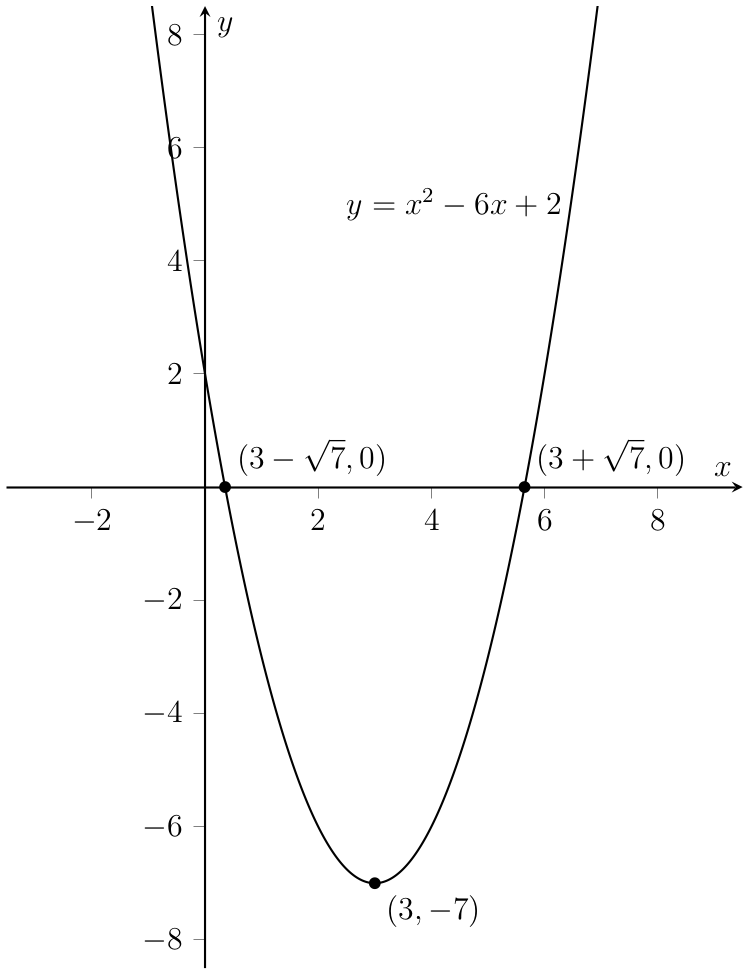
Fig. 6 \(y=x^2-6x+2\), plotted using completing the square.#
(ii) For \(q(x) = 2x^2-4x+3\), we have \(\Delta=-8\) and \(q(x) = 2(x-1)^2+1\). Hence the graph has a minimum at \((1,1)\). The graph does not cross the \(x\)-axis. The graph crosses the \(y\)-axis at \(y=3\).
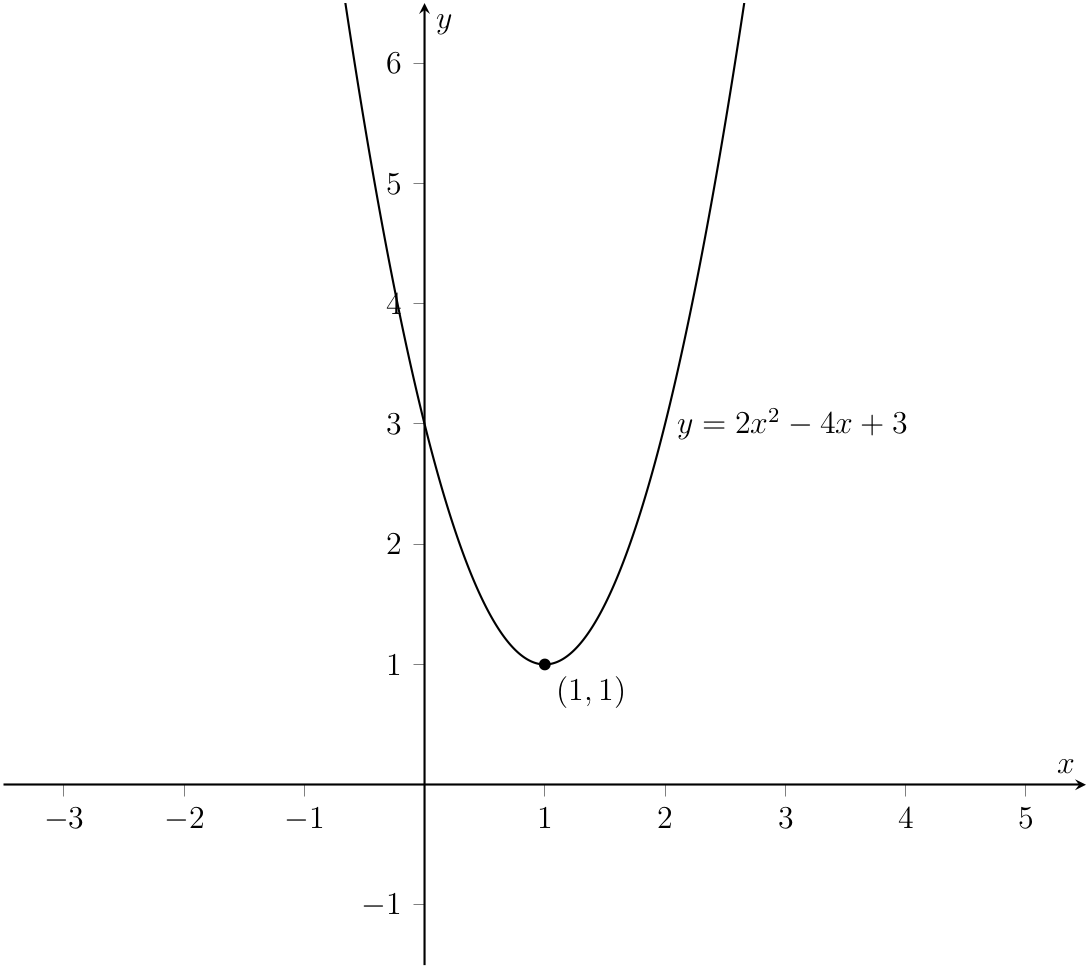
Fig. 7 \(y=2x^2-4x+3\), plotted using completing the square.#
(iii) For \(q(x) = -3x^2+6x -2\), \(\Delta=12\) and \(q(x) = -3(x-1)^2+1\). Hence the graph has a maximum at \((1,1)\). The graph crosses the \(x\)-axis at \(x=1-\frac{1}{\sqrt{3}}\) and \(x=1+\frac{1}{\sqrt{3}}\). The graph crosses the \(y\)-axis at \(y=-2\).
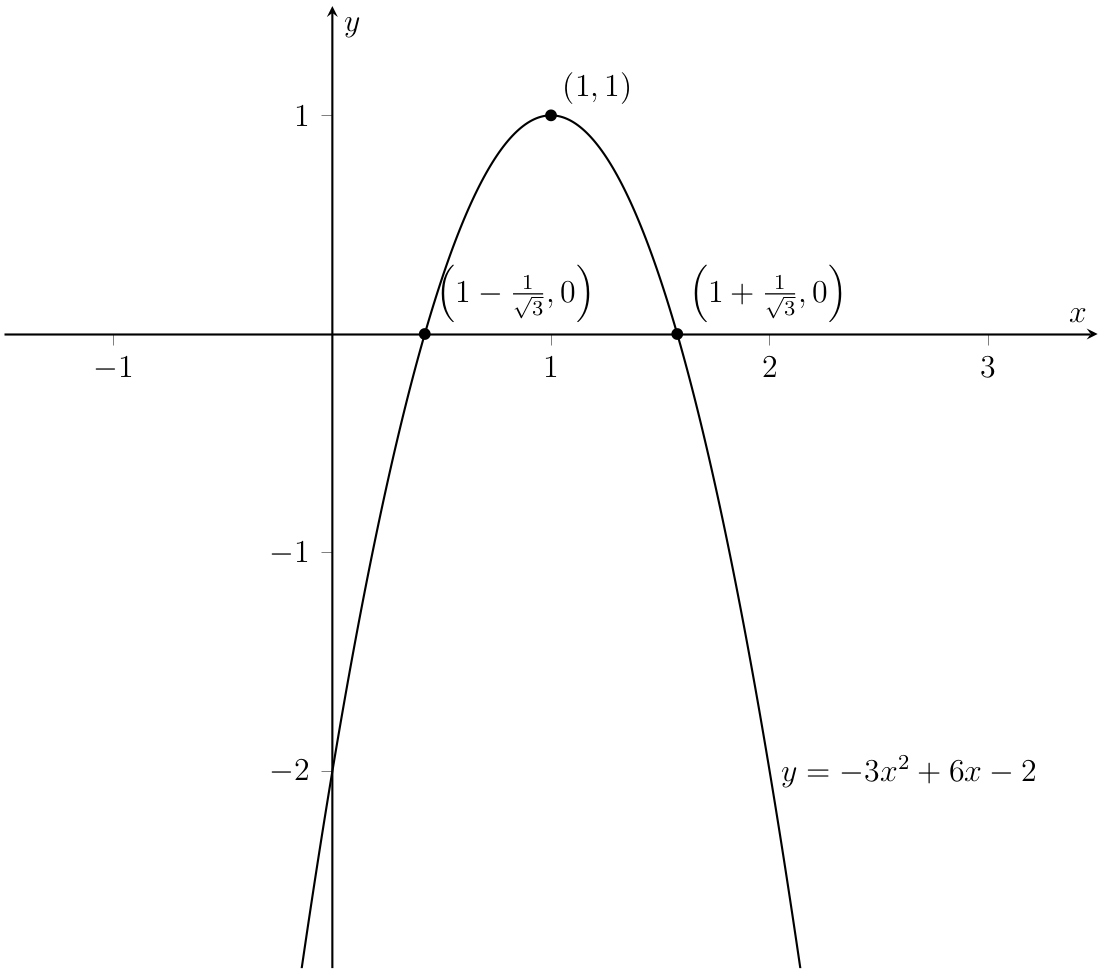
Fig. 8 \(y=-3x^2+6x -2\), plotted using completing the square.#
(iv) For \(q(x) = 3x^2-12x+12\), we have \(\Delta=0\) and \(q(x) = 3(x-2)^2\). Hence the graph has a minimum at \((2,0)\). The graph touches the \(x\)-axis at \(x=2\). The graph crosses the \(y\)-axis at \(y=12\).
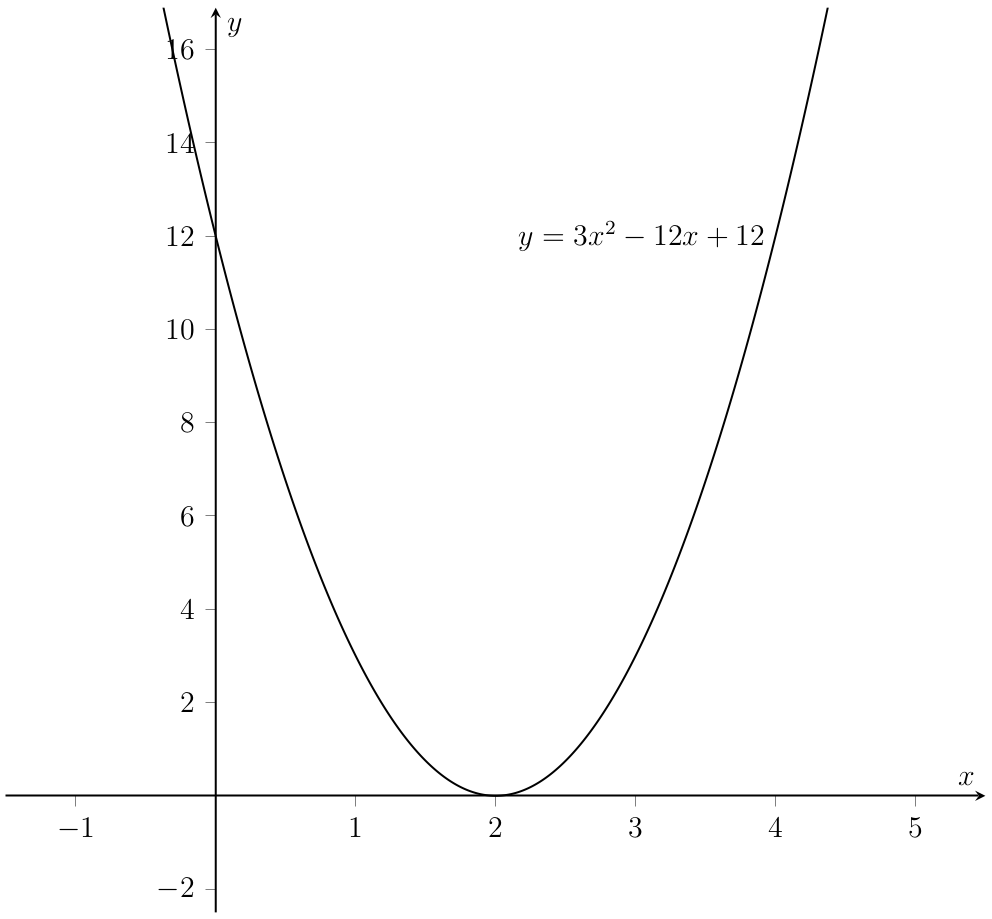
Fig. 9 \(y=3x^2-12x+12\), plotted using completing the square.#
24. The answer is (C).
(B) is wrong as we are looking at a graph which is clearly not a straight line.
(A) is wrong as the graph is a ‘sad face’, so the number in front of \(x^2\) must be negative.
(D) has a constant term of \(-4\) which means that its graph would cross the \(y\)-axis at \(-4\), so that is also not a correct answer.
Thus the only possible right answer would be (C).
Quadratic simultaneous equations#
25. We get the following solutions.
(i) \(\displaystyle\left(x = \frac{1}2 \mbox{ and } y = \frac{5}{2}\right) \mbox{ or } \left(x = \frac{3}{5} \mbox{ and } y = \frac{18}5\right)\);
(ii) \(\displaystyle\left(x = -\frac{2}{3} \mbox{ and } y = -2\right) \mbox{ or } \left(x = -\frac{1}{3} \mbox{ and } y = -2\right)\);
(iii) \(\displaystyle\left(x = -\frac{4}{3} \mbox{ and } y = -7\right) \mbox{ or } \left(x = -\frac{1}{3} \mbox{ and } y = -8\right)\);
(iv) \((x = -1 \mbox{ and } y = 0) \mbox { or } \left(x = 1 \mbox{ and } y = -1\right)\).
26. The answer is (D).
(A): There are no \(y\)-coordinates, so this cannot be a correct answer.
(B): Might be okay, there could be only one solution.
(C): Just makes no sense.
The only difference between the possible correct answer (B) and (D) is the ‘extra’ solution \((x = -1 \text{ and } y = 3)\). So we just check if this works:
For the first equation, \(LHS = -1\) and \(RHS = 4 3 - 7 3 = -33 = LHS\).
For the second \(LHS = -3 - 3 = -6\) and \(RHS = -1 - 5 = -6 = LHS\).
Thus the correct answer must be (D).
27. (i) We have \(-x +1 \leq 0\) if and only if \(x \geq 1\).

Fig. 10 Number line depicting the inequality \(x\geq 1\).#
(ii) We have \(-6x+1 < 0\) if and only if \(x > \frac{1}6\).

Fig. 11 Number line depicting the inequality \(x > \frac{1}6\).#
(iii) We have \(x +\sqrt{2} \geq 0\) if and only if \(x \geq - \sqrt{2}\).

Fig. 12 Number line depicting the inequality \(x \geq -\sqrt 2\).#
(iv) We have \(24x+4 > 0\) if and only if \(x > -\frac{1}6\).

Fig. 13 Number line depicting the inequality \(x > - \frac{1}6\).#
(v) We have \(-x-3 < x+2\) if and only if \(x > - \frac{5}{2}.\)

Fig. 14 Number line depicting the inequality \(x > -\frac{5}{2}\).#
(vi) We have \(-6x -4 > 3x +2\) if and only if \(x < - \frac{2}{3}.\)

Fig. 15 Number line depicting the inequality \(x > -\frac{2}{3}\).#
Linear and quadratic inequalities#
28. The answer is (C).
We can rule out (B) and (D) straightaway as we are dealing with an inequality which includes 0. Both (B) and (D) are answers for strict inequalities. To see if the answer is (A) or (C), put \(x = 1\) into the both sides of the inequality to get \(-3 + 4 = -1\) and \(1 + 1 = 2\) respectively.
Clearly \(-1 \ngeq 2\), so \(x \geq \frac{3}{4}\) must be the wrong answer. Thus the correct answer must be (C).
We have
(i) We have \(q(x) = 12x^2 + 5x - 3\). We have \(12\times(-3) = - 36 = -4\times 9\), and \(-4+9\). So,
Algebraic method.
For \(q(x)>0\), we need the two brackets to be non-zero and have the same sign.
So either (\(4x+3>0\) and \(3x-1>0\)) OR (\(4x+3<0\) and \(3x-1<0\)).
That is, (\(x>-\frac{3}{4}\) and \(x>\frac{1}{3}\)) OR (\(x<-\frac{3}{4}\) and \(x<\frac{1}{3}\)).
Since \(\frac{1}{3}\) is larger than \(-\frac{3}{4}\), the first bracket is equivalent to \(x>\frac{1}{3}\). Similarly, the second bracket is equivalent to \(x<-\frac{3}{4}\).
Hence \(q(x) > 0\) precisely when \(x>\frac{1}{3}\) or \(x < -\frac{3}{4}\), or, as a set, \(\left\{x \in \mathbb{R}: x > \frac{1}{3} \mbox{ or } x < -\frac{3}{4} \right\}\).
Similarly,
precisely when the brackets are non-zero and have different signs. That is, when (\(4x+3<0\) and \(3x-1>0\)) OR (\(4x+3>0\) and \(3x-1<0\)).
So, when (\(x<-\frac{3}{4}\) and \(x>\frac{1}{3}\)) OR (\(x>-\frac{3}{4}\) and \(x<\frac{1}{3}\)).
The first bracket is impossible, whereas the second can be more succinctly expressed as \(-\frac{3}{4}<x<\frac{1}{3}\).
Hence the inequality \(q(x) < 0\) has solution set \(\left\{x \in \mathbb{R}: -\frac{3}{4}<x<\frac{1}{3}\right\}\).
Graphical method.
Below is the graph of \(y=q_{(i)}(x)=(4x+3)(3x-1)\).
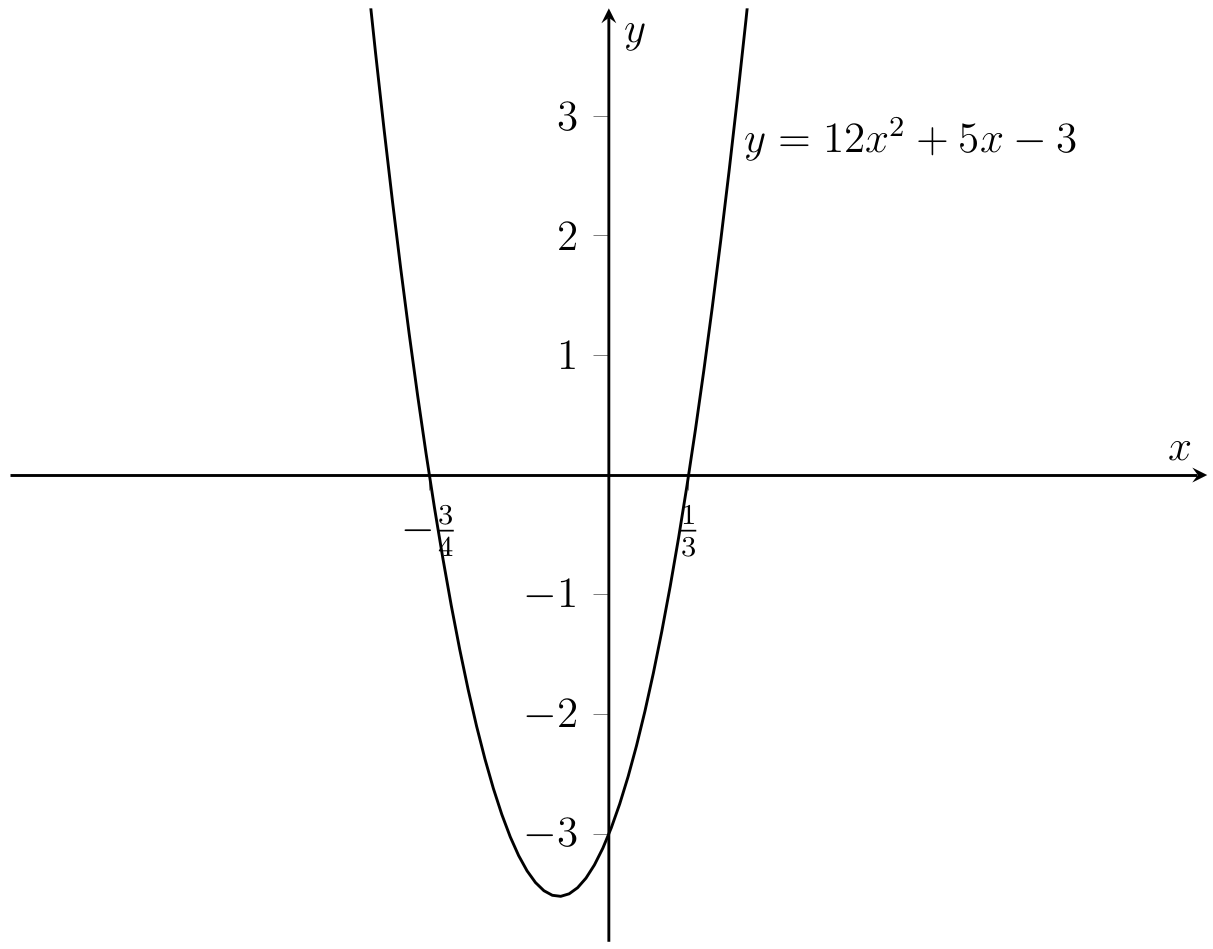
Fig. 16 Graph of \(y=12x^2+5x-3\) (Q29(i)).#
Note that we haven’t bothered to complete the square or calculate the minimum point, since it is not needed to answer the question.
From the graph, you can see that the curve lies strictly below the \(y\)-axis when \(-\frac{3}{4}<x<\frac{1}{3}\), and strictly above the \(y\)-axis when \(x<-\frac{3}{4}\) or \(x>\frac{1}{3}\). So this confirms what we found using the algebraic method.
The other inequalities are solved in exactly the same way, but with \(\leq\) and \(\geq\) in place of \(<\) and \(>\). Here are the solutions:
\(q(x) \geq 0\) for \(\displaystyle\left\{x \in \mathbb{R}: x \geq \frac{1}{3} \mbox{ or } x \leq -\frac{3}{4} \right\}\);
\(q(x) \leq 0\) for \(\displaystyle\left\{x \in \mathbb{R}: -\frac{3}{4} \leq x \leq \frac{1}{3} \right\}\).
(ii) Note that \(q(x)=x^2-5x+4=(x+1)(x-4)\).
The algebraic/graphical method is similar to (i). Here are the solutions for you to check your answers.
\(q(x) > 0\) for \(\displaystyle\left\{x \in \mathbb{R}: x > 4 \mbox{ or } x < 1 \right\}\);
\(q(x) < 0\) for \(\displaystyle\left\{x \in \mathbb{R}: x > 1 \mbox{ and } x < 4 \right\}\);
\(q(x) \geq 0\) for \(\displaystyle\left\{x \in \mathbb{R}: x \geq 4 \mbox{ or } x \leq 1 \right\}\);
\(q(x) \leq 0\) for \(\displaystyle\left\{x \in \mathbb{R}: x \geq 1 \mbox{ and } x \leq 4 \right\}\).
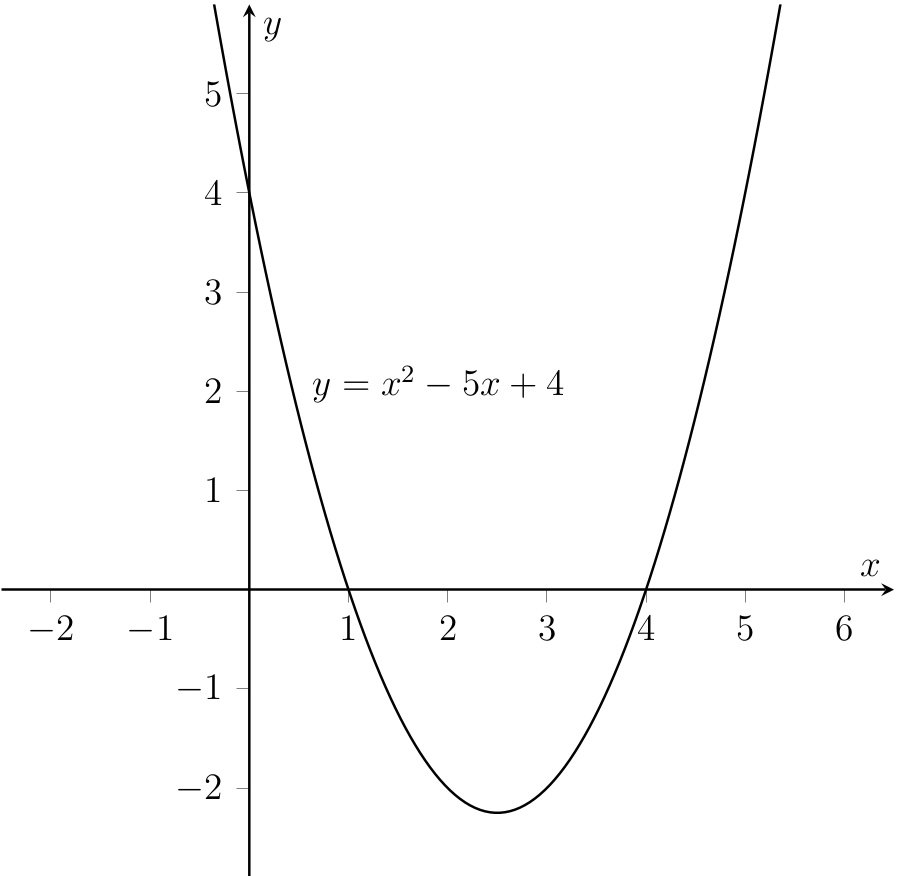
Fig. 17 Graph of \(y=x^2-5x+4\) (Q29(ii)).#
(iii) \(q(x) = -9x^2-9x+4 = -(3x-1)(3x+4)\). Here are the solutions.
\(q(x) > 0\) for \(\displaystyle\left\{x \in \mathbb{R}: x > -\frac{4}{3} \mbox{ and } x < \frac{1}{3} \right\}\);
\(q(x) < 0\) for \(\displaystyle\left\{x \in \mathbb{R}: x > \frac{1}{3} \mbox{ or } x < -\frac{4}{3}\right\}\);
\(q(x) \geq 0\) for \(\displaystyle\left\{x \in \mathbb{R}: x \geq -\frac{4}{3} \mbox{ and } x \leq \frac{1}{3} \right\}\);
\(q(x) \leq 0\) for \(\displaystyle\left\{x \in \mathbb{R}: x \geq \frac{1}{3} \mbox{ or } x \leq -\frac{4}{3} \right\}\).
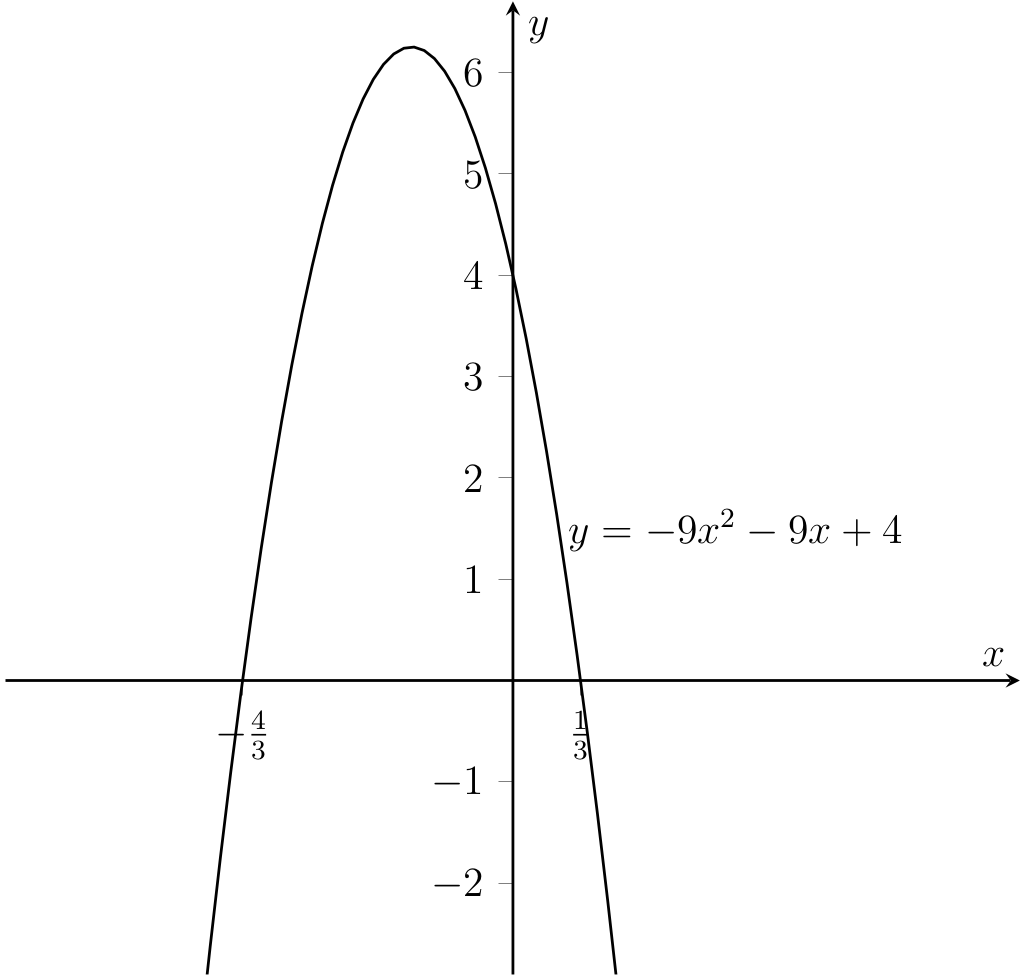
Fig. 18 Graph of \(y=-9x^2-9x+4\) (Q29(iii)).#
(iv) \(q(x)= 10x^2-11x+3=(5x-3)(2x-1)\).
\(q(x) > 0\) for \(\displaystyle\left\{x \in \mathbb{R}: x > \frac{3}{5} \mbox{ or } x < \frac{1}2 \right\}\);
\(q(x) < 0\) for \(\displaystyle\left\{x \in \mathbb{R}: x > \frac{1}2 \mbox{ and } x < \frac{3}{5} \right\}\);
\(q(x) \geq 0\) for \(\displaystyle\left\{x \in \mathbb{R}: x \geq \frac{3}{5} \mbox{ or } x \leq \frac{1}2 \right\}\);
\(q(x) \leq 0\) for \(\displaystyle\left\{x \in \mathbb{R}: x \geq \frac{1}2 \mbox{ and } x \leq \frac{3}{5} \right\}\). \end{itemize}
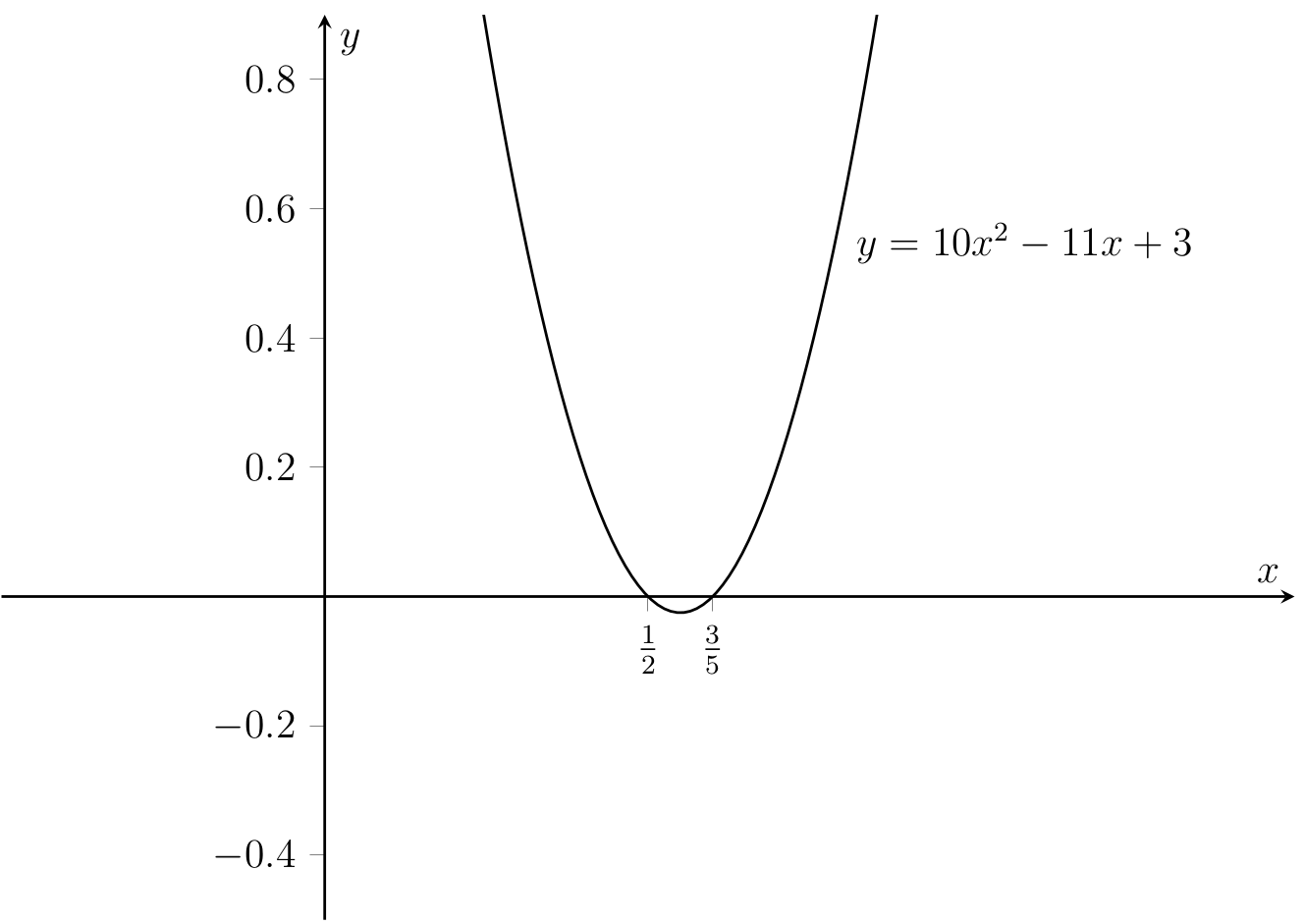
Fig. 19 Graph of \(y=10x^2-11x+3\) (Q29(iv)).#
(v) \(q(x)=x^2-16=(x-4)(x+4)\).
\(q(x) > 0\) for \(\displaystyle\left\{x \in \mathbb{R}: x > 4 \mbox{ or } x < -4 \right\}\);
\(q(x) < 0\) for \(\displaystyle\left\{x \in \mathbb{R}: x > -4 \mbox{ and } x < 4 \right\}\);
\(q(x) \geq 0\) for \(\displaystyle\left\{x \in \mathbb{R}: x \geq 4 \mbox{ or } x \leq -4 \right\}\);
\(q(x) \leq 0\) for \(\displaystyle\left\{x \in \mathbb{R}: x \geq -4 \mbox{ and } x \leq 4 \right\}\). \end{itemize}
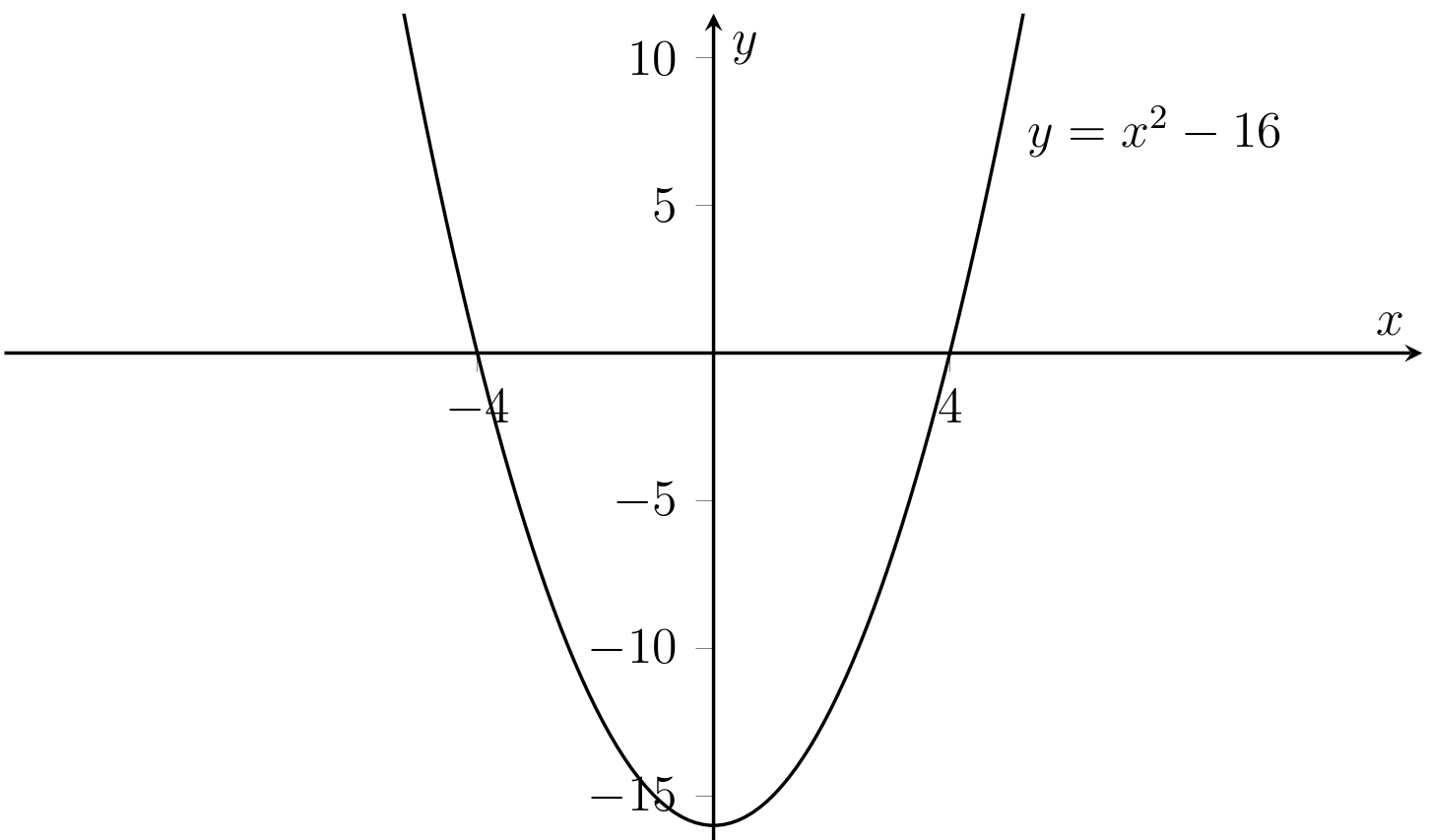
Fig. 20 Graph of \(y=x^2-16\) (Q29(v)).#
(vi) \(q(x) = x^2-2 = (x-2)(x+2)\).
\(q(x) > 0\) for \(\displaystyle\left\{x \in \mathbb{R}: x > \sqrt{2} \mbox{ or } x < -\sqrt{2} \right\}\);
\(q(x) < 0\) for \(\displaystyle\left\{x \in \mathbb{R}: x > -\sqrt{2} \mbox{ and } x < \sqrt{2} \right\}\);
\(q(x) \geq 0\) for \(\displaystyle\left\{x \in \mathbb{R}: x \geq \sqrt{2} \mbox{ or } x \leq -\sqrt{2} \right\}\);
\(q(x) \leq 0\) for \(\displaystyle\left\{x \in \mathbb{R}: x \geq -\sqrt{2} \mbox{ and } x \leq \sqrt{2} \right\}\).
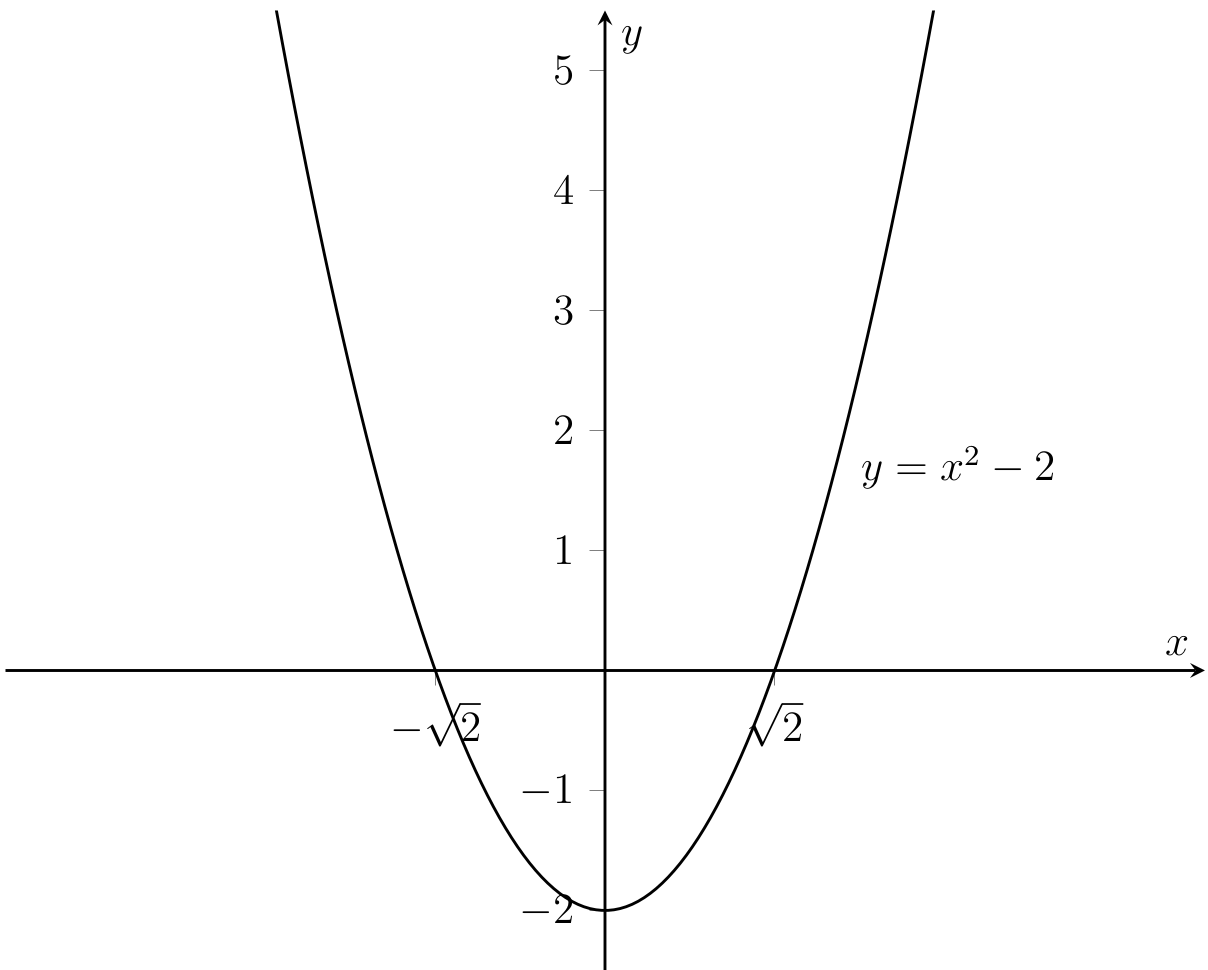
Fig. 21 Graph of \(y=x^2-2\) (Q29(vi)).#
30. (i) Note that \(x\neq \frac{2}{3}\).
Now \(\frac{x+1}{3x-2} \geq 0\) if and only if \((x + 1 \geq 0 \text{ and } 3x - 2 > 0)\) or \((x + 1 \leq 0\) and \(3x - 2 < 0)\). (Note the strict inequality due to the denominator not being zero.)
This is the case if and only if \((x \geq -1 \text{ and } x > \frac{2}{3})\) or \((x \leq -1 \text{ and } x < \frac{2}{3})\). So \(x>\frac{2}{3}\) or \(x \leq -1\).
(ii) We solve
Note first that we need \(x\neq -\frac{1}2\). We want to multiply both sides of (3) by \(2x+1\). However, the result of doing so will depend on the sign of \(2x+1\).
Case 1: If \(2x+1>0\), i.e. if \(x>-\frac{1}{2}\), then multiplying both sides of (3) by \(2x+1\) will give
and hence
So for this case, \(x>-\frac{1}{2}\) and \(x>-3\). That is, \(x>-\frac{1}{2}\) (the second inequality \(x>-3\) is implied by this)
Case 2: If instead \(2x+1<0\), then \(x<-\frac{1}{2}\), and multiplying both sides of (3) by \(2x+1\) we have
i.e. \(x<-3\) in this case. So we have \(x<-\frac{1}{2}\) and \(x<-3\), but in fact \(x<-3\) is sufficient for both of these inequalities to hold.
We get that the solutions are \(x > -\frac{1}2\) or \(x < -3\).
Chapter 3#
Polynomials#
31. We have that
(i) \(\frac{1}{3}x^7 + \frac29x^9\) is a polynomial, all the conditions are fulfilled.
(ii) \(x^{\frac{1}2}\) is not a polynomial, the exponent is \(\frac{1}2\) which is not a non-negative integer.
(iii) \(2^x + x^2\) is not a polynomial, as \(2^x\) is not a power of \(x\).
(iv) \(y^2x^{-1}\) is not a polynomial as the exponent in the variable \(x\) is \(-1\) which is not a non-negative integer. We can also have a discussion about the \(y\) as a coefficient.
(v) \(0\) is the zero-polynomial, so a polynomial by definition.
(vi) \(x^{16} +x^{15} +x^{14} +. . .+x+1+x^{-1} +x^{-2}\) is not a polynomial as the exponents \(-1\) and \(-2\) are not non-negative integers.
(vii) \(x^2 + \pi x\) is a polynomial, \(\pi\) is a real number.
(viii)) \(4x^7 - x^3 + 29x^1\) is a polynomial.
(ix) \(\sqrt x\) is not a polynomial; we can write \(\sqrt x = x^{\frac{1}2}\) so the exponent is not a non-negative integer.
(x) \(\sqrt[4]x\) is not a polynomial; we can write \(\sqrt[4]x = x^{\frac{1}{4}}\) so the exponent is not a non-negative integer.
(xi) \(x^2 + x - \frac{1}{x^{\frac{3}{4}}}\) is not a polynomial as \(\frac{1}{x^{\frac{3}{4}}}=x^{-\frac{3}{4}}\) so the exponent is not a non-negative integer.
(xii) \(\frac{4}{x}\) is not a polynomial as \(\frac{4}{x} = 4x^{-1}\) so the exponent is not a non-negative integer.
(xiii) \((3-2i)x^9\) is not a polynomial (over the real numbers) as i is not a real number. This would be a polynomial over the complex numbers, but we are not covering them in MAS003.
(xiv) \(15\) is a polynomial as we can write \(15 = 15x^0\).
Degree |
\(x^3\)-coefficient |
\(x\)-coefficient |
Leading term |
Constant term |
|
|---|---|---|---|---|---|
(i) |
\(3\) |
\(1\) |
\(0\) |
\(x^3\) |
\(1\) |
(ii) |
\(3\) |
\(2\) |
\(-3\) |
\(2x^3\) |
\(2\) |
(iii) |
\(5\) |
\(-1\) |
\(-1\) |
\(-x^5\) |
\(1\) |
(iv) |
\(2\) |
\(0\) |
\(-4\) |
\(x^2\) |
\(5\) |
(v) |
\(4\) |
\(3\) |
\(1\) |
\(4x^4\) |
\(0\) |
(vi) |
\(5\) |
\(1\) |
\(0\) |
\(-\frac{1}{5}x^5\) |
\(\sqrt{2}\) |
\(f(x)+g(x)\) |
\(f(x)-g(x)\) |
Coefficient of \(x^3\) in \(f(x)g(x)\) |
|
|---|---|---|---|
(i) |
\(3x^2 + 11x - 13\) |
\(3x^2 + 13x - 15\) |
\(-3\) |
(ii) |
\(5x^2 - 6x + 2\) |
\(3x^2 - 4x\) |
\(-9\) |
\(p(x) - q(x)r(x)\) |
Coefficient of \(x^3\) in \(p(x)q(x)\) |
|
|---|---|---|
(i) |
\(5x^4 + 2x^3 + 6x^2 - x - 2\) |
\(-4\) |
(ii) |
\(x^{5} - 2x^{4} + 2x^3 - 5x^2 - x - 2\) |
\(0\) |
35. The answer is (D).
This can be seen with minimal calculation, by noting that in
the leading coefficient is \(-3x^4\), and the constant term is \(-3\).
36. We have the following answers.
\(f(g(x))\) |
\(g(f(x))\) |
\(f(x)g(x)\) |
|
|---|---|---|---|
(i) |
\(x^3 - 5x^2 + 8x - 3\) |
\(x^3 + x^2 - 1\) |
\(x^4 -x^3-2x^2+x-2\) |
(ii) |
\(x^6 - 6x^5 + 13x^4 - 12x^3 + 4x^2 + 1\) |
\(x^6 + 2x^5 + x^4 - 1\) |
\(x^5-x^4-2x^3+x^2-2x\) |
(iii) |
\(3x^2 + 6xh + 3h^2 - x - h\) |
\(3x^2 - x + h\) |
\(3x^3+(3h-1)x^2 -hx\) |
(iv) |
\(4x^2 + 13x +8\) |
\(4x^2 + 5x\) |
\(4x^3+9x^2+4x-1\) |
37. The answer is (A).
All possible answers are of degree 4, so that is not much help.
But as all the answers have different constant terms, we can use \(x = 0\) and are very fast done with this:
so the right answer must be (A).
Polynomial division#
38. (i) We have
So when \(x^3 -2x^2 +x -1\) is divided by \(x-1\), the quotient is \(x^2 -x\) and the remainder is \(-1.\)
(ii) We have
So \((2x^4-x+1) \div (x^2 +1)=2x^2-2\) remainder \((-x + 3)\); that is, the quotient is \(2x^2-2\) and the remainder is \(-x+3=3-x\).
(iii) We have
So when \(3x^3 -2x^2 +1\) is divided by \(2x+1\) the quotient is \(\frac{3}{2}x^2 -\frac{7}{4}x + \frac78\) and the remainder is \(\frac{1}{8}\).
39. The quotient is \(x-2\) and the remainder is \(2\).
40. The answer is (B).
Just looking at the degree of the remainder for answers A and D is enough to rule those out. The remainder is either zero or has a degree strictly lower than the degree of what we divide by.
Write the two possible answers as an equation, we would get for (B) that
while (C) would be
I could do the usual trick of putting in a number, but just looking at the leading coefficient tells me that the only right answer could be (B) as the \(LHS\) of the (C) has a leading coefficient of \(-x^4\).
Note: This is an easy way to check any long division you need to do and especially if you need to use the result of a long division, this will be a very helpful trick.
Factor theorem#
41. We follow the steps below.
Step 1: Try some numbers.
First time lucky! Hence \((x-1)\) is a factor of \(f(x)\) by the Factor Theorem.
Step 2: Divide by \((x-1)\) to get a quadratic.
So \(f(x) = (x-1)(x^2 -x -6)\).
Step 3: Factorize the quadratic to get \(x^2 - x -6 = (x+2)(x-3) .\) Thus we get \(f(x) = (x-1)(x+2)(x-3) .\) So the solutions to \(f(x)= 0\) are \(x = 1\), \(x = -2\) and \(x = 3 .\)
42. The answers are shown below. For the polynomials of degree 3 and 4 we use the Factor Theorem and long division. Quadratics we factorize as earlier in the course.
(i) We have \(p(x) = x^2 - 25 = (x-5)(x+5) \). The solutions to \(p(x) = 0\) are \(x= 5\) and \(x = -5\).
(ii) \(p(x) = x^4 - 16 = (x^2-4)(x^2+4) = (x-2)(x+2)(x^2+4)\). Hence the solutions to \(p(x) = 0\) are \(x = 2\) and \(x = -2\). (Note that \(x^2+ 4\) does not factorize any further since \(\Delta=b^2-4ac=0^2-16= - 16<0\).)
(iii) We first try to find a value for \(x\) such that \(p(x)= x^3 - 7 x + 6=0\). We have
and
so \((x-1)\) and \((x-2)\) are both factors, by the Factor Theorem. Since the leading coefficient is 1, the factorisation must be
for some \(a\) we need to find. The constant term of \(p(x)\) is \(6\), and expanding the brackets, this means \(2a=6\). Hence \(a=3\), and
Hence the solutions to \(p(x) = 0\) are \(x = 13\), \(x = 2\) and \(x = -1 .\)
(iv) \(p(x)= x^3 - 14 x^2 + 11 x + 26\). We have
so \(x-1\) isn’t a factor this time.
so \((x+1)\) is a factor. We can find the other factors by using long division to divide \(p(x)\) by \(x+1\).
Hence
The solutions to \(p(x)=0\) are therefore \(x=-1\), \(x=2\) and \(x=13\).
(v) \(p(x)\) factorizes as \( (x+2)(x-1)(x+3)\). Hence the solutions to \(p(x) = 0\) are \(x = -2\), \(x = 1\) and \(x = -3 .\)
(vi) \(p(x)\) factorizes as \( (x-2)^2(x+2)^2\). Hence the solutions to \(p(x) = 0\) are \(x = 2\) and \(x = -2 .\)
(vii) \(p(x)\) factorizes as \( (x-1)(x-3)(x+2)(x+1)\). Hence the solutions to \(p(x) = 0\) are \(x = 1\), \(x = 3\), \(x =- 2\) and \(x = -1 .\)
(viii) \(p(x)\) factorizes as \( (x+1)(x-3)x^2\). Hence the solutions to \(p(x) = 0\) are \(x = -1\), \(x =3\) and \(x = 0 .\)
43. The answer is (C).
The trick here is to first look at the constant term and the leading coefficient to see what can be ruled out. After that, there are (more) numbers to put in.
The constant term needs to be \(+6\), for (A) the constant term is \((1)(-1)(1)(2)(3) < 0\) so that is not the correct answer.
The constant term for B is \((1)(-1)(1)(2)(-2) \neq 6\), so we can rule this out.
(C) has constant term \((1)(-1)(1)(2)(-3) = 6\) so that could be the correct answer.
A short look tells me that (D) also has a constant term of \(6\).
So now I consider the leading term of (C) and (D). The leading term of (C) is \((x^2)(x)(2x)(x)(x) = 2x^6\) which is okay, and the leading term of (D) is \((x^2)(x)(3x)(x)(x) = 3x^6\), so that rules (D) out. Hence the answer has to be (C).
Remainder theorem#
44.We use the Remainder Theorem to get the following:
(i) The remainder when \(x^3 +3x^2 -4x +2\) is divided by \(x-1\) is \(f(1)=2\).
(ii) The remainder when \(x^3 -2x^2 +5x +8\) is divided by \(x-2\) is \(f(2)=18\).
(iii) The remainder when \(x^5 +x -9\) is divided by \(x+1\) is \(f(-1)=-11\).
(iv) The remainder when \(x^3 +3x^2+3x+1\) is divided by \(x+2\) is \(f(-2)=-1\).
(v) Since \(2x-1=2(x-\frac{1}{2})\), the remainder when \(4x^3 -5x+4\) is divided by \(2x-1\) is the same as the remainder when \(4x^3 -5x+4\) is divided by \(x-\frac{1}{2}\), namely \(f(\frac{1}{2})=2\).
(vi) Since \(2x+3=2(x+\frac{3}{2})\), the remainder when \(4x^3 +6x^2 +3x+2\) is divided by \(2x+3\) is the same as the remainder when \(4x^3 +6x^2 +3x+2\) is divided by \(x+\frac{3}{2}\), namely \(f(-\frac{3}{2})=- \frac{5}{2}\).
45. We could do the usual long division, but since we have not been asked for the quotient, there is a quicker way, which generalises the Remainder Theorem.
Note that in the division of \(3x^5 - 4x^4 + x^3 - x^2 + 3x - 1\) by \(x^2 + x - 2 = (x - 1)(x + 2)\), the remainder would have degree at most \(1\), and so we would get
for some real numbers \(a\) and \(b\), and where \(q(x)\) is an unknown cubic that we do not need to calculate. Then, substituting \(x = 1\), we get that
so
while putting \(x = -2\) into (4) gives
so \(-3\cdot 32 - 2\cdot 32 -8-4-6-1 = -5\cdot 32-19=-2a+b\), which simplifies to
Finally, solving (5) and (6) simultaneously gives \(a = 60\) and \(b = -61\). So the remainder when \(3x^5 - 4x^4 + x^3 - x^2 + 3x - 1\) is divided by \(x^2 + x - 2\) is \(60x - 61\).
Chapter 4#
Functions, domains and rules#
46. The domains of the functions are given below.
(i) \(\mathbb{R}\),
(ii) \(\{ x \in \mathbb{R}:x\geq 2 \} \),
(iii) \(\{ x \in \mathbb{R}:x \neq 2 \}\),
(iv) \(\{ x \in\mathbb{R}: x \geq 2 \}\),
(v) \(\{ x \in \mathbb{R}:x \leq -2 \mbox{ or } x \geq 2 \}\),
(vi) \(\{ x \in \mathbb{R}:x\neq 0\mbox{ and } (x \geq 4 \mbox{ or } x \leq 1) \}\),
(vii) \(\{ x \in \mathbb{R}:x \geq 0 \}\),
(viii) \(\{ x \in\mathbb{R}:x \geq 2 \mbox{ or } x \leq - 3 \}\),
47. The answer is (C).
One can here easily sketch the graphs and see where they are above the \(x\)-axis.
But one can also look at the conditions and put numbers in to see which ones can be ruled out:
All conditions involve \(x > 0\), but putting \(x = 1\) would give \(f(1) = \sqrt{11}-1 +\ldots\), so clearly (D) is not the right answer.
Now if \(x < -2\) works, this would rule out (B) and (A) leaving is with (C).
So let’s try \(x = -3\) to get
which works as cube roots of negative numbers exist (over the real numbers). So the answer has to be (C).
48. Here are some possibilities. There are more possible correct answers than these, so ask if necessary!
(i) \(u(x) = 2x+3\) and \(g(x) = x^2\).
(ii) \(u(x) = 3x+4\) and \(g(x) =2x^4\)
(iii) \(u(x) = 3x+2\) and \(g(x) = \frac{1}x\)
(iv) \(u(x) = 2x+3\) and \(g(x) =x^{-2}\)
(v) \(u(x) = \sqrt{3x+1}\) and \(g(x) = \frac{1}x\)
(vi) \(u(x) = 2x-1\) and \(g(x) =x^{-\frac{2}{3}}\)
The range of a function#
49. By considering the appropriate graphs we get the following answers.
(i) If the domain of \(q(x)\) is \(\mathbb{R}\) then the range is \(\{ y\in\mathbb{R}:y \geq -\frac{25}4\}\); while when restricting the domain to \(\{ x\in \mathbb{R}:-2 \leq x < 2\}\) the range is \(\{ y\in\mathbb{R}:-\frac{25}{4} \leq y < 6\}\).
(ii) If the domain of \(q(x)\) is \(\mathbb{R}\) then the range is \(\{ y\in\mathbb{R}:y \geq -3\}\); while when restricting the domain to \(\{ x\in \mathbb{R}:-2 \leq x < 2\}\) the range is \(\{y\in\mathbb{R}:-3 <y \leq 13\}\).
(iii) If the domain of \(q(x)\) is \(\mathbb{R}\) then the range is \(\{ y\in\mathbb{R}:y \geq -1\}\); while when restricting the domain to \(\{ x\in \mathbb{R}:-2 \leq x < 2\}\) the range is \(\{ y\in\mathbb{R}:-1 \leq y \leq 26\}\).
(iv) If the domain of \(q(x)\) is \(\mathbb{R}\) then the range is \(\{ y\in\mathbb{R}:y \leq \frac{17}4\}\); while when restricting the domain to \(\{ x\in \mathbb{R}:-2 \leq x < 2\}\) the range is \(\{ y\in\mathbb{R}:-8 \leq y \leq \frac{17}4\}\).
(v) If the domain of \(q(x)\) is \(\mathbb{R}\) then the range is \(\{ y\in\mathbb{R}:y \leq \frac{73}3\}\); while when restricting the domain to \(\{ x\in \mathbb{R}:-2 \leq x < 2\}\) the range is \(\{ y\in\mathbb{R}:8 \leq y \leq\frac{73}3\}\).
(vi) If the domain of \(q(x)\) is \(\mathbb{R}\), then the range is \(\{ y\in\mathbb{R}:y \geq - 16\}\); while when restricting the domain to \(\{ x\in \mathbb{R}:-2 \leq x < 2\}\) the range is \(\{ y\in\mathbb{R}:- 16 \leq y \leq 0\}\).
Inverse functions#
50. (i) The domain of \(f(x)\) is \(\{ x \in \mathbb{R}:x \neq 3\}\), \(\displaystyle f^{-1}(x) = \frac{3x-8}{1+x}\) and the domain of \(f^{-1}(x)\) is \(\{ x\in \mathbb{R}:x \neq -1\}\).
(ii) The domain of \(f(x)\) is \(\{ x \in \mathbb{R}:x \neq \frac{2}{3}\}\), \(\displaystyle f^{-1}(x) = \frac{8+2x}{9+3x}\) and the domain of \(f^{-1}(x)\) is \(\{ x\in \mathbb{R}:x \neq -3\}\).
(iii) The domain of \(f(x)\) is \(\{ x \in \mathbb{R}:x \neq 3\}\), \(\displaystyle f^{-1}(x) =\frac{5-3x}{1-x}\) and the domain of \(f^{-1}(x)\) is \(\{ x\in \mathbb{R}:x \neq 1\}\).
(iv) The domain of \(f(x)\) is \(\{ x \in \mathbb{R}:x \neq \frac{3}{2}\}\), \(\displaystyle f^{-1}(x) =\frac{15x-19}{10x+9}\) and the domain of \(f^{-1}(x)\) is \(\{ x\in \mathbb{R}:x \neq -\frac9{10}\}\).
51. The answer is (A).
(C) is wrong as it does not give the domain.
For the others, we know that \(f(x) = y\) if and only if \(f^{-1}(y) = x\). So we try some numbers. If \(x = 0\) then \(y = f(0) = -5\). For (A) we get \(f^{-1}(-5) = 0\), so (A) is a possible right answer.
For (B) we get \(f^{-1}(-5) \neq 0\), so that is not a correct answer.
For (D) we get \(f^{-1}(-5) \neq 0\), so that is not a correct answer either and thus (A) is the only possible answer.
52. Note that \(y = ax + b\), for \(a\) and \(b \in \mathbb{R}\), is always a sum of the two functions \(ax\) and \(b\) and \(ax\) is just the function \(x\) multiplied by a real number.
(i) \(f(x) = \frac{3x+2}{3-x}\) is the quotient of \(3x+2\) with \(3-x\) . \smallskip
(ii) \( f(x) = \left(\frac{3x-4}{2-3x}\right)^\frac{1}2\) is a function of a function with outer function \(y = x^2\) and inner function \(y = \frac{3x-4}{2-3x}\) which is a quotient of two functions .\smallskip
(iii) \(f(x) = \sin (2x)\) is a function of a function with the inner function \(y = 2x\) and the outer function \(y = \sin x\) .
(iv) \(f(x) = (3x+2)\cos (3-2x) + \frac{3}5\) is the sum of two functions, namely \(y_1= (3x+2) \cos(3-2x)\) and \(\frac{3}{5}\) . Now \(y_1\) is a product of two functions, \(3x+2\) and \(\cos(3-2x)\) and finally, \(\cos(3-2x)\) is a function of a function with inner function \(3-2x\) and outer function \(\cos x\) .
(v) \( f(x) = \tan (x)\) is a standard function, or the quotient of \(\sin x\) and \(\cos x\) .
(vi) \(f(x) = \cos^3 (3-2x) + \frac{3}5\) is the sum of two functions and \(\cos^3 (3-2x)\) is first of all a function of a function with inner function \(\cos(3-2x)\) and outer function \(y = x^3\). But \(\cos (3-2x)\) is a function of a function again; the inner function being \(3-2x\) and the outer one is \(\cos x\) .
(vii) \(f(x) = (2x)^3(5x - 3)^9\) is the product of the two functions \(y_1 = (2x)^3\) and \(y_2 = (5x -3)^9\). Now \(y_1\) is a function of a function with inner function \(2x\) and outer function \(x^3\) while \(y_2\) is a function of a function with inner function \(5x -3\) and outer function \(x^9\) .
(viii) \(f(x) = (3x+2)+ (3-2x) + \frac{3}5\) is the same as \(f(x) = x + \frac{28}{5} .\)
(ix) \(f(x) = \sin (x) + 2\cos x\) is the sum of two standard function with \(2\cos x\) just multiplied by the number \(2\) .
(x) \(f(x) = \frac{1} {x^2 +1}\) is the quotient of \(1\) with \(x^2+1\) and \(x^2+1\) is the sum of the standard function \(x^2\) with \(1\) .
(xi) \(f(x) = \sin (2x)\) is a function of a function with inner function \(2x\) and outer function \(\sin x\) .
(xii) \(f(x) = (3x+2)^{\frac{3}{4}}\) is a function of a function with inner function \(3x+2\) and outer function \(x^\frac{3}{4}\) .
(xiii) \(f(x) = \sin^{-1} (x)\) is a standard function, the inverse function of \(\sin x\). Note that it is not a function of a function or a quotient!
(xiv) \(f(x) = \cos^{-1} (3-2x) + \frac{3}5\) is the sum of \(\cos^{-1}(3-2x)\) and the number \(\frac{3}{5}\). Now \(\cos^{-1}(3-2x)\) is a function of a function with inner function \(3-2x\) and outer function \(\cos^{-1} x\) which is the inverse function to \(\cos x\) .
Graph sketching using graphical transformations#
53. (i) \(y = \sin(x)\).
The domain is \(\mathbb{R}\), while the range is \(\{y\in\mathbb{R} :-1\leq y\leq 1\}\).
Some other features:
\(\sin x = 0\) when \(x = \pi k\), for \(k\in\mathbb{Z}\).
\(\sin x = 1\) when\(x = \pi/2 + 2\pi k\), for \(k\in\mathbb{Z}\).
\(\sin x = -1\) when \(x = -\pi/2 +2\pi k\), for \(k\in \mathbb{Z}\).
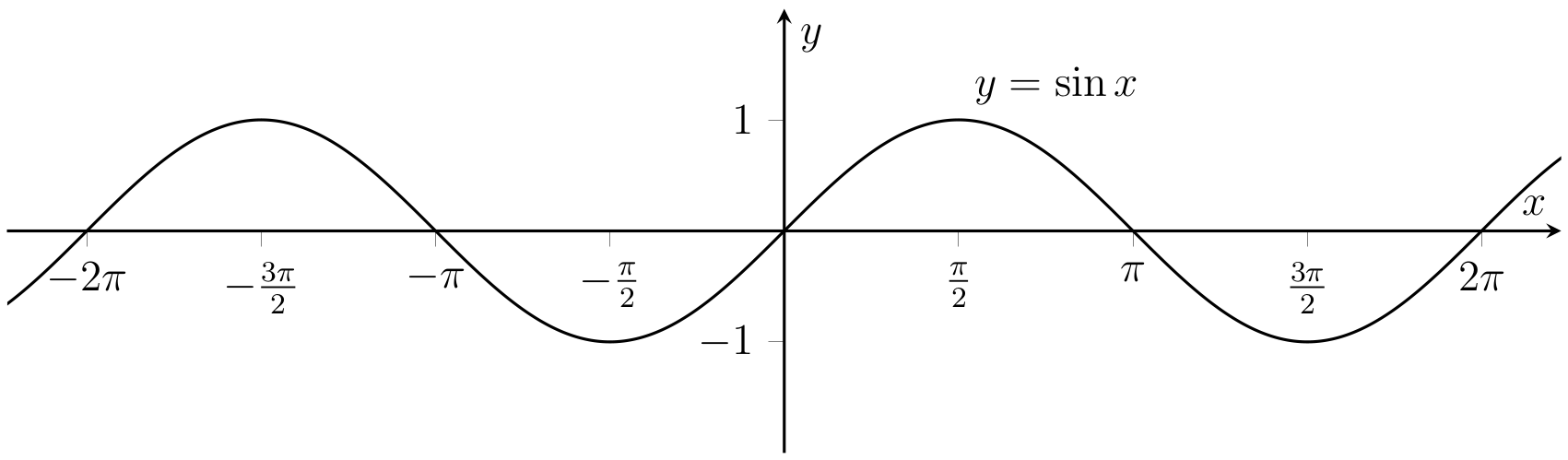
Fig. 22 Graph of \(y=\sin x\).#
(ii) \(y=\sin(2x)\).
We should get the graph from (i), stretched in the \(x\) direction by a scale factor of \(\frac{1}{2}\).
Some other notable features are:
The domain is \(\mathbb{R}\), while the range is \(\{y\in\mathbb{R} :-1\leq y\leq 1\}\).
\(\sin(2x) = 0\) when \(x = (\pi/2) k\), for \(k\in\mathbb{Z}\).
\(\sin(2x) = 1\) when \(x = \pi/4 + \pi k\), for \(k\in\mathbb{Z}\).
\(\sin(2x) = -1\) when\(x = -\pi/4 +\pi k\), for \(k\in\mathbb{Z}\).
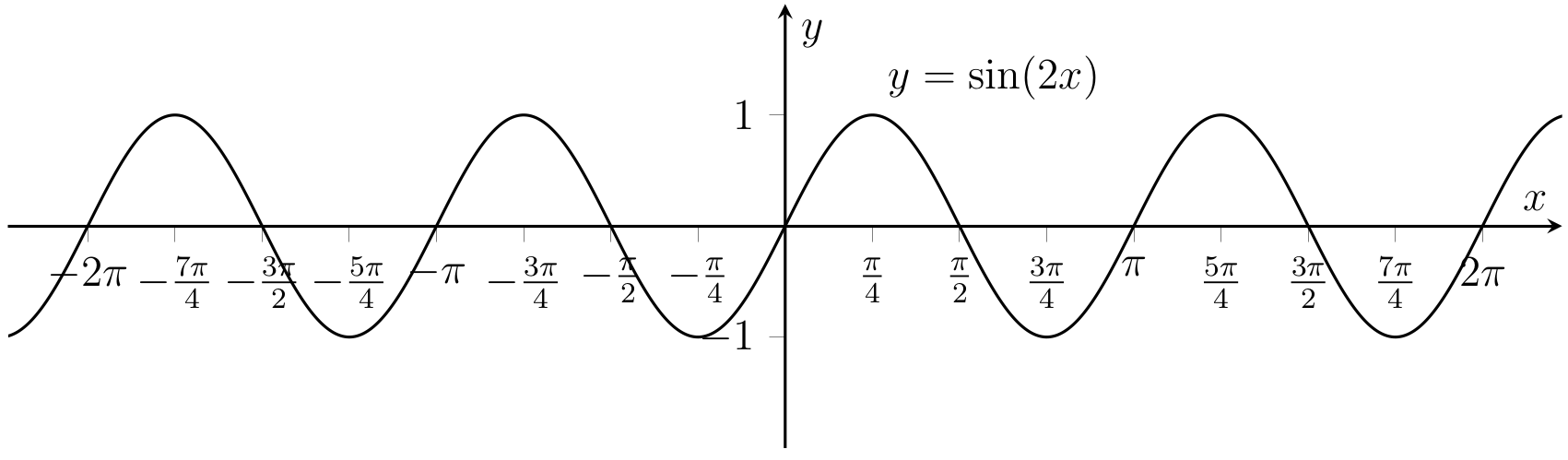
Fig. 23 Graph of \(y=\sin(2x)\)#
(iii) \(y=\sin\left(x+\frac{\pi}{2}\right)\).
This time, the sine graph has been translated in the \(x\) direction by \(-\frac{\pi}{2}\).
The domain is still \(\mathbb{R}\), while the range is \(\{y\in\mathbb{R} :-1\leq y\leq 1\}\).
\(\sin\left(x+\frac{\pi}{2}\right) = 0\) when \(x = -\pi/2 +\pi k\), for \(k\in\mathbb{Z}\).
\(\sin\left(x+\frac{\pi}{2}\right) = 1\) when \(x = 2\pi k\), for \(k\in\mathbb{Z}\).
\(\sin\left(x+\frac{\pi}{2}\right) = -1\) when \(x = \pi +2\pi k\), \(k\in \mathbb{Z}\).
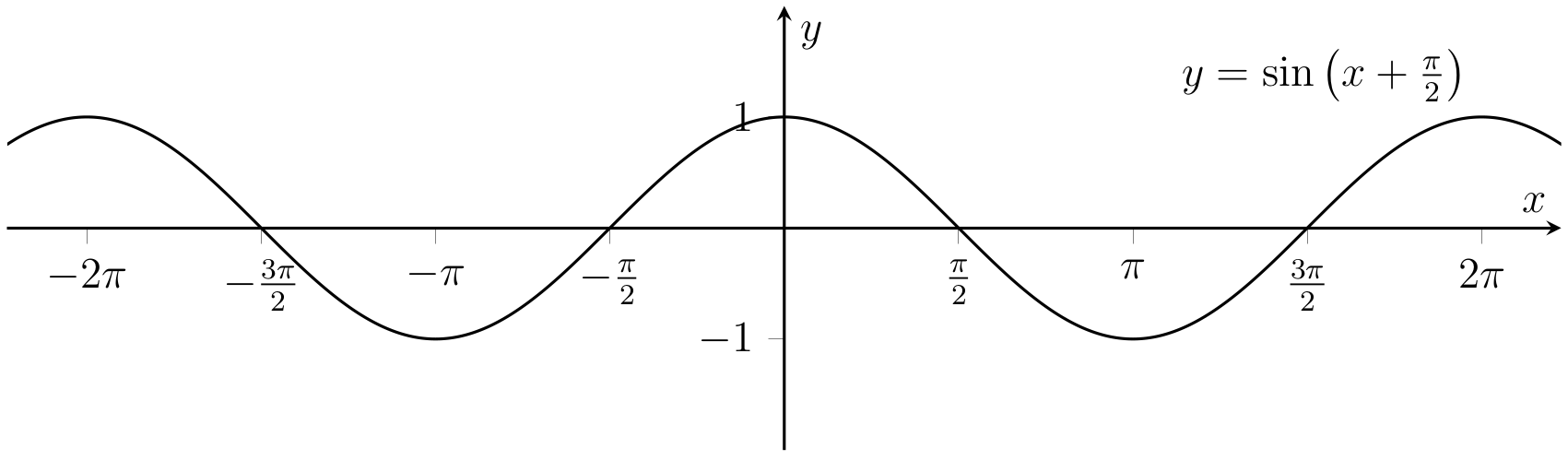
Fig. 24 Graph of \(y=\sin\left(x+\frac{\pi}{2}\right)\)#
(iv) \(y=\sin(x)+3\).
This time, \(y=\sin(x)\) is translated in the \(y\) direction by \(+3\).
The domain is \(\mathbb{R}\), while the range is \(\{y\in\mathbb{R} :2 \leq y \leq 4\}\).
\(\sin(x) +3 \neq 0\) for all \(x\in\mathbb{R}\), so the graph doesn’t cross the \(x\)-axis.
\(\sin x +3 = 3\) when \(x = \pi k\), for \(k\in\mathbb{Z}\).
\(\sin(x) +3 = 4\) when \(x = \frac{\pi}{2} + 2\pi k\), for \(k\in\mathbb{Z}\). So local maximum points are at \((\frac{\pi}{2} + 2\pi k,4)\), for \(k\in\mathbb{Z}\).
\(\sin(x) = 2\) when \(x = -\pi/2 +2\pi k\), \(k\in \mathbb{Z}\).So local minimum points are at \((-\pi/2 +2\pi k,2)\), for \(k\in\mathbb{Z}\).
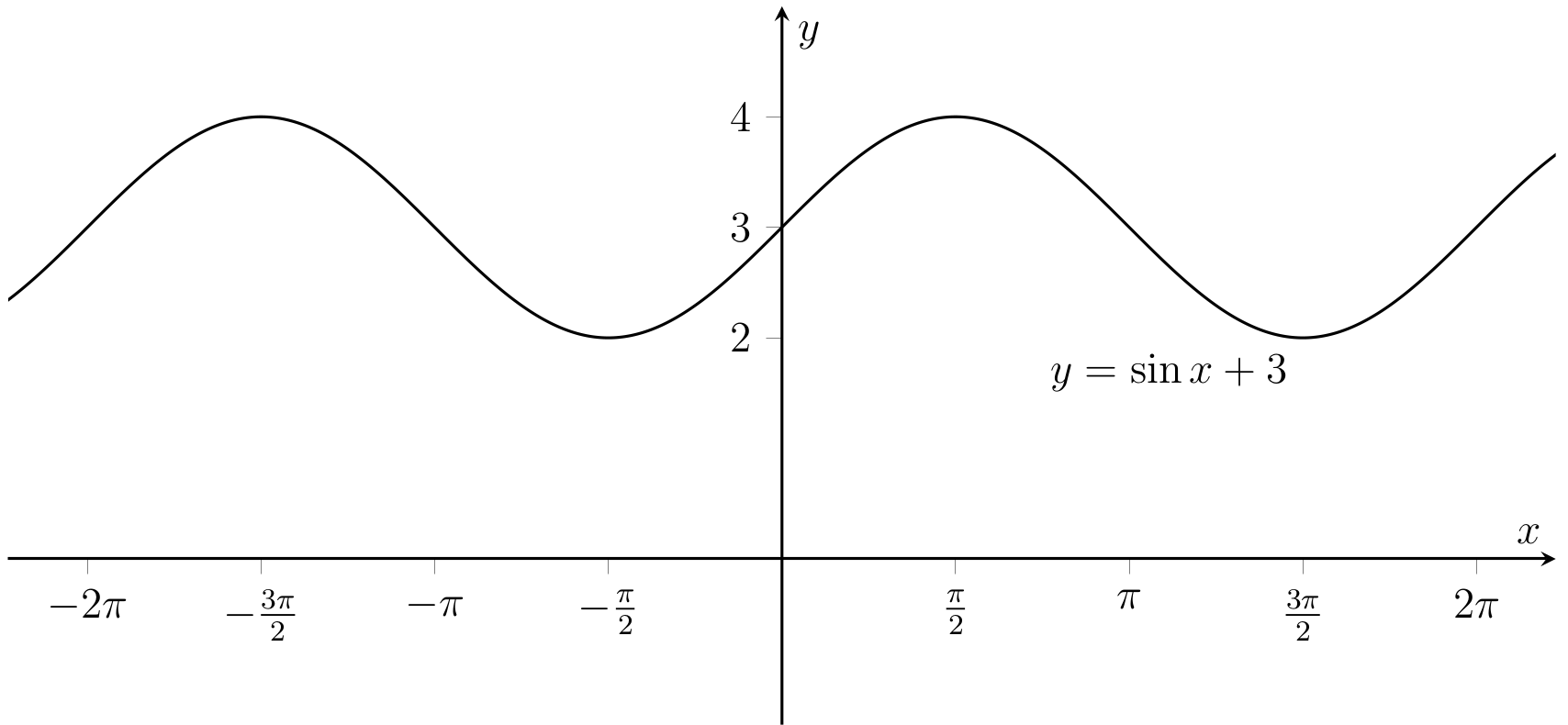
Fig. 25 Graph of \(y=\sin(x)+3\)#
(v) \(y=3\sin(x)\)
The standard sine graph is stretched in the \(y\) direction by a scale factor of \(3\).
The domain is \(\mathbb{R}\), while the range is \(\{y\in\mathbb{R} :|y| \leq 3\}\).
The zeros, max and min points will occur at the same \(x\)-values as for the standard sine graph, but the corresponding \(y\)-values will be \(3\) times as big.
In particular:
\(3\sin x = 0\) when \(x = \pi k\), for \(k\in\mathbb{Z}\), so \(x\)-intercepts are at \((\pi k,0)\), for \(k\in\mathbb{Z}\).
\(3\sin x = 3\) when \(x = \frac{\pi}{2} + 2\pi k\), for \(k\in\mathbb{Z}\).
In other words, the local max points occur at \(\left(\frac{\pi}{2} + 2\pi k,3\right)\), for \(k\in\mathbb{Z}\).
\(3\sin x = -3\) when \(x = -\frac{\pi}{2} +2\pi k\), \(k\in \mathbb{Z}\).
So local min points occur at \(\left(-\frac{\pi}{2} + 2\pi k,-3\right)\), for \(k\in\mathbb{Z}\).
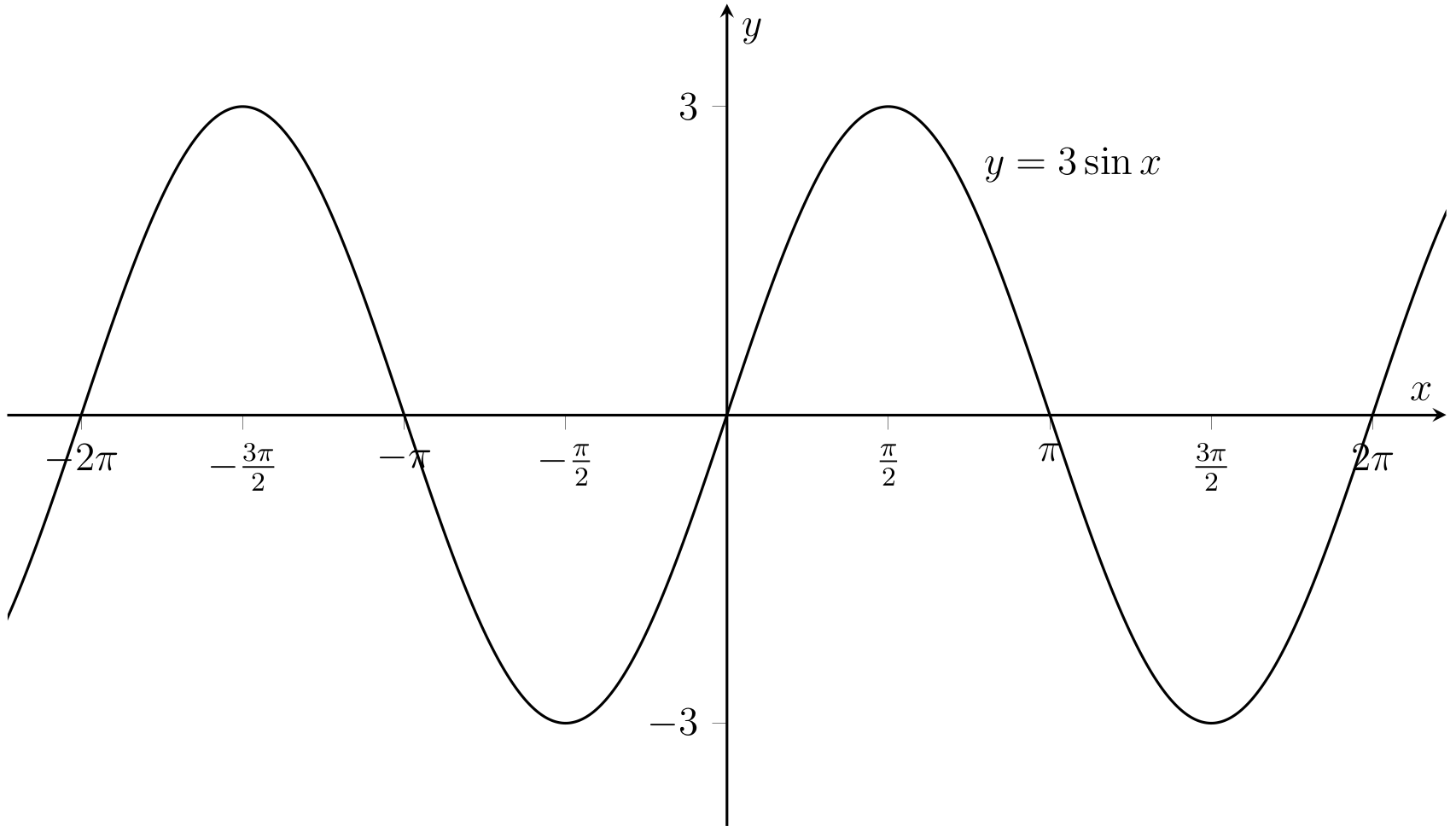
Fig. 26 Graph of \(y=3\sin(x)\)#
(vi) \(y=3\sin(2x)\).
We should get the graph from part (v), stretched by scale factor \(\frac{1}{2}\) in the \(x\)-direction.
The domain is \(\mathbb{R}\), while the range is \(\{y\in\mathbb{R} :|y| \leq 3\}\).
\(3\sin(2x) = 0\) when \(x = \frac{\pi}{2}k\), for \(k\in\mathbb{Z}\), so \(x\)-axis crossings will be at \(\left(\frac{\pi}{2}k,0\right)\) for \(k\in\mathbb{Z}\).
\(3\sin x = 3\) when \(x = \frac{\pi}{4} + \pi k\), for \(k\in\mathbb{Z}\), so local max points will be at \(\left(\frac{\pi}{4}+\pi k,3\right)\) for \(k\in\mathbb{Z}\).
\(3\sin x = -3\) when \(x = -\frac{\pi}{4} +\pi k\), \(k\in \mathbb{Z}\), so local min points will be at \(\left(-\frac{\pi}{4}+\pi k,3\right)\) for \(k\in\mathbb{Z}\).
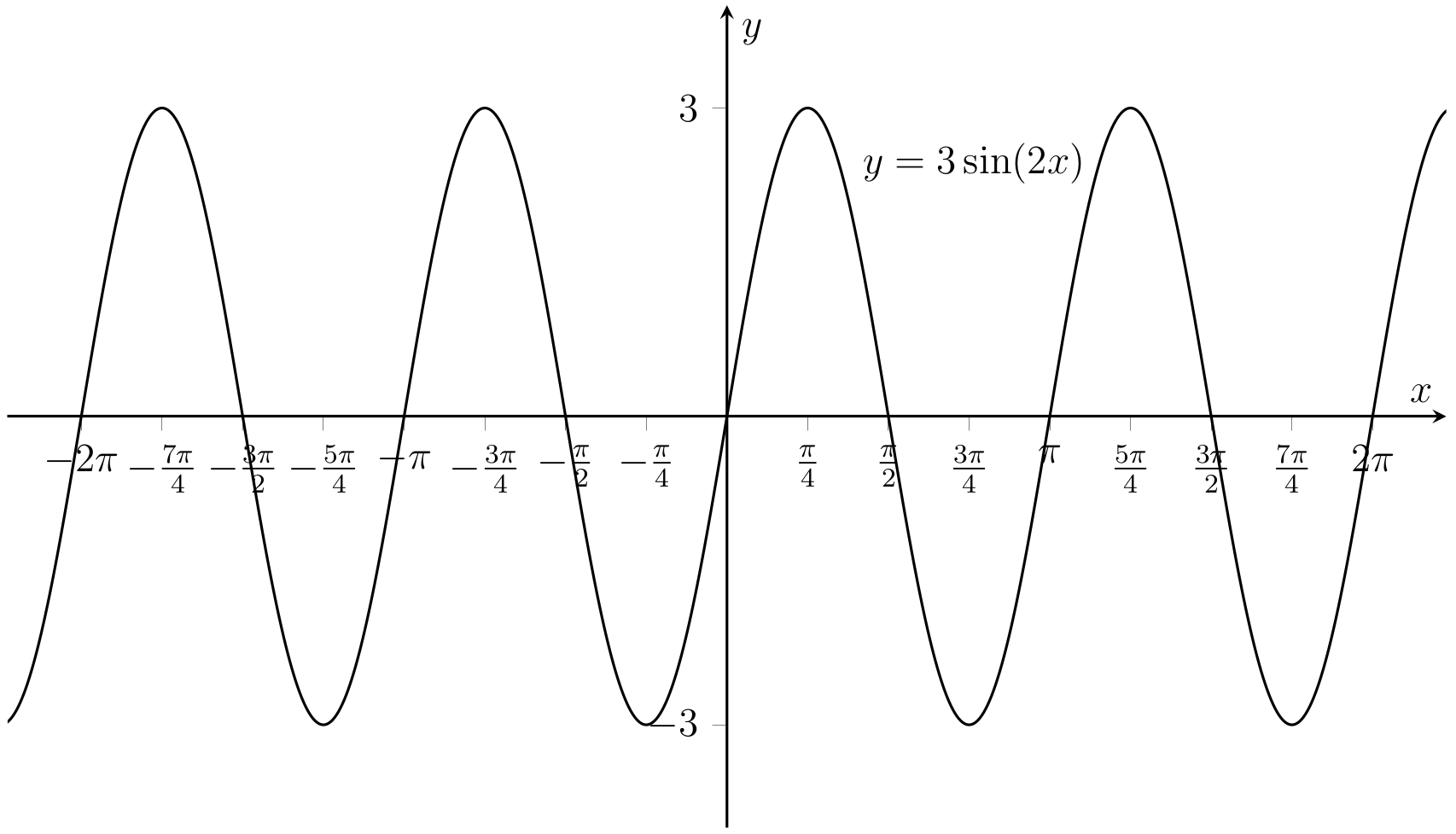
Fig. 27 Graph of \(y=3\sin(2x)\)#
(vii) \(y=\cos(x)\)
The domain is \(\mathbb{R}\), while the range is \(\{y\in\mathbb{R} :-1\leq y\leq 1\}\).
\(\cos x = 0\) when \(x = \pi/2 +\pi k\), for \(k\in\mathbb{Z}\).
\(\cos x = 1\) when \(x = 2\pi k\), for \(k\in\mathbb{Z}\).
\(\cos x = -1\) when \(x = -\pi + 2\pi k\), for \(k \in \mathbb{Z}\).
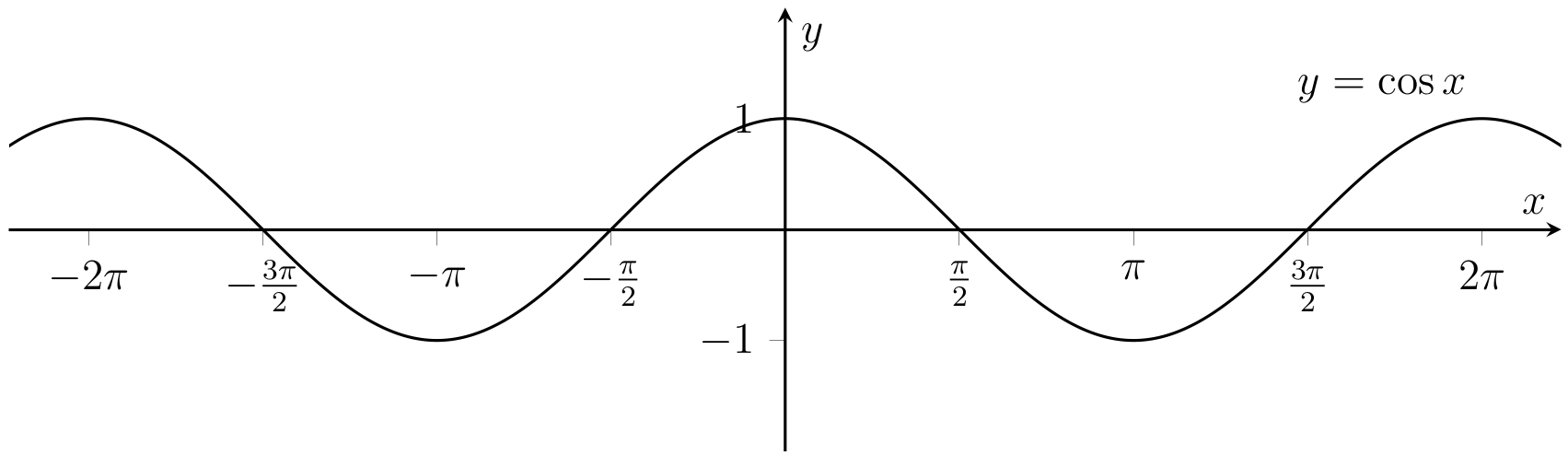
Fig. 28 Graph of \(y=\cos(x)\)#
(viii) \(y=-\cos(x)\)
This is the graph of (vii) reflected in the \(x\)-axis.
The domain is \(\mathbb{R}\), while the range is \(\{y\in\mathbb{R} :-1\leq y\leq 1\}\).
\(-\cos x = 0\) when \(x = \pi/2 + \pi k\), for \(k\in\mathbb{Z}\).
\(-\cos x = -1\) when \(x = 2\pi k\), for \(k\in\mathbb{Z}\).
\(-\cos x = 1\) when \(x = -\pi + 2\pi k\), for \(k \in \mathbb{Z}\).
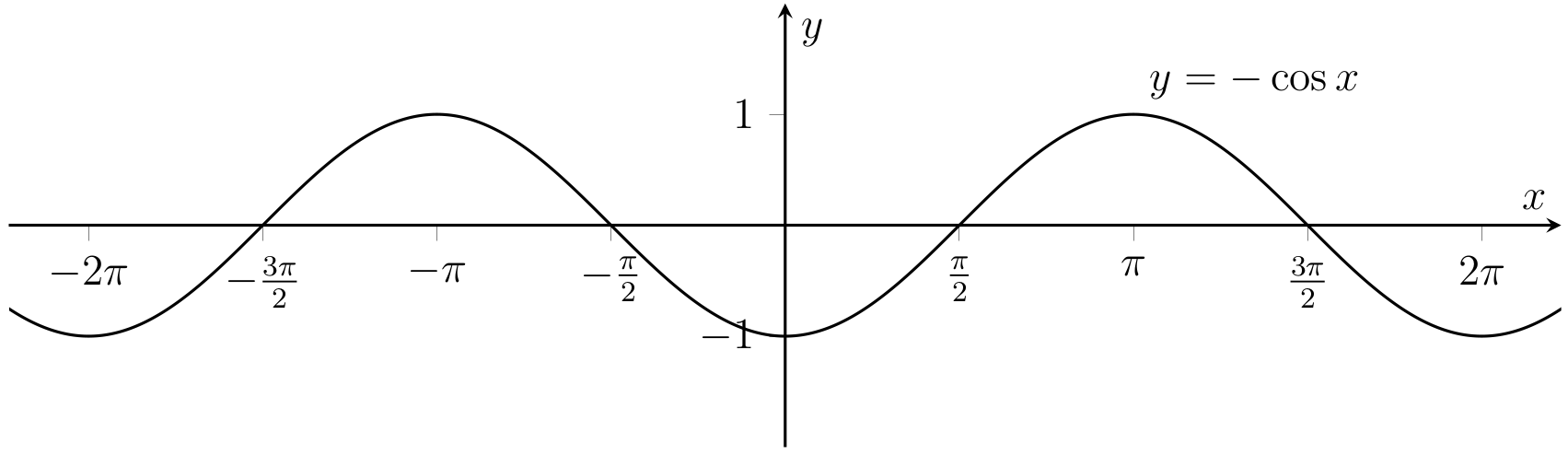
Fig. 29 Graph of \(y=-\cos(x)\)#
(ix) \(y=\cos(x+\pi)\).
This is the graph of \(y=\cos(x)\) translated by \(-\pi\) in the \(x\)-direction.
The domain is \(\mathbb{R}\), while the range is \(\{y\in\mathbb{R} :-1\leq y\leq 1\}\).
\(\cos (x+\pi) = 0\) when \(x = \frac{\pi}{2} + \pi k\), for \(k\in\mathbb{Z}\).
\(\cos (x+\pi) = -1\) when \(x = 2\pi k\), for \(k\in\mathbb{Z}\).
\(\cos (x+\pi) = 1\) when \(x = -\pi + 2\pi k\), for\(k \in \mathbb{Z}\).
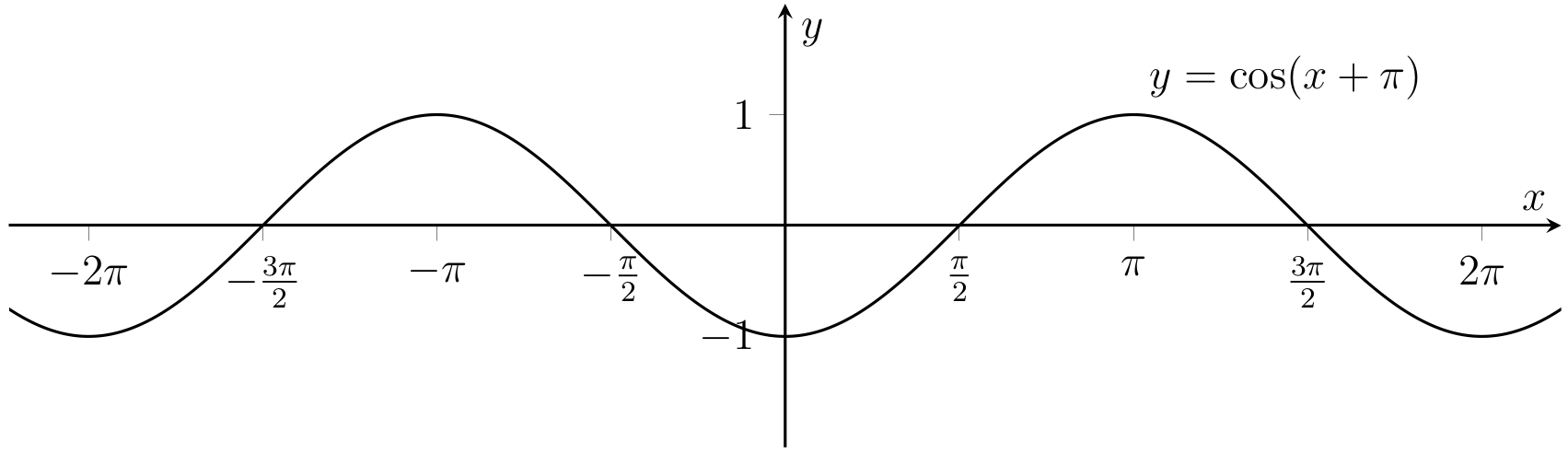
Fig. 30 Graph of \(y=\cos(x+\pi)\)}#
Comparing Figures Fig. 29 and Fig. 30 we see that the graphs of \(y=-\cos(x)\) and \(y=\cos(x+\pi)\) are the same! In fact,
(x) \(y=\cos\left(x+\frac{\pi}{2}\right) - 1\).
The domain is \(\mathbb{R}\), while the range is \(\{y\in\mathbb{R} :-2 \leq y \leq 0\}\).
\(\cos\left(x+\frac{\pi}{2}\right)-1= -1\) when \(x = \pi k\), for \(k\in\mathbb{Z}\).
\(\cos\left(x+\frac{\pi}{2}\right)-1= 0\) when \(x = -\frac{\pi}{2} +2\pi k\), for \(k\in\mathbb{Z}\).
\(\cos\left(x+\frac{\pi}{2}\right)-1 = -2\) when \(x = \frac{\pi}{2} + 2\pi k\), \(k \in \mathbb{Z}\).
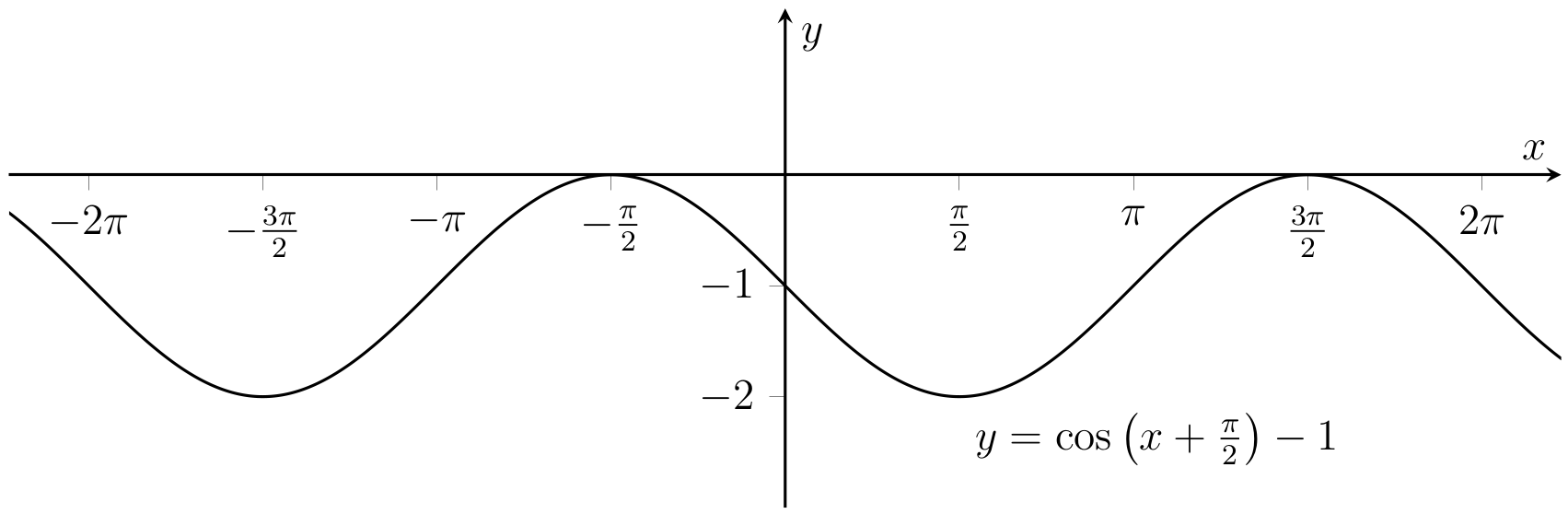
Fig. 31 Graph of \(y=\cos\left(x+\frac{\pi}{2}\right)-1\)#
(xi) \(y=\cos(3x)\)
The domain is \(\mathbb{R}\), while the range is \(\{y\in\mathbb{R} :-1\leq y\leq 1\}\).
\(\cos 3x = 0\) when \(x = \frac{\pi}{6} + \frac{\pi}{3}k\), for \(k\in\mathbb{Z}\).
\(\cos x = 1\) when \(x = \frac{2\pi}{3}k\), for \(k\in\mathbb{Z}\).
\(\cos 3x = -1\) when \(x = -\frac{\pi}{3} + \frac{2\pi}{3}k\), for \(k \in \mathbb{Z}\).
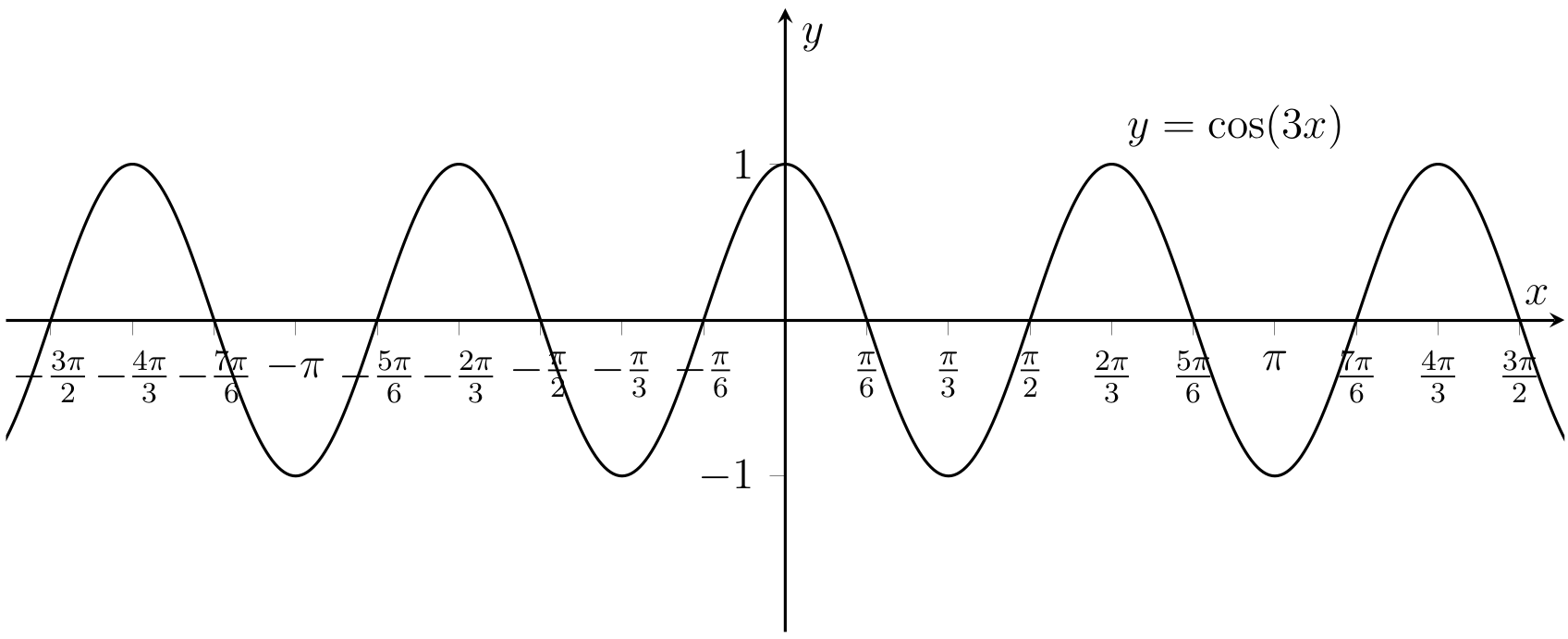
Fig. 32 Graph of \(y = \cos(3x)\)#
(xii) \(y = \cos(x)\).
The domain is \(\mathbb{R}\), while the range is \(\{y\in\mathbb{R} :-1\leq y\leq 1\}\).
\(\cos\left(\frac{x}{2}\right) = 0\) when \(x = \pi + 2\pi k\), for \(k\in\mathbb{Z}\).
\(\cos\left(\frac{x}{2}\right) = 1\) when \(x = 4\pi k\), for \(k\in\mathbb{Z}\).
\(\cos\left(\frac{x}{2}\right) = -1\) when \(x = -2\pi + 4\pi k\), for \(k \in \mathbb{Z}\).
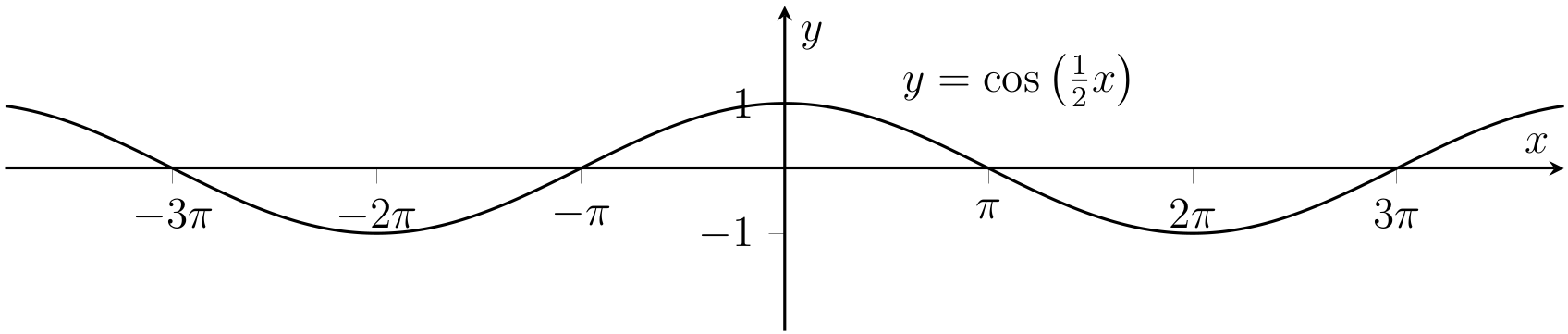
Fig. 33 Graph of \(y=\cos\left(\frac{x}{2}\right)\)#
(xiii) \(y=|x|\).
The domain is \(\mathbb{R}\), while the range is \(\{y\in\mathbb{R} :y \geq 0\}\). The minimum of this curve is at \((0,0)\).
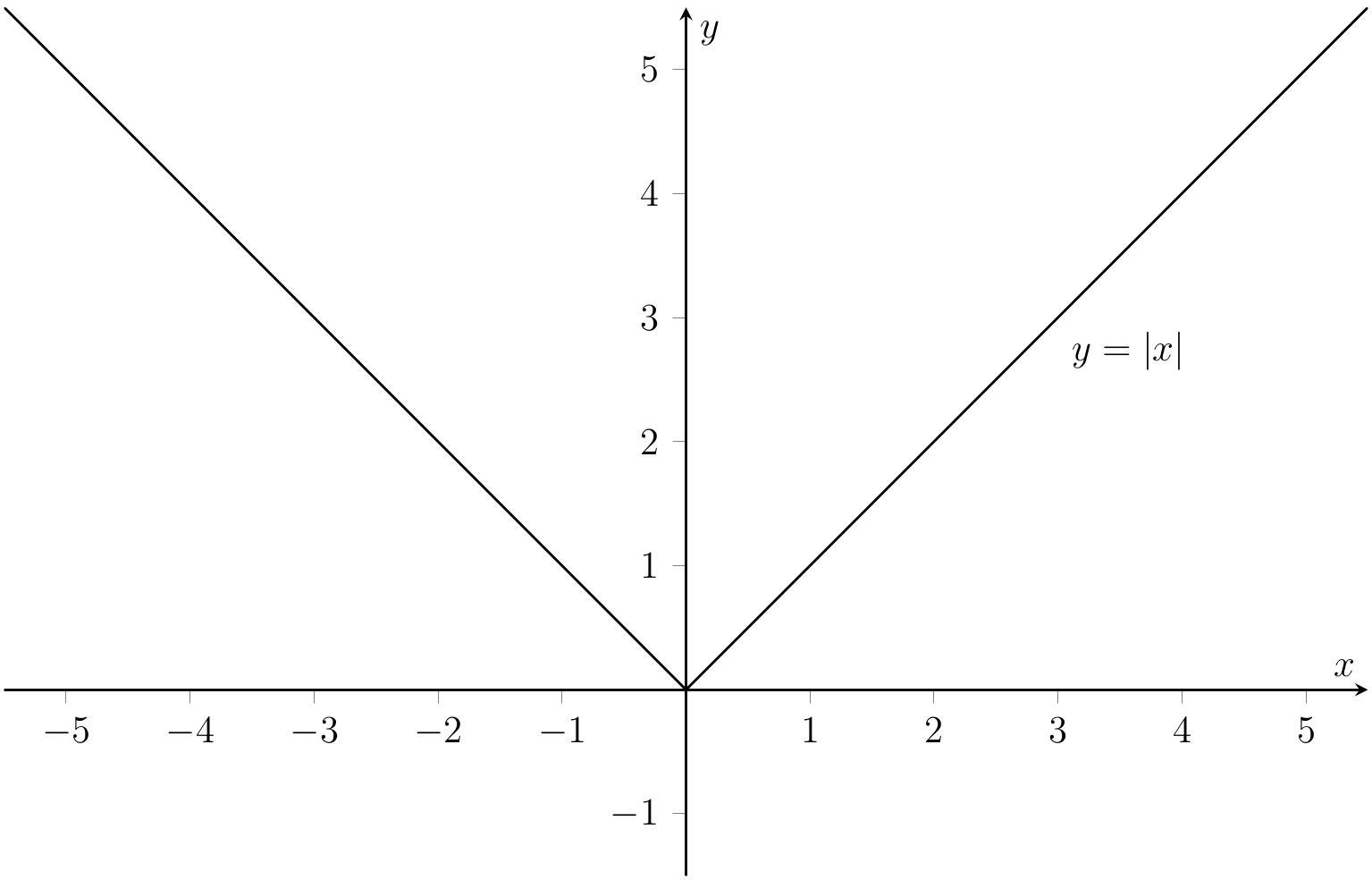
Fig. 34 Graph of \(y=|x|\)#
(xiv) \(y=|x-1|\).
This is just \(y=|x|\) shifted by \(+1\) in the \(x\)-direction.
The domain is \(\mathbb{R}\), while the range is \(\{y\in\mathbb{R} :y \geq 0\}\). The curve has a minimum at \((1,0)\) and crossed the \(y\)-axis at \((0,1)\).
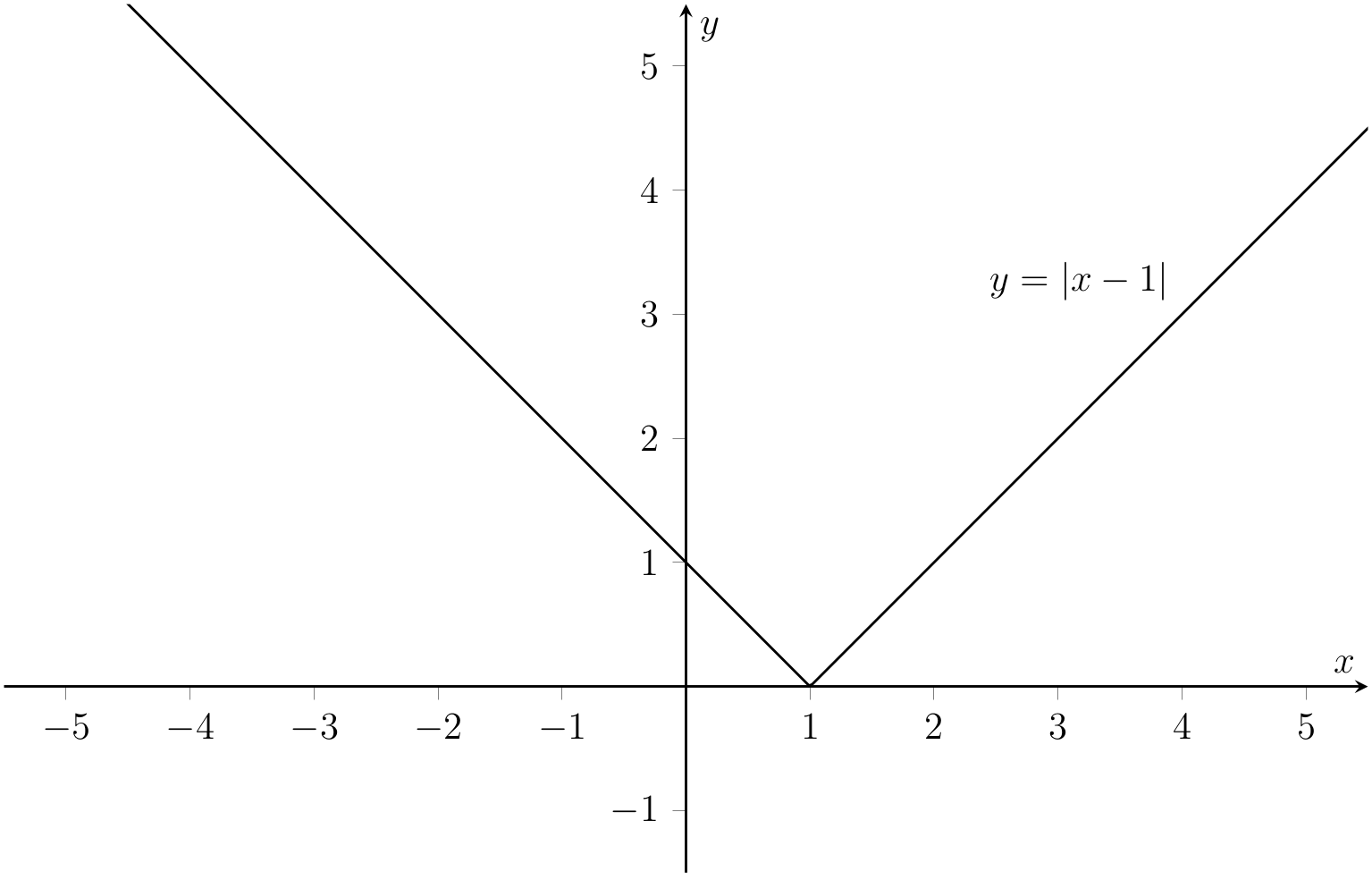
Fig. 35 Graph of \(y=|x-1|\)#
(xv) \(y=|x|+2\).
This time, \(y=|x|\) is shifted by \(+2\) in the \(y\)-direction.
The domain is \(\mathbb{R}\), while the range is \(\{y\in\mathbb{R} :y \geq 2\}\). The minimum of this curve is at \((0,2)\).
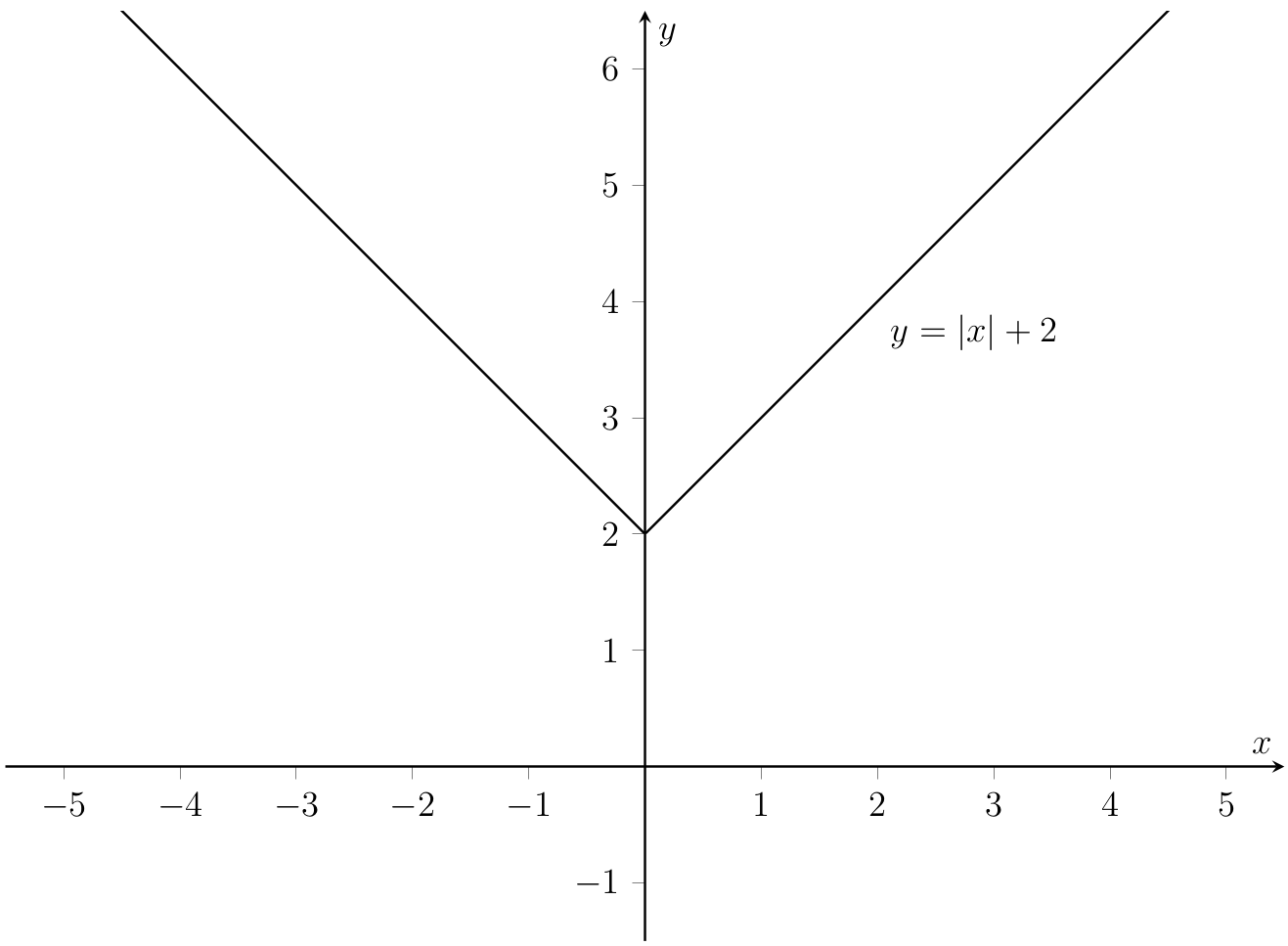
Fig. 36 Graph of \(y=|x|+2\)#
(xvi) \(y=2|x|\).
\(y=|x|\) is stretched by scale factor 2 in the \(y\) direction.
The domain is \(\mathbb{R}\), while the range is \(\{y\in\mathbb{R} :y \geq 0\}\). The minimum of the curve is at \((0,0)\).
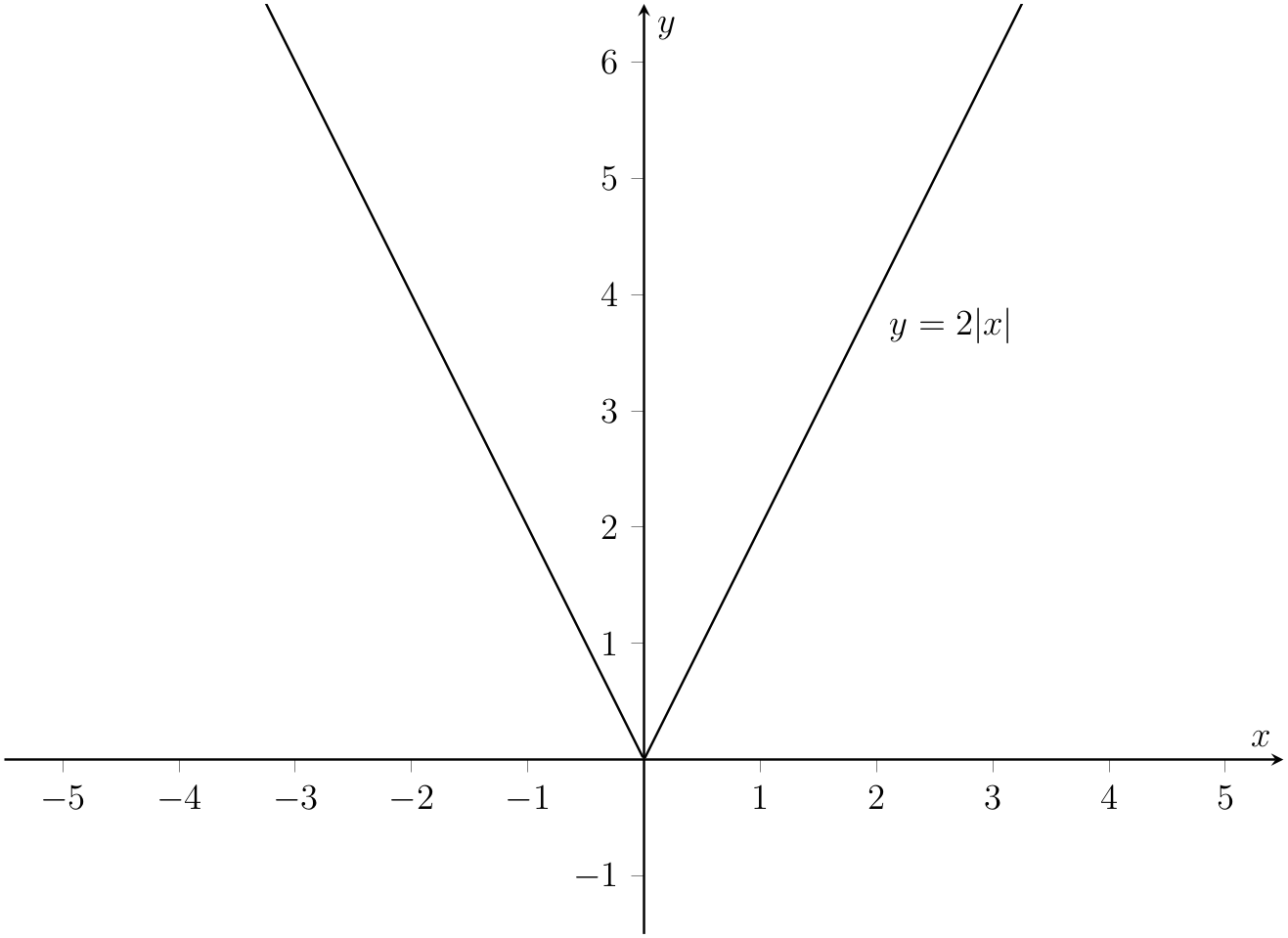
Fig. 37 Graph of \(y=2|x|\)#
(xvii) \(y=x^2+3x -4\).
Note that
which means that the minimum point is \(\left(\frac{3}{2}, -\frac{25}{2}\right)\), the \(y\)-intercept is \(-4\) and the \(x\)-intercepts are \((-4,0)\) and \((1,0)\).
The domain is \(\mathbb{R}\), while the range is \(\{y\in\mathbb{R} :y \geq - \frac{25}{4}\}\).
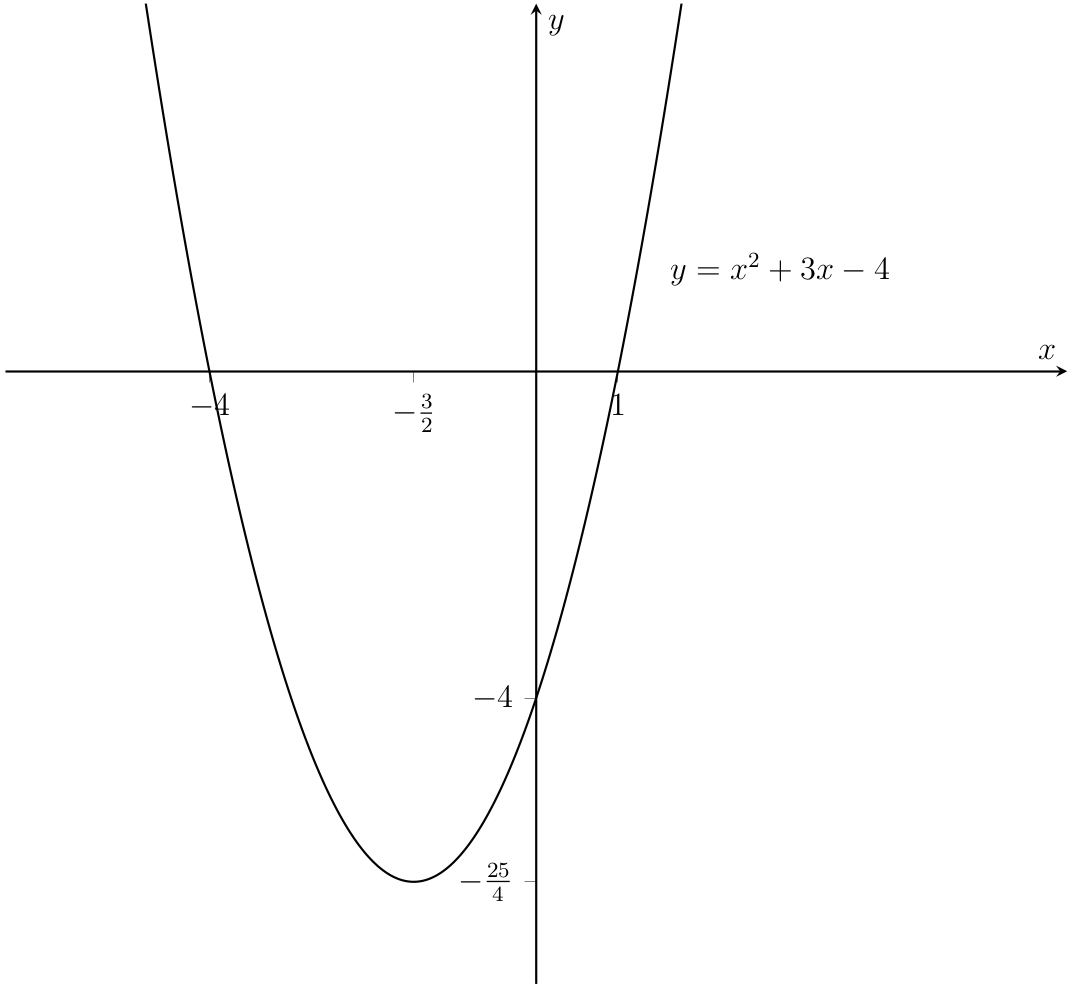
Fig. 38 Graph of \(y=x^2+3x-4\)#
(xviii) \(y=-x^2 -4\) has \(y\)-intercept \((0,-4)\), no \(x\)-intercept and its maximum point is \((0,-4)\). The domain is \(\mathbb{R}\), while the range is \(\{y\in\mathbb{R} :y \leq -4\}\).
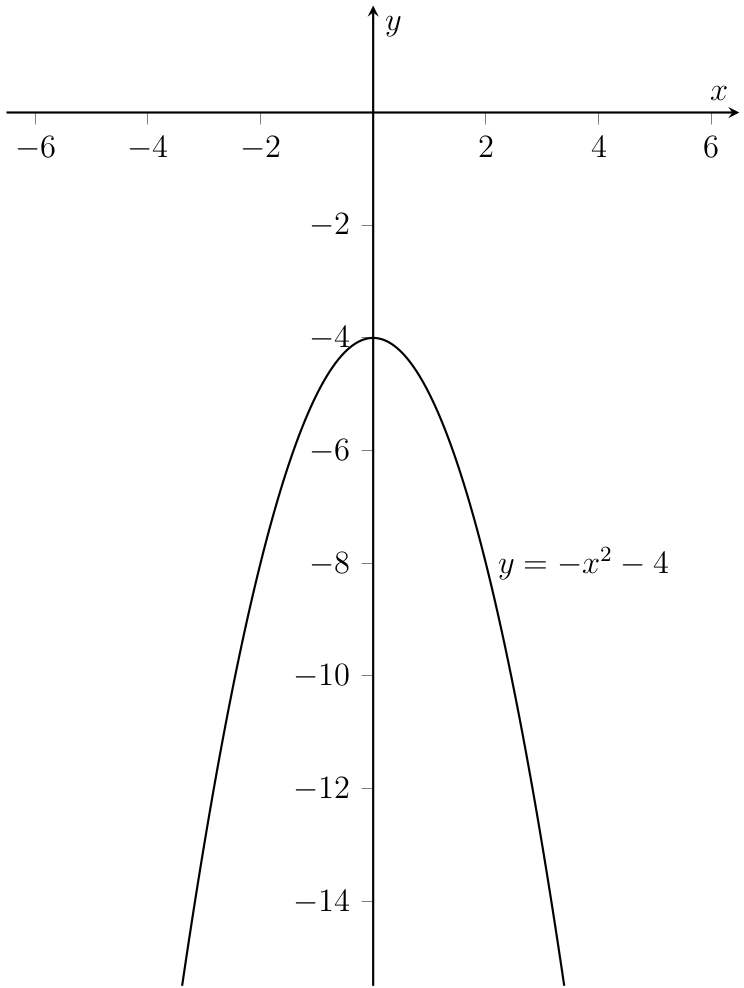
Fig. 39 Graph of \(y=-x^2-4\)#
(xix) \(y=2x^2+4x-5\).
Completing the square this time gives \(y=2(x+1)^2 -7\), which means that the minimum point is \((-1, -7)\), and the \(x\)-intercepts are \(\left(-1-\sqrt{\frac{7}{2}},0\right)\) and \(\left(-1+\sqrt{\frac{7}{2}},0\right)\). From the original expression, the \(y\)-intercept is \(-5\).
The domain is \(\mathbb{R}\), while the range is \(\{y\in\mathbb{R} :y \geq -7\}\).
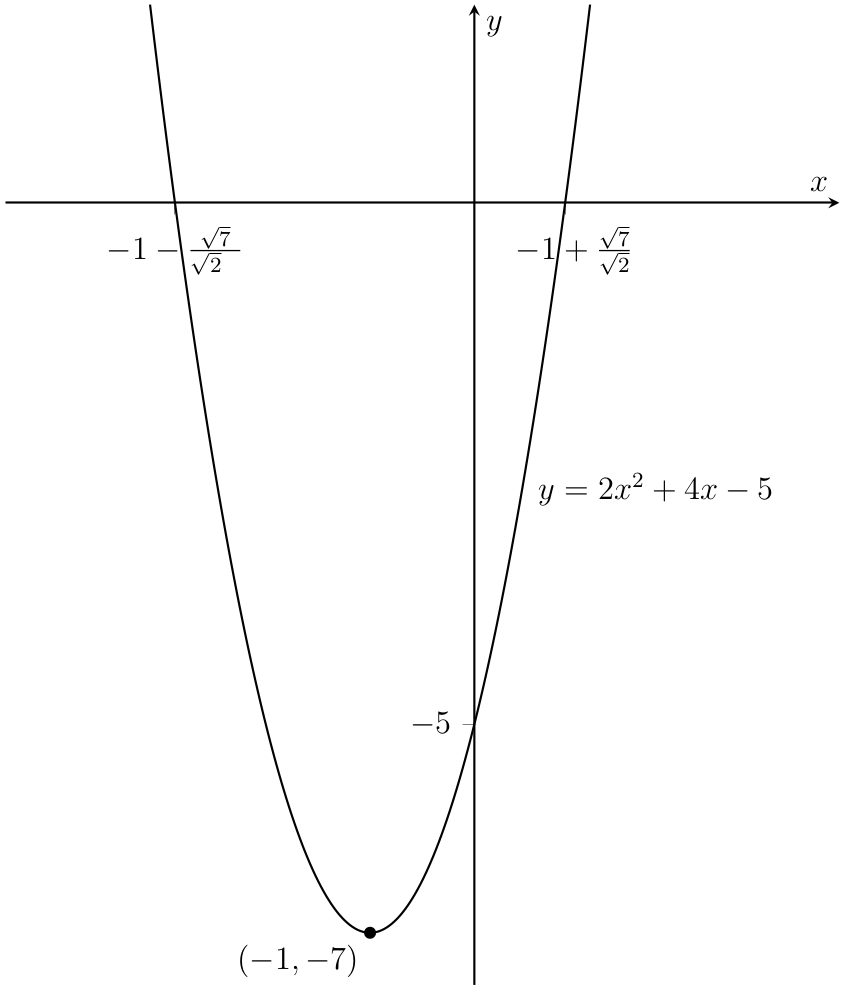
Fig. 40 Graph of \(y=2x^2+4x-5\)#
(xx) \(y=x^4\).
The domain is \(\mathbb{R}\), while the range is \(\{y\in\mathbb{R} :y \geq 0\}\). Note that this graph has a minimum at \((0,0)\).
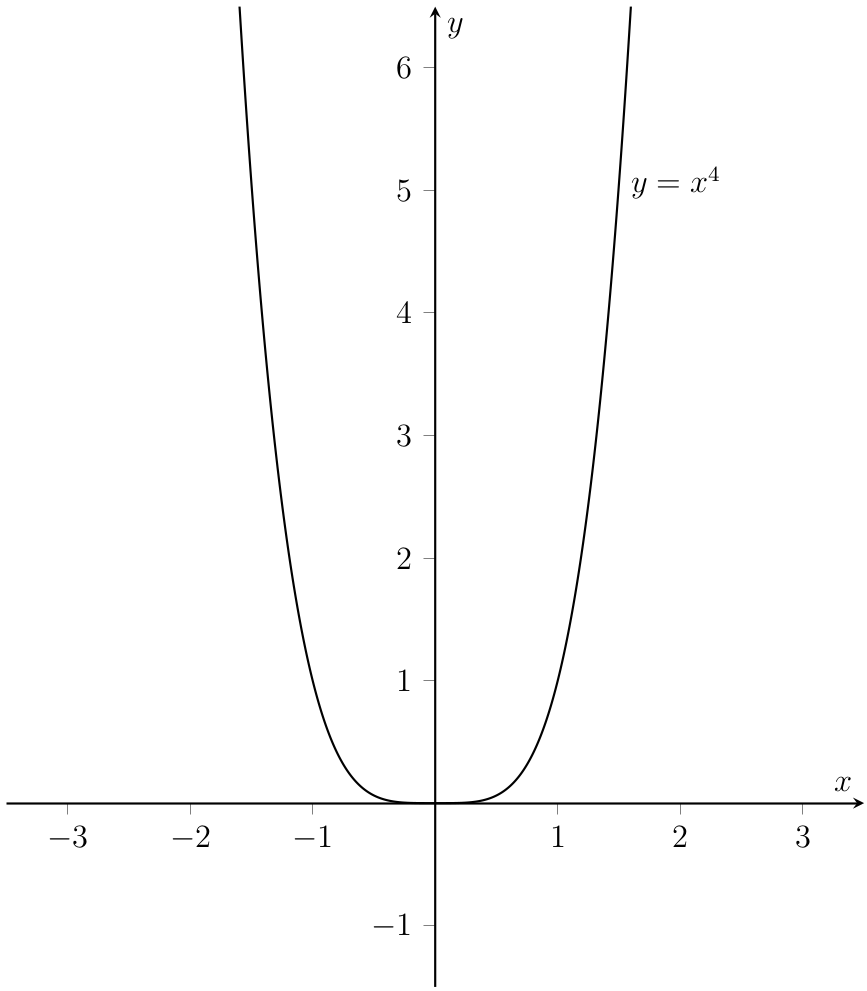
Fig. 41 Graph of \(y=x^4\)#
54. (i) \(y=6+2\cos(2x-\pi)\) is never zero. It crosses the \(y\)-axis at \(y=6+2\cos(-\pi)=4\), and its max/min values occur when \(\cos(2x-\pi)=\pm 1\).
Maxima: we have \(\cos(2x-\pi)=1\), so \(2x-\pi= 2k\pi\) for \(k\in\mathbb{Z}\). That is, \(x=\frac{(2k+1)\pi}{2}\). Since the domain restricted to \(0\leq x\leq 2\pi\), the maxima occur at \(x=\frac{\pi}{2}\) and \(x=\frac{3\pi}{2}\). The corresponding \(y\)-value is \(y=6+2=8\).
Minima: \(\cos(2x-\pi)=-1\) when \(2x-\pi=(2k+1)\pi\), for \(k\in\mathbb{Z}\). That is, \(x=(k+1)\pi\), so minima occur at integer multiples of \(\pi\). For the given domain we have \(x=\pi, 2\pi\) and \(y=6-2=4\).
The end points for this domain are \((0,4)\) and \((2\pi,4)\).
We get the following sketch:
.png)
Fig. 42 Graph of \(y=6+2\cos(2x-\pi)\) with domain \(\left\{x\in\mathbb{R}:0\leq x\leq 2\pi\right\}\).#
From the graph, we see that the range of the function is \(\{y\in\mathbb{R}:4\leq y\leq 8\}\).
(ii) \(y=\frac{1+\cot(x)}{2}\) crosses the \(x\)-axis when \(\cot(x)=-1\), so at \(x=-\frac{\pi}{4}+2k\pi\), for \(k\in\mathbb{Z}\). For the given range of \(x\), we have \(x\)-intercepts at \(\left(-\frac{\pi}{4},0\right)\) and \(\left(\frac{3\pi}{4},0\right)\). There is no \(y\)-intercept since the graph is not defined at \(x=0\).
There are also no maximum or minimum points.
The end points for this domain are \(\left(-\frac{\pi}{2},\frac{1}{2}\right)\) and \(\left(\frac{3\pi}{2},\frac{1}{2}\right)\).
Hence we have the following graph:
),2.png)
Fig. 43 Graph of \(\displaystyle y=\frac{1+\cot(x)}{2}\) with domain \(\displaystyle\left\{x\in\mathbb{R}:-\frac{\pi}{2}< x<\frac{3\pi}{2}, x\neq 0, x\neq \pi\right\}\).#
From the graph, we see that the range of the function is \(\mathbb{R}\).
(iii) By the definition of the modulus function, when \(x\leq -\frac{1}{2}\), we have \(2x+1\leq 0\) and so \(|2x+1|=-(2x+1)\). Therefore, when \(x\leq -\frac{1}{2}\),
Similarly, when \(x\geq -\frac{1}{2}\),
The graph of \(y=3-|2x+1|\) will have a “pointy” maximum point at \(\left(-\frac{1}{2},3\right)\). To the left of this point, the graph will coincide with \(y=4+2x\), and to the right of this point it will coincide with \(y=2-2x\).
It crosses the \(y\)-axis at \(y=3-|1|=2\), and the \(x\) axis when \(|2x+1|=3\), so when \(x=1\).
The end points for this domain are \((-1,2)\) and \((1,0)\).
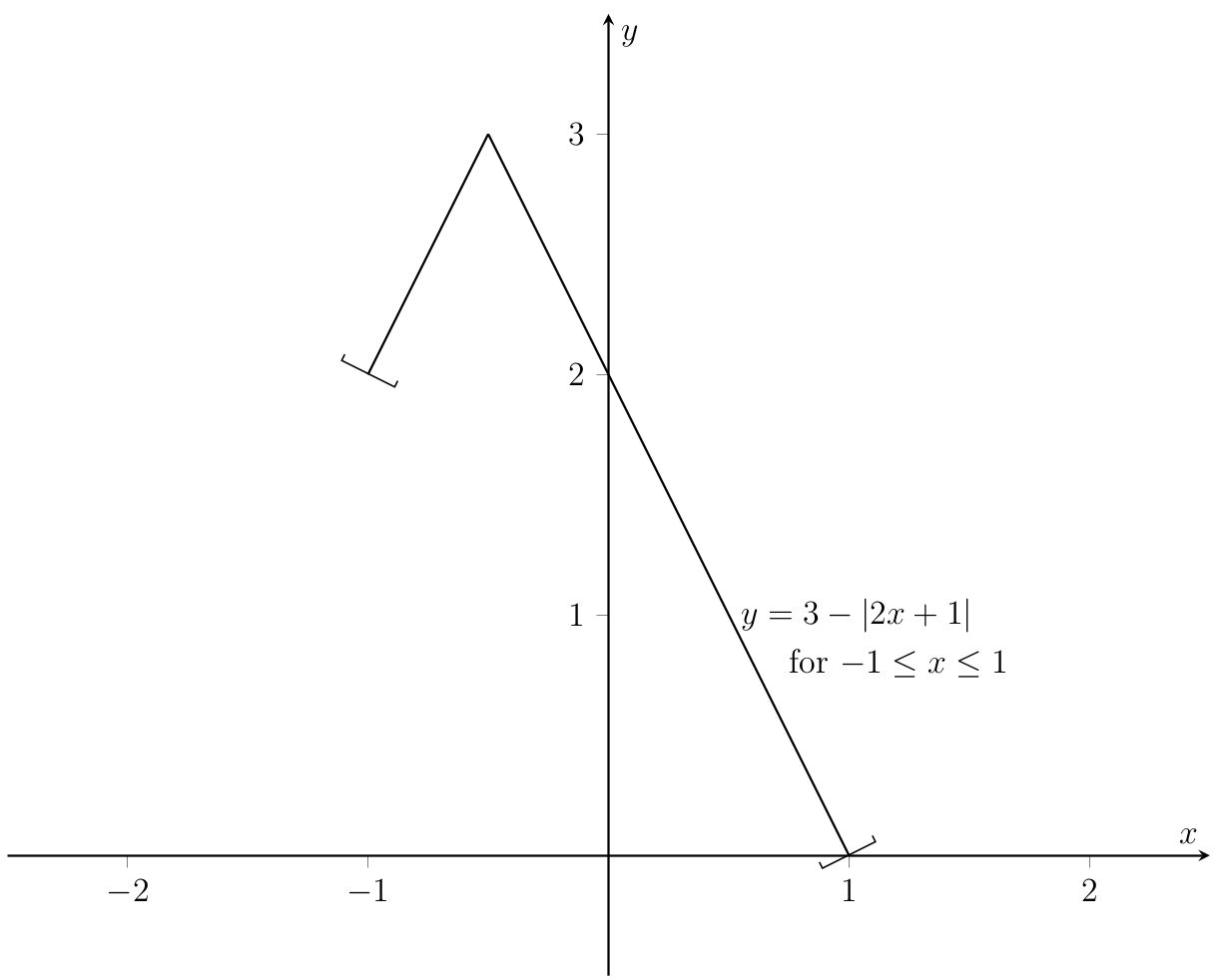
Fig. 44 Graph of \(y=3-|2x+1|\) with domain \(\{x\in\mathbb{R}:-1\leq x\leq 1\}\).#
From the graph, the range is \(\{y\in\mathbb{R}:0\leq y\leq 3\}\). 55. The answer is (C).
(D) is wrong as it does not give the domain.
From the shape it cannot be (A).
All the other possibilities involve \(\sec(x)\), so as long as we know thew basic shape of this, i.e.
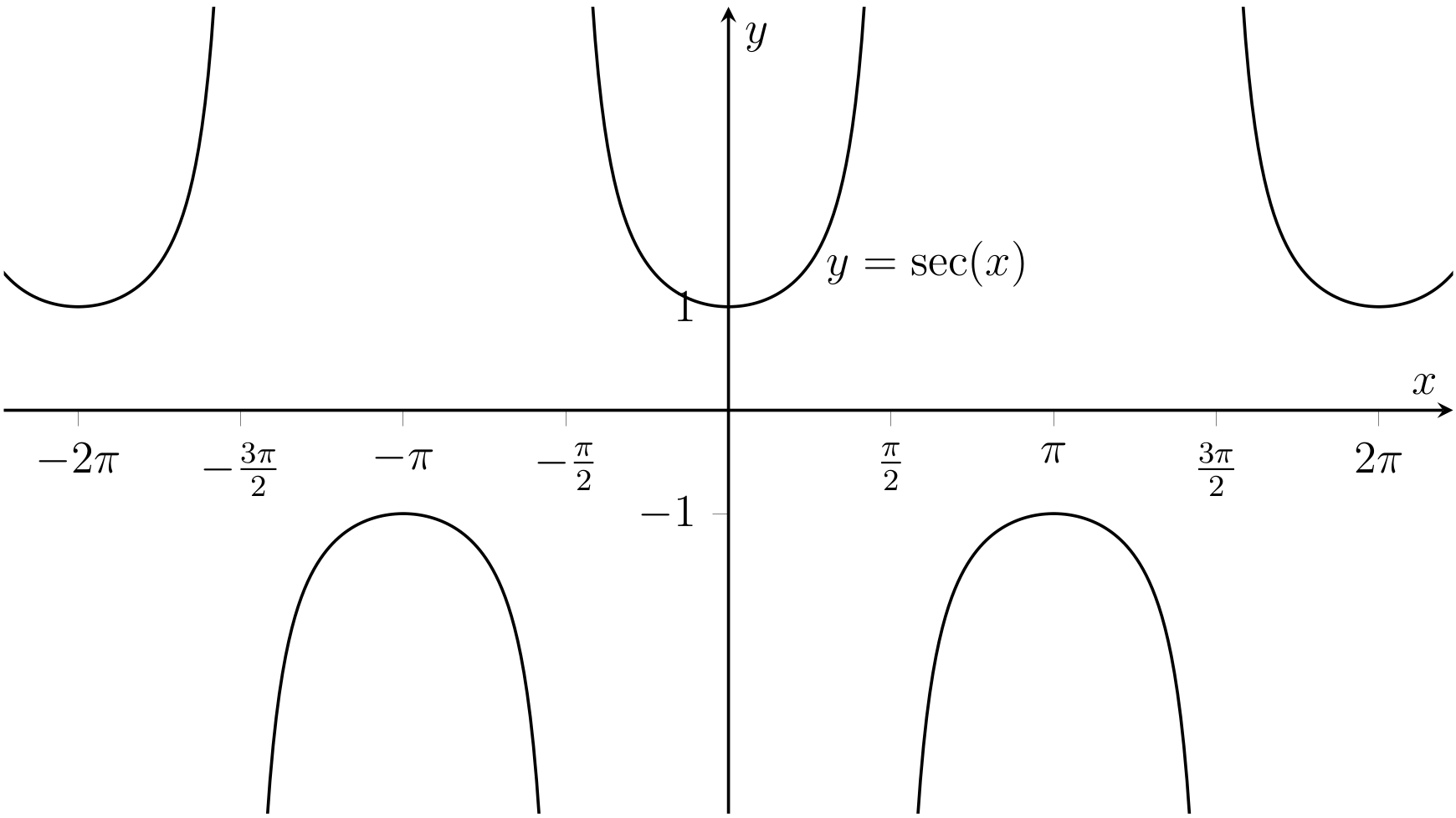
Fig. 45 Graph of \(y=\sec(x)\)#
we can easily see which one it needs to be.
It cannot be (B) as we clearly have a shift of \(y = \sec(x)\) up by 1 on the \(y\)-axis.
So it must be (C).
If there are any interesting points given in the sketch, we can of course put these into the possible answers to rule the wrong ones out.
Chapter 5#
Partial fractions#
(i) Note that the fraction is proper, with non-repeated linear factors in the denominator. Therefore, partial fractions takes the form
where \(A\) and \(B\) are constants to be found. Clearing denominators, we have
Substituting in \(x=2\) gives \(-8=4B\), so \(B=-2\). Substituting in \(x=-2\) gives \(-12=-4A\), so \(A=3\). Thus,
(ii) Note that the fraction is proper, with a repeated linear factor in the denominator. Therefore partial fractions takes the form
Multiplying through by \((x-2)^2\), we have
and substituting \(x=2\) gives \(B=5\). Hence
By comparing coefficients, we see that \(A=4\), and hence
(iii) Note that the fraction is proper and that \(x^2+4\) does not factorize any further. Thus we get for partial fractions
Clearing denominators,
Let \(x=1\), then \(-5=5C\) so \(C=-1\). Also, from (7) we can see that the coefficient of \(x^2\) is
so \(A=1-C=2\). Comparing the constant terms of (7) gives
so \(B=4C+5=-4+5=1\). Thus,
is the final answer.
(iv) Note that the fraction is proper, and the denominator has a non-factorising quadratic factor of \(x^2+1\) as well as a twice repeated linear factor of \(x-3\). Hence
Multiplying through by denominators,
Substitute in \(x=3\). Then
so \(-10=10D\), and so \(D=-1\). Substituting this back into (11), we have
We can now compare coefficients to find \(A\), \(B\) and \(C\).
Coeff.~of \(x^3\): \(3=A+C\), so
Coeff. of \(x^2\): \(-13=B-6A-3C-1\), and using (11) we get
so \(B-18+3C=-12\), i.e.
Coeff.~ of \(x^0\): \(-7 = 9B-3C-1\), so
We can now solve (11) and (11) simultaneously, in the usual way. For example, summing them gives \(10B=0\), so \(B=0\). Therefore \(3C=6\), and so \(C=2\). By (11), \(A=3-C=1\), and recall we found \(D=-1\) early on. Thus
(v) Note that the fraction is proper with a three times repeated linear factor in the denominator. The usual method gives
(vi) Note that the fraction is proper. We get $\( \frac{5x^2 - 24x + 19}{(x + 1)(x - 3)^2}= \frac{3}{x+1} + \frac{2}{x-3} - \frac{2}{(x-3)^2} \)$
(vii) We do not actually need partial fractions here as
(viii) Note that the fraction is proper and that \(x^2+3\) does not factorize any further. Hence we get
(ix) Note that the fraction is proper and that \(x^2+1\) does not factorize any further. We get
(x) Note that the fraction is proper and that neither \(x^2+1\) nor \(x^2+3\) factorize any further. We get
(xi) Note that the fraction is proper. We get
(xii) Note that the fraction is proper and that neither \(x^2+4\) not \(x^2=5\) factorize any further. We get
(i) Note that this fraction is improper as the degree of the numerator is \(3\), while the degree of the denominator is \(1\). Long division of polynomials gives
(ii) Note that the fraction is improper as the degree of the numerator is \(5\), while the degree of the denominator is \(2\). Using long division of polynomials,
and so
Since the denominator of \(\frac{2x-3}{(x-2)^2}\) has a twice repeated linear factor, its partial fractions takes the form
Therefore
Comparing coefficients, \(A=2\) and \(-2A+B=-3\). Therefore \(B=2A-3=4-2=1\), and so
It follows that
(iii) Note that the fraction is improper as the degree of the numerator is \(4\), while the degree of the denominator is \(3\). Also \(x^2+1\) does not factorize further. Using lon5g division of polynomials and then partial fractions gives
(iv) Note that the fraction is improper as the degree of the numerator is \(9\), while the degree of the denominator is \(2\). Also \(x^2+5\) does not factorize further. Using long division of polynomials gives
(v) Note that the fraction is improper as the degree of the numerator is \(4\), while the degree of the denominator is \(3\). Also \(x^2+3\) does not factorize further. Using long division of polynomials and then partial fractions gives
(vi) Note that the fraction is improper as the degree of the numerator is \(4\), while the degree of the denominator is \(2\). Also \(2x^2+1\) does not factorize further. Using long division of polynomials gives
(i) Note first that
is a proper fraction as the numerator has degree 0 while the denominator has degree 12.
We can refactorize the denominator as
since \(x^2-1=(x+1)(x-1)\). Therefore, the denominator has a linear nonrepeaated factor \((x+1)\), a non-factorizing quatratic \(x^2+4\), a \(7\)-times repeated linear factor \(x\) and a twice repeated linear factor \((x-1)\).
Hence partial fractions will take the form
(ii) Note that
is a proper fraction, as the numerator has degree 1 while the denominator has degree 11. The denominator has two non-factorizing quadratic factors, \(x^2+2\) and \(x^2+5\), as well as a 5 times repeated linear factor \(x-3\) and a twice repeated linear factor \(x+2\).
Therefore, partial fractions will take the form
(iii) Note that \(\frac{x^7}{(x-1)^4(x+2)^3(x^2+2x+1)}\) is a proper fraction, as the numerator has degree 7 while the denominator has degree 9.
Note that the denominator factorizes further: we have
Hence the denominator has a 4 times repeated linear factor \(x-1\), a 3 times repeated linear factor \(x+2\), and a twice repeated linear factor \(x+1\).
Partial fractions takes the form
(iv) Certainly
is a proper fraction. In the denominator, there are two quadratic factors that can be factorized further:
and
The quadratic \(x^2+x+5\) has discriminant \(\Delta = 1^2- 4\cdot 5 = -19\), and so does not factorize over \(\mathbb{R}\). It follows that the most factorized form for the denominator is
As partial fractions, we get
59. The answer is (D).
Before we do a plausibility check on these four possible answers, let’s see if we can rule some out anyway.
Comparing the different answers, we can see that C is not a right answer because the denominators are different. We have a \(x^2 + 1\) on the \(RHS\), but the answer (C) has \(x^2 - 1\). If you put the \(C\) on a common denominator, you will not get the denominator of the \(LHS\).
If (B) is correct, then we must be able to cancel a factor of \(x\) out of the \(LHS\) to get the same denominators. That is clearly not possible, so we can disregard this as an answer.
Now we do a plausibility check for A and D. We can use x = 1, so this would give
while
So this means that the answer must be (D). If there is spare time, I would do a plausibility check:
60. The answer is (A).
Before we do a plausibility check on these four possible answers, let’s see if we can rule some out anyway.
Comparing the different answers, we can see that B is not a right answer because the fraction in the question is improper and the answer needs to start with a \(\frac{x^{20}}{x^6} = x^{14}\)-term. This also rules out (D).
(C) is wrong as the common denominator of (C) is \(x^2(x + 1)^2(x + 2)(x - 1) \neq x^2(x +1)(x + 2)(x^2 + 1)\).
Thus the only possible answer is (A).