
Semester 1 Problems#
Solutions are available for you to check your answers.
Chapter 1#
Numbers and fractions revision#
Here is a list of factorisation rules for numbers:
(i) A number is divisible by 2 if the last digit is even.
(ii) A number is divisible by 3 if the sum of its digits is divisible by 3. For example, 345 is divisible by 3 as 3 + 4 + 5 = 12.
(iii) A number is divisible by 5 if it ends on a 0 or 5.
(iv) A number is divisible by 9 if the sum of its digits is divisible by 9.
(v) A number is divisible by 11 if the alternating sum of its digits is divisible by 11. For example, 1331 is divisible by 11 as 1-3+3-1 = 0.
Using these rules, and without using a calculator, determine which of the numbers 101, 105, 1111, 3939393, 427000, 3456552, 8585 and 9999 are divisible by 2, 3, 5, 9 and 11.
You may wish to copy and complete the following table:
101
105
1111
3939393
427000
3456552
8585
9999
Divisble by 2?
Divisble by 3?
Divisble by 5?
Divisble by 9?
Divisble by 11?
Without using a calculator, express the following fractions in lowest terms. (Hint: Question 1 may help.)
(i) \(\displaystyle\frac{105}{9999}\),
(ii) \(\displaystyle\frac{427000}{105}\),
(iii) \(\displaystyle\frac{29700}{3456552}\),
(iv) \(\displaystyle\frac{427000}{8585}\).
Evaluate the following without the use of a calculator:
(i) \(\frac{2}{4} + \frac{3}{4}\),
(ii) \(\frac{2}{4} - \frac{3}{4}\),
(iii) \(\frac{2}{4} \times \frac{3}{4}\),
(iv) \(\frac{2}{4} \div \frac{3}{4}\),
(v) \(\frac{2}{3}- \left(-\frac{-2}{3}\right)\),
(vi) \(\frac{1}{5} \times \left(\frac{3}{6} - \frac{2}{5}\right)\),
(vii) \(\frac{9}{7}- \left(\frac{4}{-3}\right)\),
(viii) \(\frac{3}{8} \times \frac{7}{4} \times \frac{5}{2}\),
(ix) \(\frac{1}{3} - \frac{1}{4} - \frac{1}{5}\),
(x) \(\frac{8}{9} + \frac{3}{7} \times \frac{4}{3} - \frac{2}{5}\).
(i) Simplify \(\displaystyle \frac{1}{1+\frac{1}{1+\frac{1}{2}}}\).
(ii) Use your answer to (i) to simplify \(\displaystyle \frac{1}{1+\frac{1}{1+\frac{1}{1+\frac{1}{2}}}}\) and \(\displaystyle \frac{1}{1+\frac{1}{1+\frac{1}{1+\frac{1}{1+\frac{1}{2}}}}}\).
Write each of the following as a single fraction, collecting like terms in the numerator.
(i) \(\displaystyle\frac{1}{p} + \frac{1}{q}\),
(ii) \(\displaystyle\frac{1}{p}-\frac{1}{q}\),
(iii) \(\displaystyle\frac{1}{p+1} + \frac{1}{q-1}\),
(iv) \(\displaystyle\frac{1}{p+1} - \frac1{q-1}\),
(v) \(\displaystyle\frac{p-q}{p+q} - \frac{pq}{q-1}\),
(vi) \(\displaystyle\frac{p}{q(p+1)} - \frac{5p}{q-1}\),
(vii) \(\displaystyle\frac{3}{(p+1)^2} + \frac{p}{p^2-1}\),
(viii) \(\displaystyle\frac{(p+2q)q}{p+1} - \frac{(p-2q)p}{q-1}\),
(ix) \(\displaystyle\frac{3}{p+1} + \frac{p}{p-1} - \frac{1}{p}\),
(x) \(\displaystyle\frac{(p+2q)q}{p+1} - \frac{(p-2q)p}{q-1}+ \frac{3p}{q}\).
(i) Comment on the presentation and mathematical accuracy of the following piece of written mathematics:

Fig. 1 Question 6#
What changes would you recommend to increase the clarity and accuracy of their work?
(ii) Express \(\displaystyle \frac{3}{x+2}-\frac{7}{x-3}\) as a single fraction, collecting like terms in the numerator.
You should apply any tips identified in (i), to make your solution as clear as possible.
Write the following as a single fraction, collecting like terms in the numerator.
(i) \(\displaystyle \frac{x-1}{x+1} + \frac{2x-3}{x^2+1}\),
(ii) \(\displaystyle \frac{1}{x+1} + \frac{2x-3}{x^2-1}\),
(iii) \(\displaystyle \frac{1}{x+1} + \frac{2x-3}{x-1} - \frac1{x+2}\),
(iv) \(\displaystyle \frac{1}{x+1} - \frac{2x-3}{x-1} - \frac{3x-4}{x+2}\),
(v) \(\displaystyle \frac1{x^2+1} - \frac1{x^2+2}\),
(vi) \(\displaystyle x^2 - \frac{3x+4}{(x-2)(x+1)(x^2)}\),
(vii) \(\displaystyle x^2-x+3 - \frac{-x^3+x^2-x+1}{x-1}\),
(viii) \(\displaystyle x^2-x+3 - \frac{-x^3+x^2-x+1}{x+1}\).
Exactly one of the following answers is correct. Which one?
\[ \frac{ 2 p - 3 q } { 2 p + q } - \frac{ 3 p + 5 q } { 3 p - 2 q } + \frac{ 5 p - 7 q } { p - 2 q } = \](A) \(\displaystyle\frac{30p^3 + 73p^2q + 50pq^2 + 12q^3}{(2p+q)(3p-2q)(p-2q)}\);
(B) \(\displaystyle \frac{1}{(2p+q)(3p-2q)(p-2q)}\);
(C) \(\displaystyle\frac{30p^3 - 73p^2q + 50pq^2 + 12q^3}{(2p+q)(3p-2q)(p-2q)}\);
(D) \(\displaystyle \frac{30p^3 - 73p^2q + 50pq^2 + 12q^3}{(2p-q)(3p-2q)(p-2q)}\).
Equations in one variable#
Solve the following equations.
(i) \(3x - 1 = 2\),
(ii) \(\displaystyle\frac{x-1}5 = 1\),
(iii) \(\displaystyle\frac{x}{5} - 1 = 1\),
(ix) \(\displaystyle \frac{x-1}x = \frac{2}{5}\),
(v) \(\displaystyle\frac1x - \frac3{2x} = 5\),
(vi) \(\displaystyle \frac{3x-1}{x+1} = \frac{5x}{2x+2}\).
Exactly one of the following answers is correct. Which one?
The solution to \(\displaystyle\frac{7x-1}{x+3}=-1\) is \(x=\)
(A) \(-3\);
(B) \(\displaystyle \frac17\);
(C) \(\displaystyle \frac{1}{4}\);
(D) \(\displaystyle -\frac{1}{4}\).
Solve the following equations for \(x.\)
(i) \(\displaystyle x+4 = 3\),
(ii) \(\displaystyle \frac{x+1}{x-2} = 0\),
(iii) \(\displaystyle \frac{x+3}{x-4} = 4\),
(iv) \(\displaystyle \frac{1}{3} = 2x\),
(v) \(\displaystyle \frac{x+4}{2x-3} = 1\),
(vi) \(\displaystyle 5-\frac{x+2}{4x-3}=2\),
(vii) \(\displaystyle x+4 = -1\),
(viii) \(\displaystyle -\frac{3}{5} +\frac{x+1}{x-2} = -4\),
(ix) \(\displaystyle \frac{2}{3} \times\frac{x+4}{5x+4} = 4\),
(x) \(\displaystyle \frac{ax+b}{cx+d} = 1\).
Changing the subject of an equation#
Make \(y\) the subject of the following equations.
(i) \(x = 3y -4\),
(ii) \(xy + 1 = y-x\),
(iii) \(\displaystyle x = \frac{2y + 5}{3y -2}\),
(iv) \(x = 1 -y\),
(v) \(\displaystyle\frac{1}{x} = \frac{1}{y} + 2\),
(vi) \(\displaystyle\frac{1}{x+1} = \frac{1}{y+1} + \frac{1}{z+1}\).
(i) Comment on the presentation and mathematical accuracy of the following piece of written mathematics:
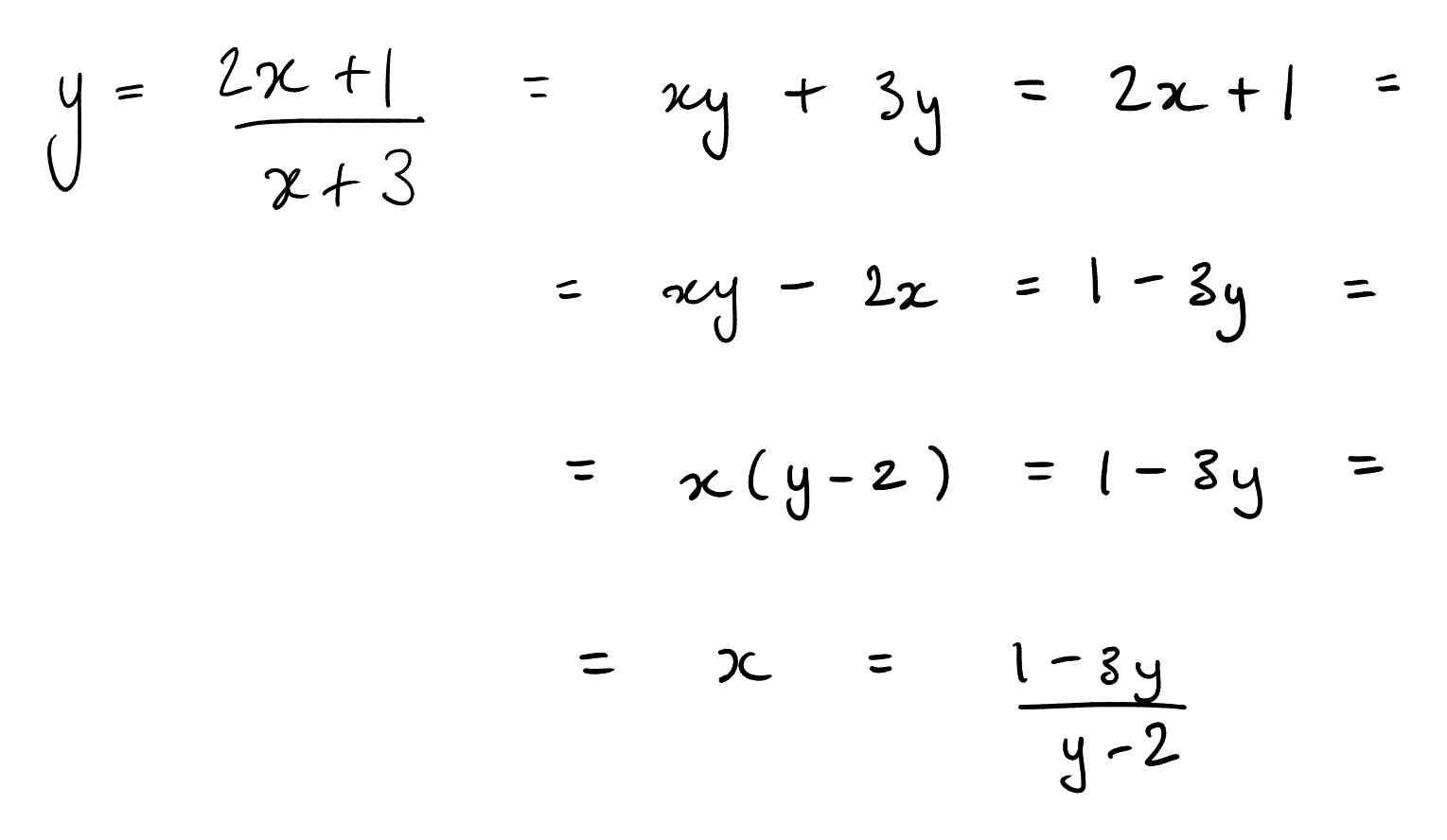
Fig. 2 Question 13#
What changes would you recommend to increase the clarity and accuracy of their work?
(ii) Make \(x\) the subject of the equation \(\displaystyle y=\frac{2x+1}{x+3}\).
You should apply any tips identified in (i), to make your solution as clear as possible.
Make \(x\) the subject of the following equations.
(i) \(y = x+4\),
(ii) \(\displaystyle y = \frac{x+1}{x-2}\),
(iii) \(\displaystyle y + 4 = \frac{x+3}{x-4}\),
(iv) \(\displaystyle \frac1y = 2x\),
(v) \(\displaystyle 2y = \frac{x+4}{2x-3}\),
(vi) \(\displaystyle y = \frac{x+1}{x-2} + 5\),
(vii) \(\displaystyle -y = x+4\),
(viii) \(\displaystyle -4y= -\frac{3}{5} +\frac{x+1}{x-2}\),
(ix) \(\displaystyle y = \frac{2}{3} \frac{x+4}{5x+4}\),
(x) \(\displaystyle y= \frac{ax+b}{cx+d}\).
Exactly one of the following answers is correct. Which one?
Solving \(y=\displaystyle\frac{4x-3}{2x+1}-7\) for \(x\), where \(x\neq-\frac12\), gives \(x=\)
(A) \(-10\);
(B) \(\displaystyle -\frac{y+10}{2(y+5)}\) for \(y\neq -5\);
(C) \(\displaystyle \frac{y+10}{2(y+5)}\) for \(y\neq -5\);
(D) \(\displaystyle\frac{10+y}{2(2-y)}\) for \(y\neq 2\).
Simultaneous linear equations#
Solve the following simultaneous equations. Your solution should involve a check.
(i) \(\left\{\begin{array}{rcl} 3x + 11y &=& 3\\ -x+ 4y &=&2\\ \end{array}\right.\)
(ii) \(\left\{\begin{array}{rcl} 5x -3y &=& 1\\ -4x+ 3y &=& 0\\ \end{array}\right.\)
(iii) \(\left\{\begin{array}{rcl} x + 3y &=& 6\\ 2x+ y &=& 4\\ \end{array}\right.\)
(iv) \(\left\{\begin{array}{rcl} 2x + 3y &=& 0\\ 4x+ 8y &=&0\\ \end{array}\right.\)
(v) \(\left\{\begin{array}{rcl} 5x -9y &=& -1\\ 7x+ 4y &=& -18\\ \end{array}\right.\)
(vi) \(\left\{\begin{array}{rcl} 3x + 1y &=& 0\\ 9x+ 3y &=& 0\\ \end{array}\right.\)
Exactly one of the following answers is correct. Which one?
The solution to the simultaneous equations
\[\begin{split} \left\{\begin{array}{rcl} 3x + y &=& 5\\ 2x+ 3y &=& 6 \end{array}\right. \end{split}\]is
(A) \(\displaystyle x=\frac{9}{7}\);
(B) \(\displaystyle y=\frac{8}{7}\);
(C) \(\displaystyle x=\frac{9}{7}\) and \(y=\displaystyle\frac{8}{7}\);
(D) \(\displaystyle x=\frac{9}{7}\) or \(y=\displaystyle\frac{8}{7}\).
Chapter 2#
Quadratics and quadratic equations#
Factorise the following.
(i) \( x^2 + 8x + 7\),
(ii) \(x^2-16x+15\),
(iii) \(x^2 - 4x - 12\),
(iv) \(12x^2 + 5x - 3\),
(v) \(9x^2 - 15x + 4\),
(vi) \(x^2 - 5x + 4\),
(vii) \(15x^2 - 8x + 1\),
(viii) \(- 9x^2 - 9x + 4\),
(ix) \(10x^2 - 11x + 3\),
(x) \(12x^2 + 11x + 2\),
(xi) \(15x^2 + 7x - 4\),
(xii) \(12x^2 - 29x - 60\),
(xiii) \(x^2-36\),
(xiv) \(x^2-16\),
(xv) \(x^2 -2\),
(xvi) \(-x^2 + 12x - 35\),
(xvii) \(30x^2 - 300x - 720\),
(xviii) \(-6x^2 + x + 1\),
(xix) \(132x^2 + 1584x + 4752\).
Exactly one of the following answers is correct. Which one?
The quadratic \(q(x)=420420x^2-390390x+90090\) factorises as \(q(x)=\)
(A) \(\displaystyle 30030(2x-1)(7x+3)\);
(B) \(\displaystyle -30030(2x-1)(7x-3)\);
(C) \(30030(2x-1)(7x-3)\);
(D) \(\displaystyle 30030(2x+1)(7x+3)\).
For each of the following quadratics \(q(x)\)
(a) complete the square;
(b) solve \(q(x) = 0\) using the completed square form;
(c) find the discriminant \(\Delta\);
(d) check your answer to (b) by using the Quadratic Formula.
(i) \(q(x) = x^2 +3x -4 \),
(ii) \(q(x) = x^2 -4x +1\),
(iii) \(q(x) = 3x^2 - 6x +2\),
(iv) \(q(x) = -x^2 +3x +2\),
(v) \(q(x) = -3x^2 + 2x + 24\),
(vi) \(q(x) = 4x^2 -16\),
(vii) \(q(x) = x^2 -2x +1\),
(viii) \(q(x) = x^2 +2x +1\),
(ix) \(q(x) = 4 - x - 4x^2\),
(x) \(q(x) = 2x^2 - 25x - 4\),
(xi) \(q(x) = 24x^2 - 48x - 12\),
(xii) \(q(x) = ax^2 + bx + c\).
Exactly one of the following answers is correct. Which one?
The completed square form of
\[ q(x)=-2x^2+3x+4 \]is \(q(x)=\)
(A) \(\displaystyle -2\left(x+\frac{3}{4}\right)^2 + \frac{41}{8}\);
(B) \(\displaystyle \left(x-\frac{3}{4}\right)^2 - \frac{41}{16}\);
(C) \(\displaystyle \left(-2x+\frac{3}{2}\right)^2 + \frac{41}{8}\);
(D) \(\displaystyle -2\left(x-\frac{3}{4}\right)^2 + \frac{41}{8}\).
Exactly one of the following answers is correct. Which one?
The solutions to \(14x^2-13x+3=0\) are
(A) \(\displaystyle x=-\frac{1}{2}\) or \(x=\frac{3}{7} \);
(B) \(\displaystyle x=\frac{1}{2}\) or \(x=\frac{3}{7}\);
(C) \(\displaystyle x=-\frac{1}{2}\) or \(x=-\frac{3}{7}\);
(D) \(\displaystyle x=\frac{1}{2}\) or \(x=-\frac{3}{7}\).
Sketching quadratic graphs#
For each of the following quadratics find the discriminant \(\Delta\), complete the square and sketch the graph of \(y = q(x)\) indicating the maximum or minimum point and the points where it crosses the \(x\)- and \(y\)-axes.
(i) \(q(x) = x^2-6x+2\),
(ii) \(q(x) = 2x^2-4x+3\),
(iii) \(q(x) = -3x^2+6x -2\),
(iv) \(q(x) = 3x^2-12x+12\).
Exactly one of the following answers is correct. Which one?
The graph
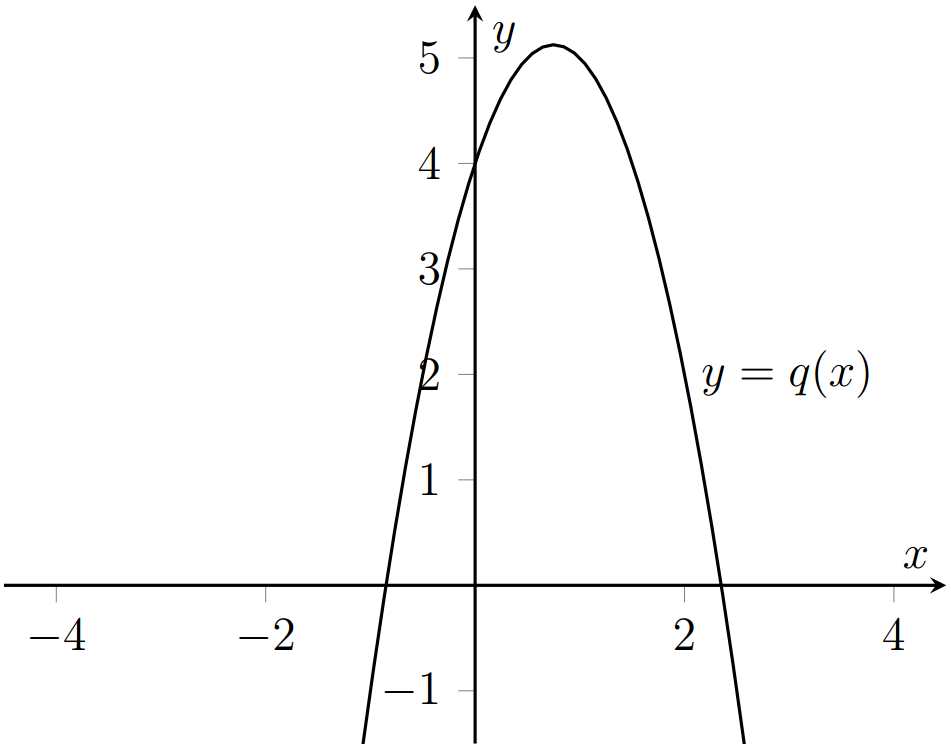
Fig. 3 Mystery graph#
has equation
(A) \(y=x^2+3x+4\);
(B) \(y=5x+4\);
(C) \(y=-2x^2+3x+4\);
(D) \(y=-x^2+3x-4\).
Quadratic simultaneous equations#
Solve the following quadratic simultaneous equations and check your answers.
(i) \(\left\{\begin{array}{rcl} y&=& 11x -3\\ y&=& 10x^2\\ \end{array}\right.\),
(ii) \(\left\{\begin{array}{rcl} -y&=&2\\ y&=&9x^2+9x\\ \end{array}\right.\),
(iii) \(\left\{\begin{array}{rcl} y&=& 3x^2+4x-7\\ y&=& -6x^2-11x-11\\ \end{array}\right.\),
(iv) \(\left\{ \begin{array}{rclcc} x^2 + xy + y^2 &=&1 \\ x+ 2y + 1 &=& 0\\ \end{array}\right.\).
Exactly one of the following answers is correct. Which one?
The solutions to the simultaneous equations
\[\begin{split} \left\{ \begin{array}{rclcc} \displaystyle \frac{1}{x} &=& \displaystyle \frac{4}{y}+\frac{7}{xy} \\[10pt] \displaystyle \frac{y}{x}-3 &=& \displaystyle x+\frac{5}{x} \end{array}\right.. \end{split}\]are
(A) \(\displaystyle x=-1 \text{ or } x=2\) ;
(B) \(\displaystyle y=15 \text{ and } x=2\);
(C) \(\displaystyle x=-1, x=2 \text{ and } y=3,y=15\)
(D) \(\displaystyle (x=-1 \text{ and } y=3) \text{ or } (x=2 \text{ and } y=15)\).
Linear and quadratic inequalities#
Solve the following linear inequalities and indicate your answer on the real line:
(i) \(-x +1 \leq 0\);
(ii) \(-6x+1 < 0\);
(iii) \(x +\sqrt{2} \geq 0\);
(iv) \(24x+4 > 0\);
(v) \(-x-3 < x+2\);
(vi) \(-6x -4 > 3x +2\).
Exactly one of the following answers is correct. Which one?
The solution to \(-3x+4\geq x+1\) is
(A) \(\displaystyle x\geq\frac{3}{4}\);
(B) \(\displaystyle x>\frac{3}{4}\);
(C) \(\displaystyle x\leq\frac{3}{4}\);
(D) \(\displaystyle x<\frac{3}{4}\).
For each of the following quadratics \(q(x)\), find solutions to the inequalities \(q(x) > 0\), \(q(x) < 0\), \(q(x) \geq 0\) and \(q(x) \leq 0\). You should use a mixture of methods (algebraic and graph sketching).
(i) \(q(x) = 12x^2 + 5x - 3\);
(ii) \(q(x) = x^2 - 5x + 4\);
(iii) \(q(x) = - 9x^2 - 9x + 4\);
(iv) \(q(x) = 10x^2 - 11x + 3\);
(v) \(q(x) = x^2-16\);
(vi) \(q(x) = x^2 -2\).
Solve the following inequalities. Remember to take care when multiplying by expressions that may be negative or positive.
(i) \(\displaystyle\frac{x+1}{3x-2}\geq 0\),
(ii) \(\displaystyle\frac{3x-1}{2x+1}<2\).
Chapter 3#
Polynomials#
Decide which of the following are polynomials (over the real numbers) in the variable \(x\) and which are not, giving reasons for your answer.
(i) \(\frac{1}{3}x^7 + \frac{2}{9}x^9\)
(ii) \(x^{\frac{1}{2}}\)
(iii) \(2^x+x^2\)
(iv) \(y^2x^{-1}\)
(v) \(0\)
(vi) \(x^{16}+x^{15}+x^{14}+\ldots+x+1+x^{-1}+x^{-2}\)
(vii) \(x^2+x-\pi x\)
(viii) \(4x^7-x^3+29x^1\)
(ix) \(\displaystyle\sqrt{x}\)
(x) \(\displaystyle\sqrt[4]{x}\)
(xi) \(x^2+x-x^{\frac{3}{4}}\)
(xii) \(\displaystyle\frac{4}{x}\)
(xiii) \((3-2i)x^9 \text{ where } i^2=-1\)
(xiv) \(15\)
For each of the following polynomials give the degree, the coefficient of \(x^3\), the coefficient of \(x\), the leading term and the constant term.
(i) \(x^3 - x^2 +1\),
(ii) \(2x^3 -3x +2\),
(iii) \(1-x-x^2-x^3-x^4-x^5\),
(iv) \((x-2)^2+1\),
(v) \(4x^4 +3x^3-2x^2 +x\),
(vi) \(\frac{1}{4}x^4 - \frac{1}{5}x^5 + x^3 -x^2+\sqrt{2}\).
In each of the following, find \(f(x) + g(x)\), \(f(x) - g(x)\) and the coefficient of \(x^3\) in \(f(x)g(x)\).
(i) \(f(x) = 3x^2 + 12x -14\) and \(g(x) = 1-x;\)
(ii) \(f(x) = 4x^2 -5x +1\) and \(g(x) = x^2-x+1.\)
In each of the following, expand \(p(x) - q(x)r(x)\) and find the coefficient of \(x^3\) in \(p(x)q(x)\).
(i) \(p(x) = 5x^4+3x^3+2x^2+x+1,\quad q(x) = x^2-x-1,\quad r(x) = x-3\);
(ii) \(p(x) = x^3-x+1,\quad q(x) = -x^2-1, \quad r(x) = x^3-2x^2-3\).
Exactly one of the following answers is correct. Which one?
Let \(p(x)=3x^2+x-1\), \(q(x)=-x^2+x+2\) and \(r(x)=x^2+1\).
Then \(p(x)q(x)-r(x)=\)
(A) \(\displaystyle 3x^2+2x+2\);
(B) \(\displaystyle x^4-x^3+2x^2-3\);
(C) \(\displaystyle -3x^4+2x^3+7x^2+x-1\);
(D) \(-3x^4+2x^3+7x^2+x-3\).
In each of the following find \(f(g(x))\), \(g(f(x))\) and \(f(x)g(x)\).
(i) \(f(x) = x^3 + x^2 + 1\) and \(g(x) = x-2.\)
(ii) \(f(x) = x^3 + x^2 + 1\) and \(g(x) = x^2-2x.\)
(iii) \(f(x) = 3x^2 -x\) and \(g(x) = x+h.\)
(iv) \(f(x) = 4x^2 + 5x -1\) and \(g(x) = x+1.\)
Exactly one of the following answers is correct. Which one?
Let \(p(x)=3x^2+x-1\), \(q(x)=-x^2+x+2\). Then \(p((q(x))=\)
(A) \(\displaystyle 3x^4-6x^3-10x^2+13x+13\);
(B) \(\displaystyle 3x^4-6x^3-10x^2+11x+9\);
(C) \(-9x^4-6x^3+8x^2+3x\);
(D) \(-3x^4+2x^3+8x^2+x-2\).
Polynomial division#
(i) Find the quotient and the remainder when \(x^3 -2x^2 +x -1\) is divided by \(x-1.\)
(ii) Find \((2x^4 - x + 1) \div (x^2 +1).\)
(iii) Find the quotient and the remainder on dividing \(3x^3-2x^2 +1\) by \(2x +1.\)
Find the quotient and the remainder when \(4x^4 - 8x^3 - 4x^2 + 7x + 4\) is divided by \(4x^3 -4x -1\).
Exactly one of the following answers is correct. Which one?
The quotient \(q(x)\) and remainder \(r(x)\) when \(4x^4+6x^2+3x^3+x+3\) is divided by \(x^2+1\) are
(A) \( \displaystyle q(x) = -2x+1\); and \(r(x) = 4x^2+3x+2\)
(B) \(\displaystyle q(x) = 4x^2+3x+2\); and \(r(x) = -2x+1\)
(C) \(\displaystyle q(x) = -x^2+3x-2\); and \(r(x) = 1\)
(D) \(\displaystyle q(x) = 4x^2+3x+2\); and \(r(x) = -2x^2+x-1\).
Factor theorem#
Factorise \(f(x) = x^3 -2x^2 -5x +6\). Hence, or otherwise, find all the solutions to \(f(x) = 0\).
Factorise the following polynomials \(p(x)\) and hence solve \(p(x) = 0.\)
(i) \(\displaystyle p(x) = x^2 - 25\),
(ii) \(\displaystyle p(x) = x^4 - 16\),
(iii) \(\displaystyle p(x) = x^3 - 7 x + 6\),
(iv) \(p(x) = x^3 - 14 x^2 + 11 x + 26\),
(v) \(p(x) = x^3 + 4 x^2 + x - 6\),
(vi) \(p(x) = x^4 - 8 x^2 + 16\),
(vii) \(p(x) = x^4 - x^3 - 7 x^2 + x + 6\),
(viii) \(p(x) = x^4 - 2 x^3 - 3 x^2\).
Exactly one of the following answers is correct. Which one?
The polynomial \(p(x) = 2x^6 - 3x^5 - 10x^4 + 4x^3 - 6x^2 + 7x + 6\) factors fully over the real numbers as \(p(x) =\)
(A) \((x^2 + 1)(x - 1)(2x + 1)(x + 2)(x + 3)\);
(B) \((x^2 + 1)(x - 1)(2x + 1)(x + 2)(x - 2)\);
(C) \((x^2 + 1)(x - 1)(2x + 1)(x + 2)(x - 3)\);
(D) \((x^2 + 1)(x - 1)(3x + 1)(x + 2)(x - 3)\)
Remainder theorem#
Using the Remainder Theorem, find the remainders when
(i) \(x^3 +3x^2 -4x +2\) is divided by \(x-1;\)
(ii) \(x^3 -2x^2 +5x +8\) is divided by \(x-2;\)
(iii) \(x^5 +x -9\) is divided by \(x+1;\)
(iv) \(x^3 +3x^2+3x+1\) is divided by \(x+2;\)
(v) \(4x^3 -5x+4\) is divided by \(2x-1;\)
(vi) \(4x^3 +6x^2 +3x+2\) is divided by \(2x+3.\)
Find the remainder when \(3x^5 - 4x^4 + x^3 - x^2 + 3x - 1\) is divided by \(x^2 + x - 2\). [Hint: Mimic the proof of the remainder theorem, but using a different expression for \(r(x)\).]
Chapter 4#
Functions, domains and rules#
For each of functions \(f\) given below, the domain of \(f\) is the set of all \(x\) for which \(f(x)\) is defined. In each case find the domain of \(f\).
(i) \(f(x)=x^2\),
(ii) \(f(x) = \sqrt{x-2}\),
(iii) \(f(x) = \frac1{x-2}\),
(iv) \(f(x) = \frac{\sqrt{x-2}}{x+2}\),
(v) \(f(x) = \sqrt{(x-2)(x+2)}\),
(vi) \(f(x) = \frac1x - \sqrt{(x-4)(x-1)}\),
(vii) \(f(x) = \frac{\sqrt{x}}{x^2+2x+1}\),
(viii) \(f(x) = \frac{\sqrt{(x-2)(x+3)}}{x^2+1}\).
Exactly one of the following answers is correct. Which one?
The domain of
\[ f(x)=\frac{1}{\sqrt{x^2-1}}+\frac{1}{\sqrt[3]{(x+1)(x-1)(x+2)}} \]is all the real numbers for which \(f(x)\) is defined.
Thus the domain of \(f(x)\) is
(A) \(\{x\in\mathbb{R}:x>1 \text{ or } -2<x<-1\}\);
(B) \(\{x\in\mathbb{R}:x>1\}\);
(C) \(\{x\in\mathbb{R}:x>1, x<-1, x\neq -2\}\);
(D) \(\{x\in\mathbb{R}:x\geq 1\}\) .
In each of the following give two functions \(u(x)\) and \(g(x)\) (which are not the identity) such that \(f(x) = g(u(x))\).
(i) \(f(x)= (2x+3)^2\);
(ii) \(f(x)= 2(3x+4)^4\);
(iii) \(f(x)= \displaystyle\frac{1}{3x+2}\);
(iv) \(f(x)= \displaystyle\frac1{(2x+3)^2}\);
(v) \(f(x)= \displaystyle\frac1{\sqrt{3x+1}}\);
(vi) \(f(x)= \displaystyle\frac1{(2x-1)^\frac{2}{3}}\);
The range of a function#
For each of the following quadratics find the range when
(a) the domain is \(\mathbb{R}\) and
(b) the domain is restricted to \(\{ x \in \mathbb{R} : -2 \leq x < 2\}.\)
(i) \(q(x) = x^2 +3x -4\),
(ii) \(q(x) = x^2 -4x +1\),
(iii) \(q(x) = 3x^2 - 6x +2\),
(iv) \(q(x) = -x^2 +3x +2\),
(v) \(q(x) = -3x^2 + 2x + 24\),
(vi) \(q(x) = 4x^2 -16\).
Inverse functions#
For each of the following state the domain of \(f\), find \(f^{-1}(x)\) and give the domain of \(f^{-1}\).
(i) \(f(x) = \displaystyle \frac{3x+2}{3-x} +2\),
(ii) \(f(x) = \displaystyle \frac{3x-4}{2-3x} -2\),
(iii) \(f(x) = \displaystyle \frac{2}{3-x} +1\),
(iv) \(f(x) = \displaystyle \frac{3x+2}{3-2x} + \frac{3}5\).
Exactly one of the following answers is correct. Which one?
The inverse of \(f(x)=\frac{2x+2}{x-1}-3\) is \(f^{-1}(x)=\)
(A) \(\displaystyle \frac{5+x}{1+x} \text{ for } x\neq -1\);
(B) \(\frac{x+3}{1-x} \text{ for } x\neq 1\);
(C) \(\frac{5+x}{1+x}\);
(D) \(\displaystyle \frac{x-1}{1+x} \text{ for } x\neq -1\).
For each of the following functions, work out how to see the function as a product, a quotient, a function of a function, both, a standard function or something else. Note: We will need this when we do differentiation and integration.
(i) \(\displaystyle f(x) = \frac{3x+2}{3-x}\),
(ii) \(\displaystyle f(x) = \left(\frac{3x-4}{2-3x}\right)^\frac12\),
(iii) \(f(x) = \sin (2x)\),
(iv) \(\displaystyle f(x) = (3x+2)\cos (3-2x) + \frac{3}5\),
(v) \(\displaystyle f(x) = \tan(x)\),
(vi) \(\displaystyle f(x) = \cos^3 (3-2x) + \frac{3}5\),
(vii) \(\displaystyle f(x) = (2x)^3(5x - 3)^9\),
(viii) \(\displaystyle f(x) = (3x+2)+ (3-2x) + \frac{3}5\),
(ix) \(\displaystyle f(x) = \sin(x) + 2\cos x\),
(x) \(\displaystyle f(x) = \frac1 {x^2 +1}\),
(xi) \(\displaystyle f(x) = \sin (2x)\),
(xii) \(\displaystyle f(x) = (3x+2)^{\frac{3}{4}}\),
(xiii) \(\displaystyle f(x) = \sin^{-1}(x)\),
(xiv) \(\displaystyle f(x) = \cos^{-1} (3-2x) + \frac{3}5\).
Graph sketching using graphical transformations#
Sketch the graphs of the following functions.
You should sketch the graph in such a way that it is clear how to extend your picture and mark on all important points. Further, find the domain and the range of each function.
(i) \(y = \sin x\),
(ii) \(y = \sin(2x)\),
(iii) \(\displaystyle y = \sin\left(x+\frac{\pi}{2}\right)\),
(iv) \(y= \sin x + 3\),
(v) \(y = 3\sin x\),
(vi) \(\displaystyle y = 3\sin(2x)\),
(vii) \(y = \cos x\),
(viii) \(y = -\cos x\),
(ix) \(y = \cos(x + \pi)\),
(x) \(y = \cos\left(x+\frac{\pi}{2}\right) - 1\),
(xi) \(y = \cos(3x)\),
(xii) \(y = \cos\left(\frac{x}{2}\right)\),
(xiii) \(y = |x|\),
(xiv) \(y = |x-1|\),
(xv) \(y = |x|+2\),
(xvi) \(y = 2|x|\),
(xvii) \(y = x^2 + 3x - 4\),
(xviii) \(y = -x^2 -4\),
(xix) \(y = 2x^2 + 4x -5\),
(xx) \(y = x^4\).
Sketch the graphs of the following functions with their given domains. What is the range of each function?
(i) \(y=6+2\cos(2x-\pi)\) with domain \(\{x\in\mathbb{R}:0\leq x\leq 2\pi\}\).
(ii) \(\displaystyle y=\frac{1+\cot(x)}{2}\) with domain \(\displaystyle\{x\in\mathbb{R}:-\frac{\pi}{2}< x<\frac{3\pi}{2}, x\neq 0 \text{ and }x\neq \pi\}\).
(iii) \(y=3-|2x+1|\), with domain \(\{x\in\mathbb{R}:-1\leq x\leq 1\}\)
Exactly one of the following answers is correct. Which one?
We have that
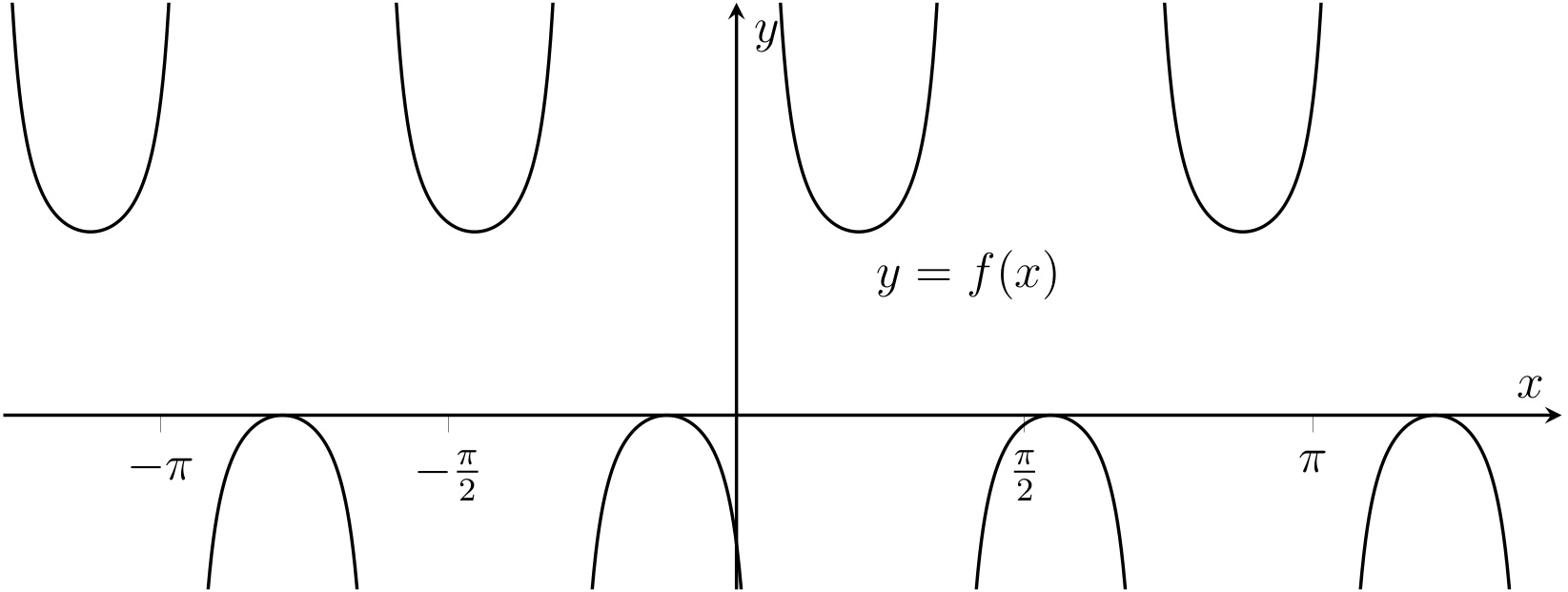
is a sketch of the graph \(y=\)
(A) \(\tan(3x-2)\) for \(x\neq \frac{2}{3}+\frac{\pi}{6}+\frac{\pi k}{3}, k\in\mathbb{Z}\).
(B) \(\sec 3x-1\) for \(x\neq \frac{\pi}{6}+\pi k, k\in\mathbb{Z}\).
(C) \(\sec(3x-2)+1\) for \(x\neq \frac{2}{3}+\frac{\pi}{6}+\frac{\pi k}{3}, k\in\mathbb{Z}\).
(D) \(\sec(3x)-1\).
Chapter 5#
Partial fractions#
Express the following as partial fractions:
(i) \(\displaystyle \frac{x - 10}{(x + 2)(x - 2)}\),
(ii) \(\displaystyle \frac{4x - 3}{(x - 2)^2}\),
(iii) \(\displaystyle\frac{x^2 - x - 5}{(x^2 + 4)(x - 1)}\),
(iv) \(\displaystyle \frac{3x^3 - 13x^2 + 11x - 7}{(x^2 + 1)(x - 3)^2}\),
(v) \(\displaystyle\frac{x^2 + 4x + 6}{(x + 1)^3}\),
(vi) \(\displaystyle \frac{5x^2 - 24x + 19}{(x + 1)(x - 3)^2}\),
(vii) \(\displaystyle\frac{2x+2}{(x+1)(x^2+3)}\),
(viii) \(\displaystyle \frac{5x^2 - 9x + 6}{(x^2 + 3)(x - 3)}\),
(ix) \(\displaystyle\frac{3x^3 - x + 1 - x^2}{(x^2 + 1)(x - 1)^2}\),
(x) \(\displaystyle \frac{3x^3 + 5x + 2}{(x^2 + 1)(x^2 + 3)}\),
(xi) \(\displaystyle \frac{8x^3 + 5x^2 - 29x - 2}{(x-2)(x-1)(x + 1)(x + 2)}\),
(xii) \(\displaystyle \frac{3x^{4} - 8x^3 + 27x^2 - 37x + 54}{(x^2 + 4)(x^2+5)(x-2)}\).
Express the following as partial fractions:
(i) \(\displaystyle \frac{x^3 + 2x^2 + 1}{x + 2}\),
(ii) \( \displaystyle \frac{x^5 - 4x^4 + 4x^3+2x^2-6x+5}{(x-2)^2}\),
(iii) \(\displaystyle\frac{2x^4-x^3-3x^2-x-7}{(x^2+1)(x+1)}\),
(iv) \(\displaystyle \frac{x^9 + 5x^7 + 1}{x^2 + 5}\),
(v) \(\displaystyle \frac{x(x^3 - 5x^2 + 5x - 9)}{(x^2 + 3)(x - 3)}\),
(vi) \( \displaystyle \frac{x(2x^3 - x + 2x^2 + 2)}{2x^2 + 1}\).
For each of the following write up to and including to Step 6 of 5.4 Recipe for Partial Fractions (link redirects to the lecture notes).
THere is no need try to fully express each fraction as a partial fraction as this will be very difficult.
(i) \(\displaystyle \frac{1}{(x^2-1)(x^2+4)(x^7)(x-1)}\)
(ii) \(\displaystyle \frac{3x}{(x^2+2)(x^2+5)(x-3)^5(x+2)^2}\)
(iii) \(\displaystyle \frac{x^7}{(x-1)^4(x+2)^3(x^2+2x+1)}\)
(iv) \(\displaystyle \frac{1}{(1-x^2)(x^2+x+5)(x^2-2x-1)(x+2)^3(x-2)(x+2)(x-3)}\)
Exactly one of the following answers is correct. Which one?
As partial fractions,
\[ \frac{x^5-4x^4-x^3-3x^2+5x+2}{x^2(x+1)(x+2)(x^2+1)} = \](A) \(\displaystyle \frac{1}{x}+\frac{1}{x^2}+\frac{1}{x+1}-\frac{1}{x+2}+\frac{2x-3}{x^2+1}\);
(B) \(\displaystyle \frac{1}{x}-\frac{1}{x+1}-\frac{1}{x+2}+\frac{2x-3}{x^2+1}\);
(C) \(\displaystyle \frac{1}{x}+\frac{1}{x^2}-\frac{1}{x+1}-\frac{1}{x+2}+\frac{2x-3}{x^2-1}\);
(D) \(\displaystyle \frac{1}{x}+\frac{1}{x^2}-\frac{1}{x+1}-\frac{1}{x+2}+\frac{2x-3}{x^2+1}\).
Exactly one of the following answers is correct. Which one?
As partial fractions,
\[ \frac{2 + x - 7x^2 - 2x^3 + 10x^4 + 12x^5 + 10x^6 + 7x^7 - x^9 + 2x^{16} + 3x^{17} + 3x^{18} + 3x^{19} + x^{20}}{x^2(x+1)(x+2)(x^2+1)} = \](A) \(\displaystyle x^{14} - x^3 + 3x^2 + x + 1 - \frac{1}{x}+\frac{1}{x^2}-\frac{1}{x+1}-\frac{1}{x+2}+\frac{2x-3}{x^2+1}\)
(B) \(\displaystyle -\frac{1}{x}+\frac{1}{x^2}-\frac{1}{x+1}-\frac{1}{x+2}+\frac{2x-3}{x^2+1}\)
(C) \(\displaystyle x^{14} - x^3 + 3x^2 + x + 1 - \frac{1}{x}+\frac{1}{x^2}-\frac{1}{x+1}+\frac{1}{(x+1)^2}-\frac{1}{x+2}+\frac{3}{x-1}\)
(D) \(\displaystyle x^{13} - x^3 + 3x^2 + x + 1 - \frac{1}{x}+\frac{1}{x^2}-\frac{1}{x+1}-\frac{1}{x+2}+\frac{2x-3}{x^2+1}\).