
Semester 2 Solutions#
Chapter 6#
Differentiation from first principles#
1. Here is a picture:
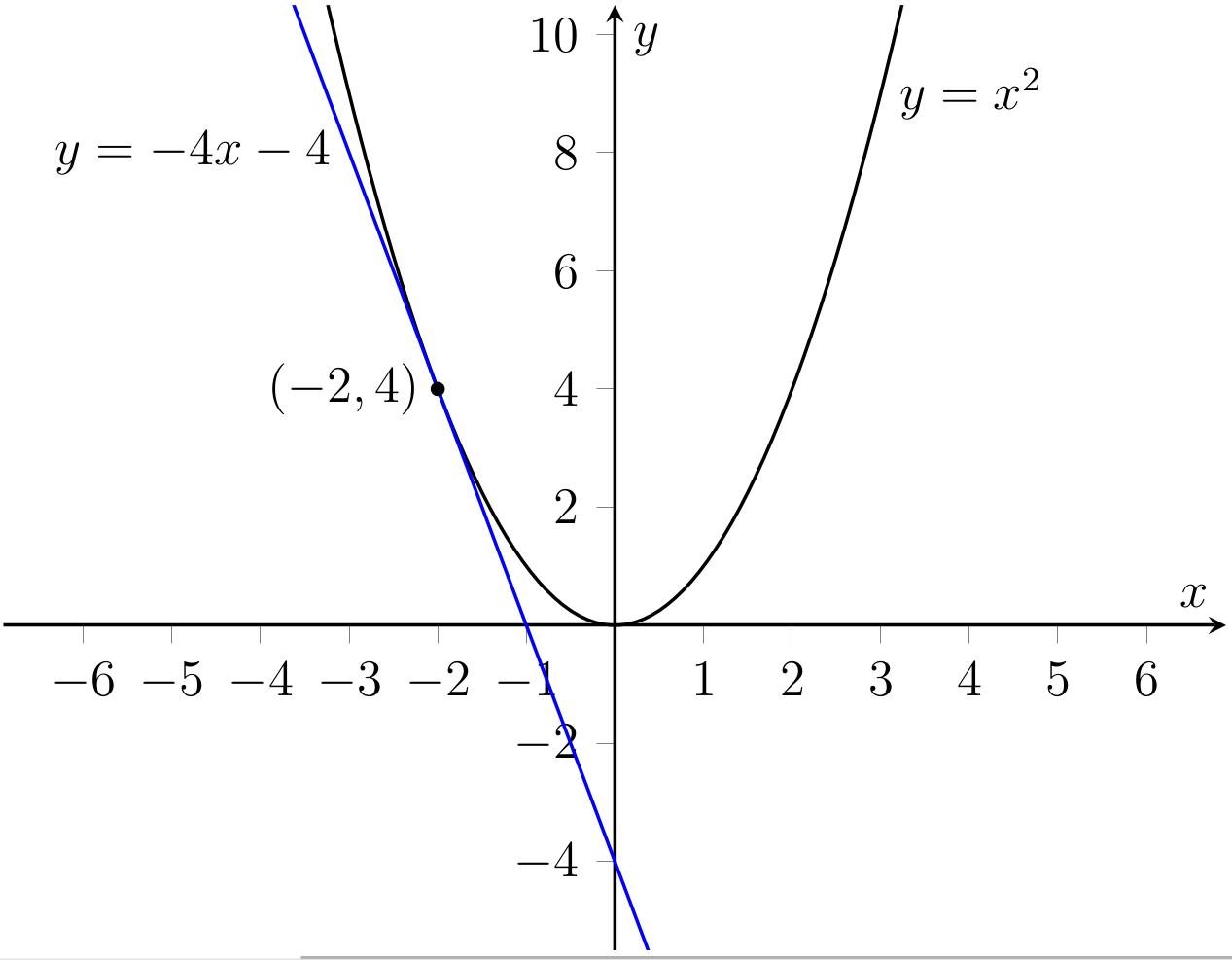
Fig. 46 Graph of \(y=x^2\), with tangent at \((-2,4)\) given by equation \(y=-4x-4\).#
The gradient of the tangent at \((-2,4)\) is \(-4\). (The formula from lectures gives the gradient at the point \((x,x^2)\) as \(2x\).)
2. (i) If we put \(x+h\) into our function \(f\) we get that
Thus we get
as \(h \rightarrow 0\). Hence, \(f'(x)=16x\) and the gradient of \(y=8x^2+2\) at the general point \((x,8x^2+2)\) is \(16x\).
(ii) If we put \(x+h\) into our function \(f\) we get that
Thus we get
as \(h \rightarrow 0\). Thus \(f'(x)=16x\).
(iii) Differentiating \(f(x)=8x^2+6\) would give the result \(16x\), as for parts (i) and (ii). The constant always vanishes when differentiating.
3. Let \(f(x)=4x^2 -4x + 4\). Then
Thus
Hence the gradient of \(y=4x^2 - 4x + 4\) at the typical point \((x,4x^2 - 4x + 4)\) is \(8x - 4\).
4. (i) We have
Thus, using the formula for differentiation we get
as \(h \rightarrow 0\). Thus \(\displaystyle f'(x)=-\frac{1}{x^2}\).
(ii) We have
Thus, using the formula for differentiation we get
as \(h \rightarrow 0\). Thus \(\displaystyle f'(x)=-\frac{2}{x^3}\).
Differentiating powers#
5. Applying Theorem 6.2.8 from the notes, we get the following answers.
(i) \(f'(x) = -2x^{-2-1} = -2x^{-3}\).
(ii) Note that \(f(x) = \sqrt{x} = x^{\frac{1}{2}}\). Thus
Note that this derivative is not defined when \(x = 0\).
(iii) \(f'(x) = -\frac{3}{4} x^{-\frac{3}{4} -1} = -\frac{3}{4}x^{-\frac{7}{4}}\).
6. Simplifying, we have
Thus we get
7. Simplifying, we have
Thus
8. (i) \(f(x)=2x(3x^2-4)=6x^3-8x\) so \(f'(x)=3.6x^2-8=18x^2-8\).
(ii) \(g\displaystyle (x)=\frac{10x^5+3x^4}{2x^2}=\frac{x^4(10x+3)}{2x^2}=\frac{x^2(10x+3)}{2}=5x^3+\frac{3}{2}x^2\). Thus \(g'(x) = 15x^2 + 3x\).
(iii) \(h(t) = (t+1)(t-2)=t^2-t-2\) so \(h'(t)=2t-1\).
(iv) \(\displaystyle k(s) = \frac{2s^3-s^2}{3s}=\frac{2}{3}s^2-\frac{1}{3}s\) so \(k'(s)=\frac{4}{3}s -\frac{1}{3}\).
Tangents and normals#
9. We first check whether \(P\) and \(Q\) actually lie on the curve. For \(P=(1,-3)\), we substitute \(x=1\) into the equation for the curve:
This means \(P\) does not lie on the curve, and so there cannot be a tangent or normal line there.
For \(Q=(-1,6)\), we instead sub in \(x=-1\). This gives
and so \(Q\) does lie on the curve.
To calculate equations for the tangent and normal at \(Q\), we differentiate. Let \(f(x)=2x^2 -3x - \frac{1}{x}\). Then \(f'(x) = 4x - 3 +\frac{1}{x^2}\) and so \(f'(-1) = -4 -3 +\frac{1}{(-1)^2} = -6\).
Hence the tangent at \(Q\) has equation
for some constant \(c\). As the tangent at \(Q\) goes through \(Q\) we have \(6 = -6\times (-1) + c\) and so \(c = 0\). Thus
is the equation of the tangent at \(Q\).
Next we consider the normal at \(Q\), \(y=mx+k\) for some \(m\) and \(k\). As the normal at a point is perpendicular to the tangent at the point, we have \(m\times -6 = -1\) which means \(m=\frac{1}{6}\). This means the normal at \(Q\)
This line also passes through \(Q\), and hence \(6 = \frac{1}{6}\times(-1) + k\), so \(k=6+\frac{1}{6} = \frac{37}{6}\). Therefore we get
for the equation of the normal at \(Q\).
10. Using the method from the notes (or the solution above) we get the following.
(i) \(\frac{dy}{dx} = 2x\); at \(x = 2\) we have \(y=4\); \(t(x) = 4x-4\) and \(n(x) = -\frac{1}{4}x+\frac{9}{2}\).
(ii) \(\frac{dy}{dx} = 6x\); at \(x = 4\) we have \(y=50\); \(t(x) = 24x -46\),and \(n(x) = -\frac{1}{24}x +\frac{301}{6}\).
Small changes formula#
11. Let \(A = 4\pi r^2\) be the surface area of the sphere in \(\mbox{cm}^2\). Then \(\frac{dA}{dr} =8\pi r\). The small change in \(A\) when the radius changes from \(10\)cm to \(10.1\)cm is then given by
Thus the increase in the surface area is approximately \(8\pi~\mbox{cm}^2\).
12. The volume of the cylinder (in \(\mbox{cm}^2\)) is given by \(V = \pi r^2 h\) where \(h\) is the height and \(r\) is the radius (in \(\mbox{cm}\)). Thus \(\frac{dV}{dr} = 2\pi rh\). Hence the change in \(V\) when the radius changes from 4cm to \(4.02\)cm and the height is \(10\)cm is given by
Thus the volume increases by \(\frac{40}{25}\pi~\mbox{cm}^3\).
13. Let \(A = \pi r^2\) be the area of the circle, \(r\) being the radius. We write \(\delta A\) for the error in the area and \(\delta r\) for the error in the radius. Then we can use our method for small changes and the formula gives
Dividing through by \(A\) we get
But we know that \(\frac{\delta A}{A}\) is the error in \(A\), which we are told is \(0.02\) (that is, \(2\%\)). Hence, \(\frac{\delta r}{r}= \frac{1}{2}\frac{\delta A}{A}=0.01\). Since \(\frac{\delta r}{r}\) is the fractional error in \(r\), we get that the percentage error in \(r\) is approximately \(1\%\).
Chapter 7#
Stationary points#
14. Differentiating, we find \(\frac{dy}{dx} = 3-2x\) and so \(\frac{dy}{dx} = 0\) if and only if \(x = \frac{3}{2}\). So the stationary point is \(P = (\frac{3}{2}, \frac{9}{4})\). We complete an L-R table.
L |
P |
R |
|
|---|---|---|---|
\(x\) |
\(1\) |
\(\frac{3}{2}\) |
\(2\) |
\(\frac{dy}{dx}\) |
\(1\) |
\(0\) |
\(-1\) |
Gradient |
\(+\)ive |
\(0\) |
\(-\)ive |
So when \(x = \frac{3}{2}\) we have a local maximum, i.e. \(P = (\frac{3}{2}, \frac{9}{4})\) is a local maximum.
15. (i) \(y = x^4\), so \(\frac{dy}{dx} = 4x^3\), and so the only stationary point of the curve \(y = x^4\) is \(P = (0,0)\).
L |
P |
R |
|
|---|---|---|---|
\(x\) |
\(-1\) |
\(0\) |
\(1\) |
\(\frac{dy}{dx}\) |
\(-4\) |
\(0\) |
\(4\) |
Gradient |
\(-\)ive |
\(0\) |
\(+\)ive |
and hence \(P\) is a local minimum.
(ii) \(y=3-x^3\), so \(\frac{dy}{dx} = -3x^2\), and the stationary point is \(P = (0,3)\).
L |
P |
R |
|
|---|---|---|---|
\(x\) |
\(-1\) |
\(0\) |
\(1\) |
\(\frac{dy}{dx}\) |
\(-3\) |
\(0\) |
\(-3\) |
Gradient |
\(-\)ive |
\(0\) |
\(-\)ive |
and hence \(P\) is a point of inflection.
(iii) \(y= x^3(2-x)=2x^3-x^4\), so \(\frac{dy}{dx} = 6x^2-4x^3 = 2x^2(3-2x)\), and so the stationary points are \(P = (0,0)\) and \(Q = (\frac{3}{2}, \frac{27}{16})\).
L |
P |
M |
Q |
R |
|
|---|---|---|---|---|---|
\(x\) |
\(-1\) |
\(0\) |
\(1\) |
\(\frac{3}{2}\) |
\(2\) |
\(\frac{dy}{dx}\) |
\(10\) |
\(0\) |
\(2\) |
\(0\) |
\(-8\) |
Gradient |
\(+\)ive |
\(0\) |
\(+\)ive |
\(0\) |
\(-\)ive |
Hence \(P\) is a point of inflection and \(Q\) is a local maximum.
(iv) \(y=3x^4 +16x^3 +24x^2 +3\), so \(\frac{dy}{dx} = 12x^3 +48x^2 +48x = 12x(x^2 +4x +4) = 12x(x+2)^2\) and thus the stationary points are \(P = (-2,19)\) and \(Q = (0,3)\).
L |
P |
M |
Q |
R |
|
|---|---|---|---|---|---|
\(x\) |
\(-3\) |
\(-2\) |
\(-1\) |
\(0\) |
\(1\) |
\(\frac{dy}{dx}\) |
\(-36\) |
\(0\) |
\(-12\) |
\(0\) |
\(108\) |
Gradient |
\(-\)ive |
\(0\) |
\(-\)ive |
\(0\) |
\(+\)ive |
Hence \(P\) is a point of inflection and \(Q\) is a local minimum.
16. Differentiating, we find
and hence
Differentiating once more we get
17. Let \(y = x\). Then \(\frac{dy}{dx} = 1\) and \(\frac{d^2y}{dx^2} = \frac{d^3y}{dx^3} = \frac{d^4y}{dx^4}= \frac{d^5y}{dx^5}= \frac{d^6y}{dx^6} = 0\).
Let \(y = x^2\). Then \(\frac{dy}{dx} = 2x\), \(\frac{d^2y}{dx^2} = 2\) and \(\frac{d^3y}{dx^3} = \frac{d^4y}{dx^4}= \frac{d^5y}{dx^5}= \frac{d^6y}{dx^6} = 0\).
Let \(y = x^3\). Then \(\frac{dy}{dx} = 3x^2\), \(\frac{d^2y}{dx^2} = 6x\), \(\frac{d^3y}{dx^3}= 6\) and \(\frac{d^4y}{dx^4}= \frac{d^5y}{dx^5}= \frac{d^6y}{dx^6} = 0\).
Let \(y = x^4\). Then \(\frac{dy}{dx} = 4x^3\), \(\frac{d^2y}{dx^2} = 12x^2\), \(\frac{d^3y}{dx^3}= 24x\), \(\frac{d^4y}{dx^4} = 24\) and \(\frac{d^5y}{dx^5}= \frac{d^6y}{dx^6} = 0\).
Let \(y = x^5\). Then \(\frac{dy}{dx} = 5x^4\), \(\frac{d^2y}{dx^2} = 20x^3\), \(\frac{d^3y}{dx^3}= 60x^2\), \(\frac{d^4y}{dx^4} = 120x\), \(\frac{d^5y}{dx^5} = 120\) and \(\frac{d^6y}{dx^6} = 0\).
The general formula is given by
18. First we differentiate to see that \(\frac{dy}{dx} = 4x^3 - 8x^2 +4x = 4x(x^2-2x+1)= 4x(x-1)^2\) and \(\frac{d^2y}{dx^2} = 12x^2 - 16x +4\). Hence, the stationary points are \(P = (0,1)\) and \(Q = (1,4-\frac{8}{3}) = (1,\frac{4}{3})\).
Now at \(x = 0\) we have \(\frac{d^2y}{dx^2} = 4 > 0\) so \((0,1)\) is a local minimum. At \(x=1\) we have \(\frac{d^2y}{dx^2} = 0\) so we need to use a LR-table to determine the nature of the stationary point \(Q\).
L |
Q |
R |
|
|---|---|---|---|
\(x\) |
\(\frac{1}{2}\) |
\(1\) |
\(2\) |
\(\frac{dy}{dx}\) |
\(2\left(-\frac{1}{2}\right)^2\) |
\(0\) |
\(8(1)^2\) |
Gradient |
\(+\)ive |
\(0\) |
\(+\)ive |
So \(Q = \left(1,\frac{4}{3}\right)\) is a point of inflection.
19. (i) \(y' = 3x^2 - 12 = 3(x^2-4)\) and \(y'' = 6x\). Thus the stationary points are \(P = (-2, 16)\) and \(Q = (2,-16)\). Now at \(x = -2\) we have \(y'' = 6(-2) < 0\) so that \(P\) is a local maximum. And at \(x= 2\) we have \(y'' = 6(2) > 0\) so that \(Q\) is a local minimum.
(ii) \(y' = 3x^2 -46x+120 = (3x-10)(x-12)\) and \(y'' = 6x -46\). Thus the stationary points are \(P = (\frac{10}{3}, \frac{4900}{27})\) and \(Q = (12, -144)\). At \(x = \frac{10}{3}\) we have \(y'' = 6\times \frac{10}{3} - 46 = 20 - 46 < 0\) and so \(P\) is a local maximum; and at \(x = 12\) we have \(y'' = 6 \times 12 - 46 = 72 -46 > 0\) so that \(Q\) is a local minimum.
(iii) \(y' = 6t -3t^2 = 3t(2-t)\) and \(y'' = 6 - 6t = 6(1-t)\). Thus the stationary points are \(P = (0,0)\) and \(Q = (2,4)\). At \(t = 0\) we have \(y'' = 6 > 0\) so that \(P\) is a local minimum; and at \(t = 2\) we have \(y'' = 6(1-2) < 0\) so that \(Q\) is a local maximum.
(iv) \(y' = 8x - x^{-2}\) and \(y'' = 8 + 2x^{-3}\). Thus the stationary point is \(P = (\frac{1}{2}, 3)\) and at \(x = \frac{1}{2}\) we have \(y'' = 8 + 2(\frac{1}{2})^{-3} > 0\) so that \(P\) is a local minimum.
Graph sketching using stationary points#
20. Let \(y = f(x) = x^4 - 8x^2 +7\). Then,
The domain of \(f\) is \(\mathbb{R}\).
\(y = (x^2 -1)(x^2-7) = (x-1)(x+1)(x-\sqrt{7})(x+\sqrt{7})\).
This means that the graph crosses the \(x\)-axis at \(x=1,\) \(x=-1,\) \(x = \sqrt{7} \approx 2.6\) and \(x = -\sqrt{7} \approx -2.6\). It crosses the \(y\)-axis when \(x = 0\), that is at the point \((0,7)\).
\(\frac{dy}{dx} = 4x^3 - 16x = 4x(x^2 - 4) = 4x(x-2)(x+2)\) and \(\frac{d^2y}{dx^2} = 12x^2 -16\).
Thus the stationary points are \((-2,-9),\) \((0,7)\) and \((2,-9)\).
At \(x =-2\)we have \(\frac{d^2y}{dx^2} = 24 -16 > 0\) so \((-2,-9)\) is a local minimum.
At \(x = 0\) we have \(\frac{d^2y}{dx^2} = - 16 < 0\) so \((0,7)\) is a local maximum.
At \(x =2\)we have \(\frac{d^2y}{dx^2} = 24 -16 > 0\) so \((-2,-9)\) is a local minimum.
As \(x \rightarrow \infty\) we have \(y \rightarrow \infty\) and as \(x \rightarrow - \infty\) we have \(y \rightarrow \infty\).
A sketch then gives
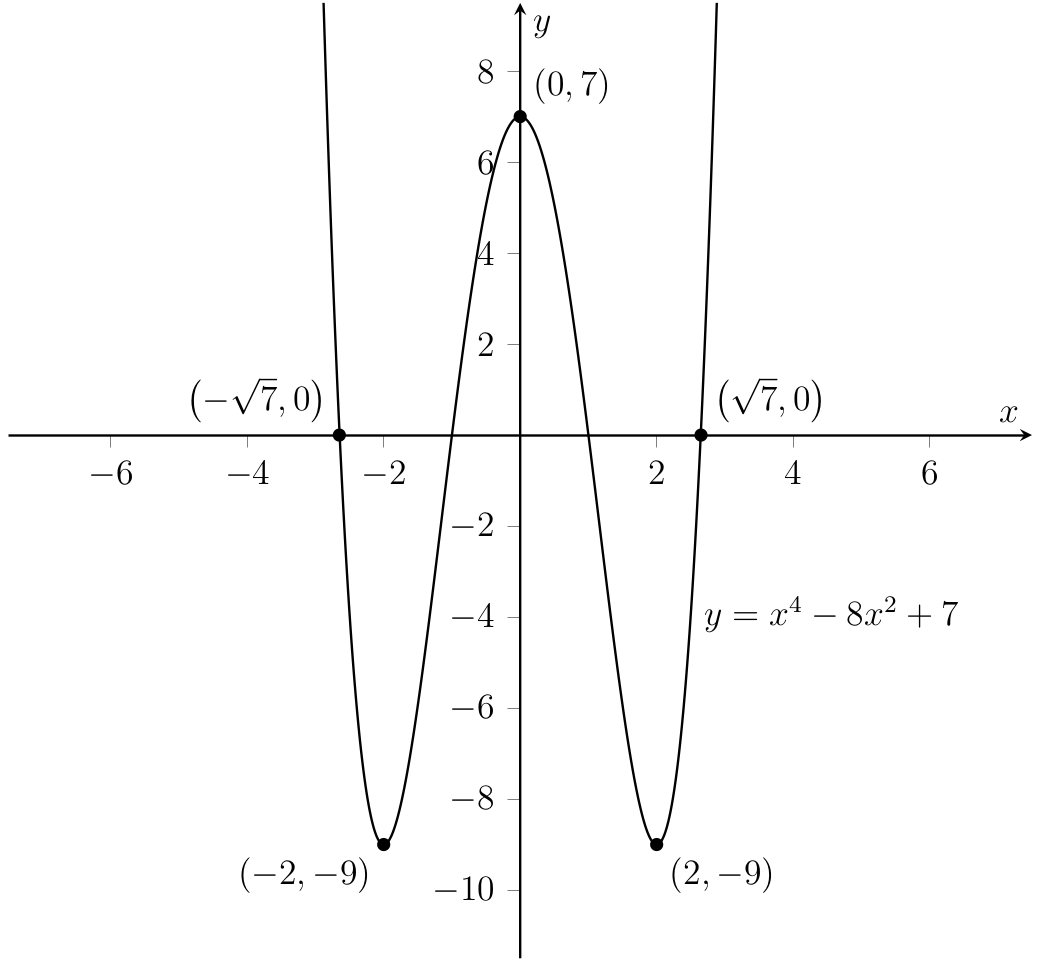
Fig. 47 Graph of \(y=x^4-8x^2+7\).#
21. (i) Let \(y=f(x)=x^3 -2x^2 +x\).
The domain of \(f\) is \(\mathbb{R}\).
\(y = x(x^2-2x+1) = x(x-1)^2\). Thus the graph crosses the \(x\)-axis at \(x=0\)and \(x = 1\).
It crosses the \(y\)-axis when \(x = 0\) so at the point \((0,0)\).
\(\frac{dy}{dx} = 3x^2 -4x +1 = (x-1)(3x-1)\) and \(\frac{d^2y}{dx^2} = 6x - 4 = 2(3x-2)\).
Thus the stationary points are \(\left(\frac{1}{3},\frac{4}{27}\right)\) and \((1,0)\).
At \(x = \frac{1}{3}\)we have \(\frac{d^2y}{dx^2} = 2\left(3\left(\frac{1}{3}\right) -2\right) <0\) so \(\left(\frac{1}{3},\frac{4}{27}\right)\) is a local maximum.
At \(x = 1\) we have \(\frac{d^2y}{dx^2} = 2(3-2) > 0\) so \((1,0)\) is a local minimum.
As \(x \rightarrow \infty\) we have \(y \rightarrow \infty\) and as \(x \rightarrow - \infty\) we have \(y \rightarrow -\infty\).
Sketch gives
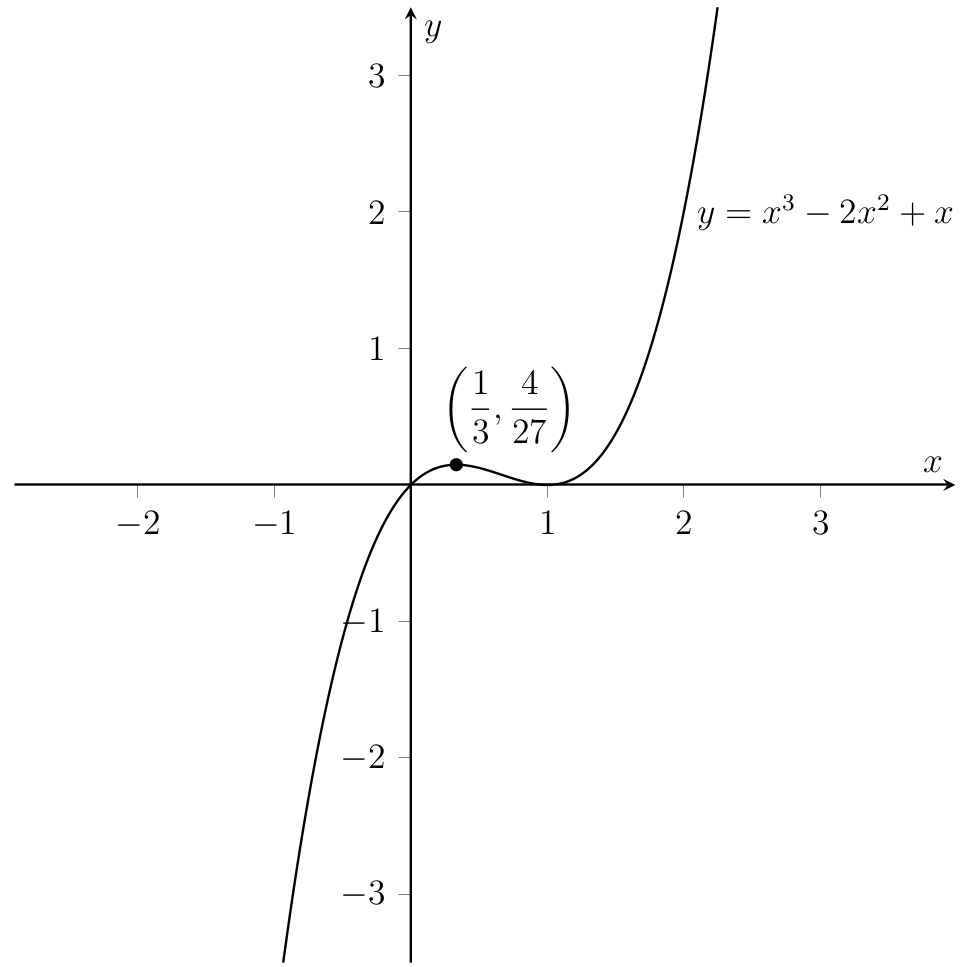
Fig. 48 Graph of \(y=x^3-2x^2+x\).#
(ii) Let \(y=f(x)=(x+1)^2(2-x)\).
The domain of \(f\) is \(\mathbb{R}\).
The graph crosses the \(x\)-axis at \(x=-1\)and \(x = 2\).
It crosses the \(y\)-axis when \(x = 0\) so at the point \((0,2)\).\(\frac{dy}{dx} = 3(x+1)(1-x)\) and \(\frac{d^2y}{dx^2} = -6x\).
Thus the stationary points are \((-1,0)\) and \((1,4)\).
At \(x = -1\) we have \(\frac{d^2y}{dx^2}> 0\) so \((-1,0)\) is a local minimum.
At \(x = 1\) we have \(\frac{d^2y}{dx^2} = - 6 <0\) so \((1,4)\) is a local maximum.As \(x \rightarrow \infty\) we have \(y \rightarrow -\infty\) and as \(x \rightarrow - \infty\) we have \(y \rightarrow \infty\).
Sketch gives
^2(2-x).png)
Fig. 49 Graph of \(y=(x+1)^2(2-x)\).#
(iii) Let \(y=f(x)=x^2(x-2)^2\).
The domain of \(f\) is \(\mathbb{R}\).
The graph crosses the \(x\)-axis at \(x= 0\)and \(x = 2\).
It crosses the \(y\)-axis when \(x = 0\) so at the point \((0,0)\).\(\frac{dy}{dx} = 4x(x-2)(x-1)\) and \(\frac{d^2y}{dx^2} = 12x^2- 24x + 8\).
Thus the stationary points are \((0,0)\), \((1,1)\)and \((2,0)\).
At \(x = 0\) we have \(\frac{d^2y}{dx^2} = 8 > 0\) so \((0,0)\) is a local minimum.
At \(x = 1\)we have \(\frac{d^2y}{dx^2} = 12-24+8 = 20-24 <0\) so \((1,1)\) is a local maximum.
At \(x = 2\) we have \(\frac{d^2y}{dx^2} = 12(4) -24(2) +8 = 8 > 0\) so \((2,0)\) is a local minimum.As \(x \rightarrow \infty\) we have \(y \rightarrow \infty\) and as \(x \rightarrow - \infty\) we have \(y \rightarrow \infty\).
Sketch gives
^2.png)
Fig. 50 Graph of \(y=x^2(x-2)^2\).#
(iv) Let \(y=f(x)=x^4-8x^3\).
The domain of \(f\) is \(\mathbb{R}\).
\(y = x^3(x-8)\). Thus the graph crosses the \(x\)-axis at \(x= 0\) and \(x = 8\).
It crosses the \(y\)-axis when \(x = 0\) so at the point \((0,0)\).
\(\frac{dy}{dx} = 4x^3 - 24x^2 = 4x^2(x-6)\) and \(\frac{d^2y}{dx^2} = 12x^2 -48x= 12x(x-4)\).
Thus the stationary points are \(P = (0,0)\)and \(Q = (6,-432)\).
At \(x = 0\)we have \(\frac{d^2y}{dx^2} =0\) so we use a LR-table.
L |
P |
R |
|
|---|---|---|---|
\(x\) |
\(-1\) |
\(0\) |
\(1\) |
Gradient |
\(-\)ive |
\(0\) |
\(-\)ive |
so \((0,0)\) is a point of inflection.
At \(x = 6\)we have \(\frac{d^2y}{dx^2} > 0\) so \((6,-432)\) is a local minimum.
As \(x \rightarrow \infty\) we have \(y \rightarrow \infty\) and as \(x \rightarrow - \infty\) we have \(y \rightarrow \infty\).
Sketch gives
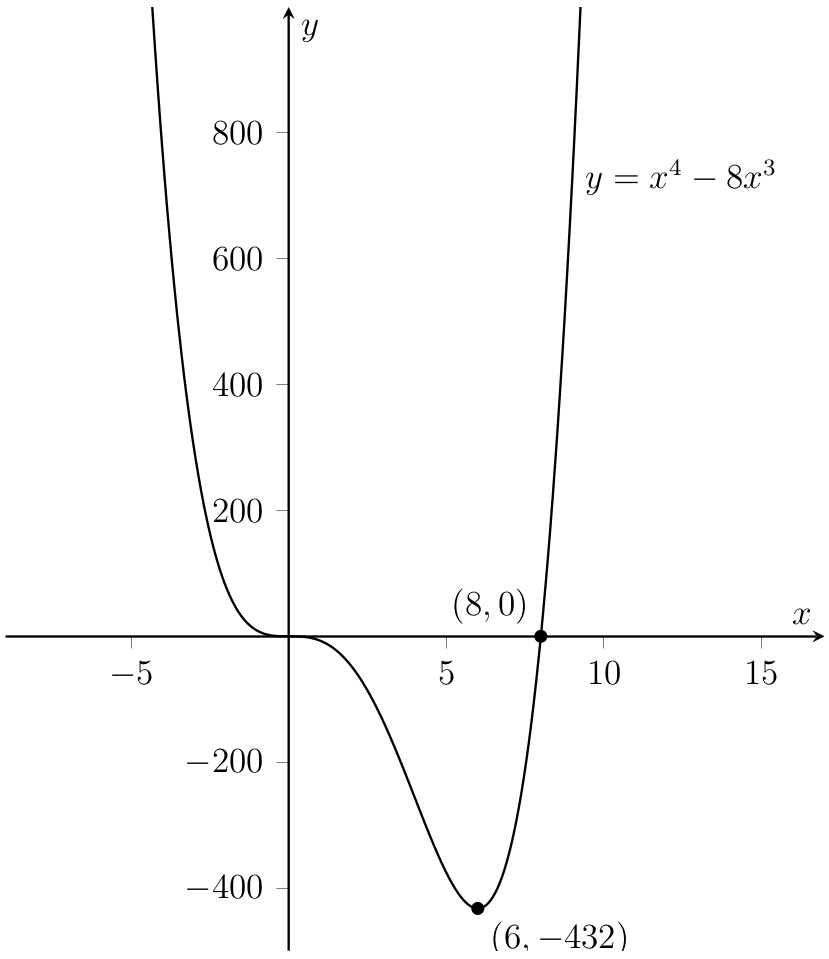
Fig. 51 Graph of \(y=x^4-8x^3\).#
22. Let \(y=f(x)=3x-\frac{12}{x}\). Then,
\(f(x)\) is not defined for \(x = 0\).
The graph of \(y\) does not cross the \(y\)-axis as \(f(x)\) is not defined for \(x = 0\).
\[\begin{split} \begin{array}{crcll} &3x - \frac{12} x&=0&|\times x\\ ~so~&3x^2 - 12 &= 0\\ ~so~&x^2 &=4, \end{array} \end{split}\]so the graph crosses the \(x\)-axis at \(x = 2\) and \(x = -2\).
\(\frac{dy}{dx} = 3+ \frac{12}{x^2}\) and \(\frac{d^2y}{dx^2} = -\frac{24}{x^3}\).
As \(3 + \frac{12}{x^2} = 0\) as no solution, this graph has no stationary points, that is no maximum, minimum or point of inflection.
As \(x \rightarrow \infty\), the \(\frac{12}{x}\) term will tend to \(0\), and so \(f(x)\) will behave more and more like \(3x\).
In particular, \(f(x) \rightarrow+\infty\) as \(x\rightarrow+\infty\) and \(f(x)\rightarrow-\infty\) as \(x\rightarrow-\infty\).
As \(x \rightarrow 0^-\) we have \(f(x) \rightarrow \infty\). As \(x \rightarrow 0^+\) we have \(f(x) \rightarrow -\infty\).
Sketch gives
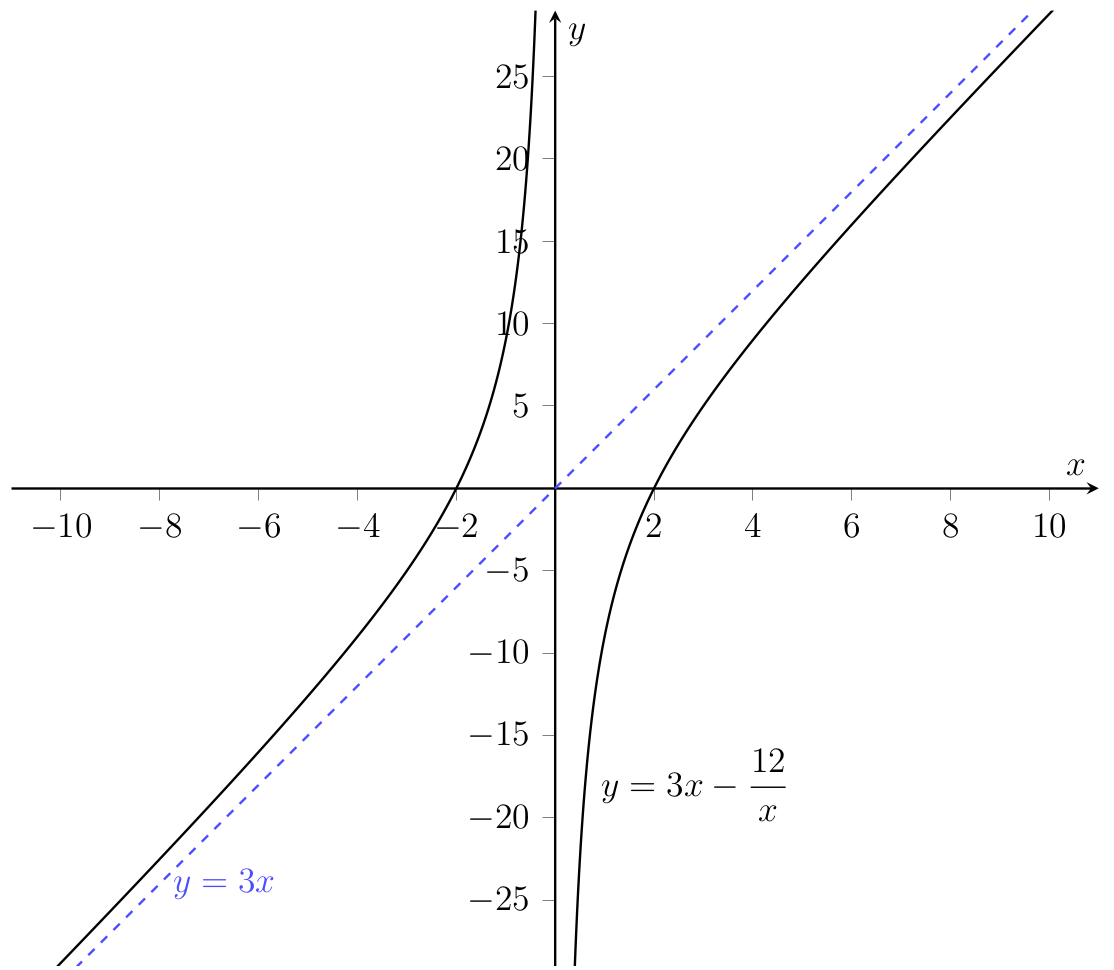
Fig. 52 Graph of \(y=3x-\frac{12}{x}\).#
Note
The line \(y=3x\) in the graph of \(y=3x-\frac{12}{x}\) (Fig. 52) is called an oblique asymptote. It is an asymptote, because it describes limiting behaviour of \(f(x)=3x-\frac{12}{x}\). It is oblique because it is not parallel to the \(x\) or \(y\) axes.
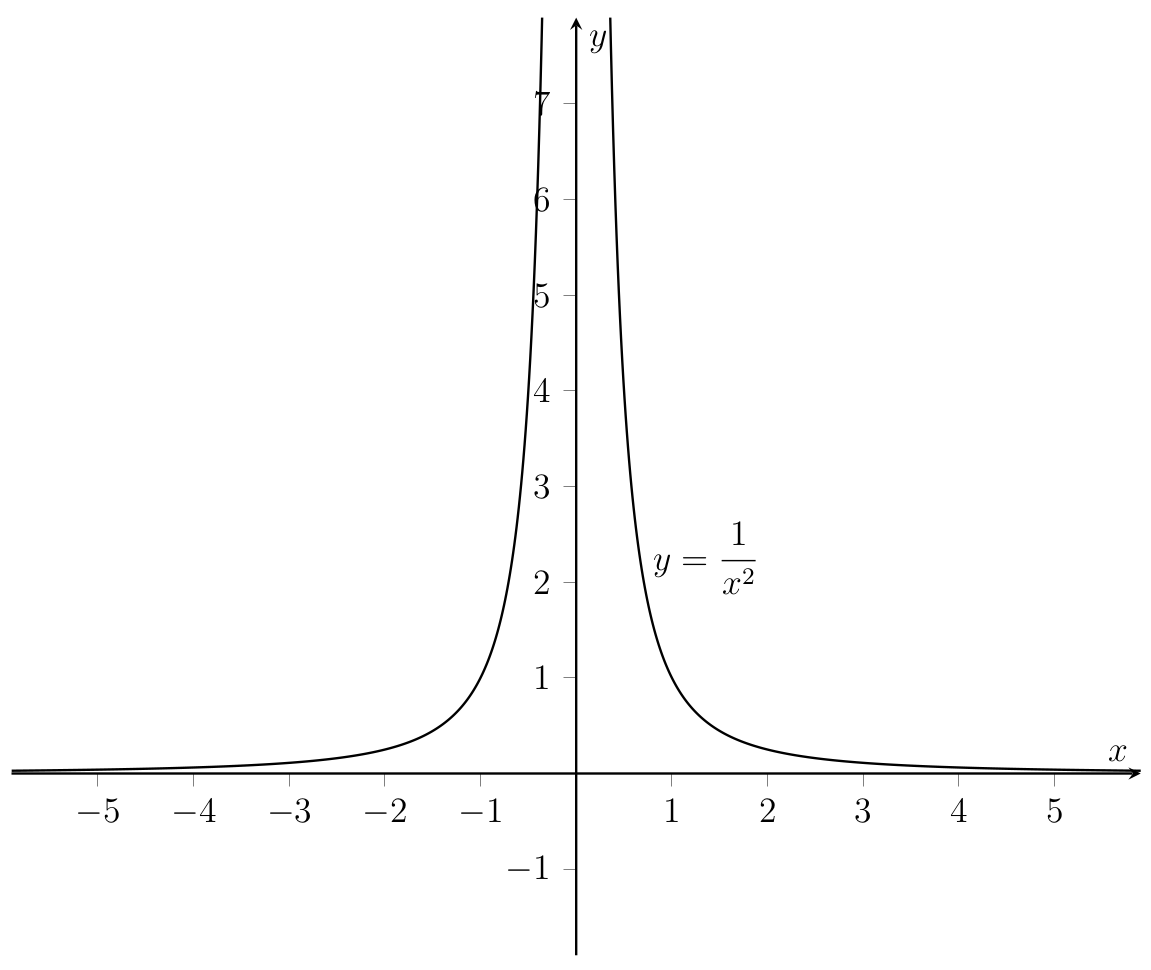
23. (i) 1. \(y=\frac{1}{x^2}\) is not defined for \(x = 0\).
The graph of \(y\) does not cross the \(y\)-axis as \(y\) is not defined for \(x = 0\).
\[\begin{split} \begin{array}{crcll} &\frac{1}{x^2} &=&0&|\times x^2\\ \Longrightarrow&1&=&0, \end{array} \end{split}\]so the graph does not cross the \(x\)-axis.
\(\frac{dy}{dx} = -\frac{2}{x^3}\) and \(\frac{d^2y}{dx^2} = \frac{6}{x^4}\). As \(-\frac{2}{x^3} = 0\) as no solution, this graph has no stationary points, i.e.~no maximum, minimum or point of inflection.
As \(x \rightarrow \infty\) we have \(y \rightarrow 0\).
As \(x \rightarrow -\infty\) we have \(y \rightarrow 0\).
As \(x \rightarrow 0^-\) we have \(y \rightarrow \infty\).
As \(x \rightarrow 0^+\) we have \(y \rightarrow \infty\).
Sketch:
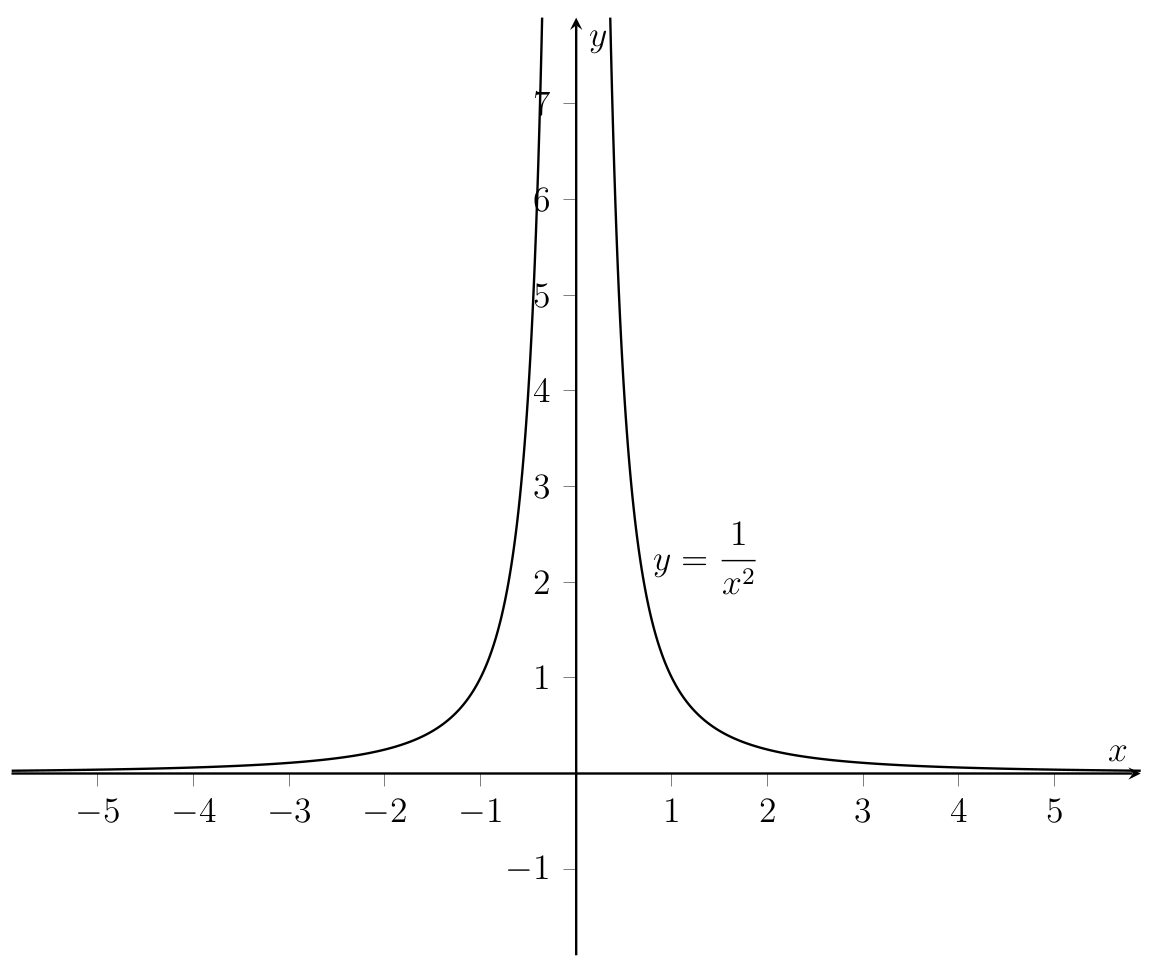
Fig. 53 Graph of \(y=\frac{1}{x^2}\) (Q23(i)).#
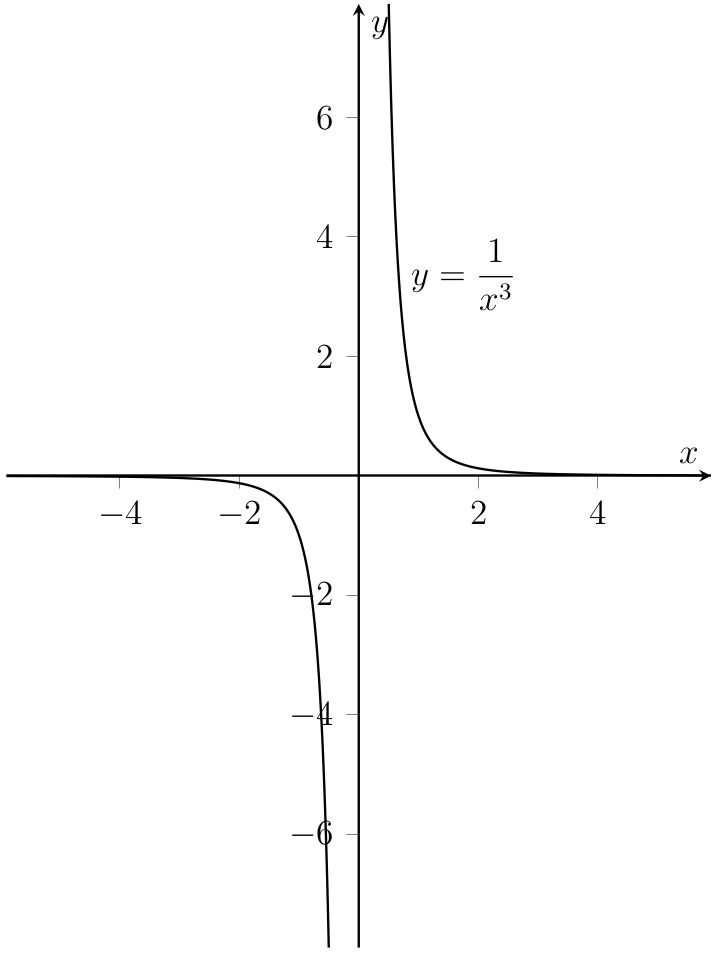
(ii) 1. \(y=\frac{1}{x^3}\) is not defined for \(x = 0\).
The graph of \(y=\frac{1}{x^3}\) does not cross the \(y\)-axis as \(y\) is not defined for \(x = 0\).
The graph also does not cross the \(x\)-axis.
\(\frac{dy}{dx} = -\frac{3}{x^4}\) and \(\frac{d^2y}{dx^2} = \frac{12}{x^5}\).
As \(-\frac{3}{x^4} = 0\) as no solution, this graph has no stationary points, i.e.~no maximum, minimum or point of inflection.
As \(x \rightarrow \infty\) we have \(y \rightarrow 0\).
As \(x \rightarrow -\infty\) we have \(y \rightarrow 0\).
As \(x \rightarrow 0^-\) we have \(y \rightarrow -\infty\).
As \(x \rightarrow 0^+\) we have \(y \rightarrow \infty\).
Sketch:
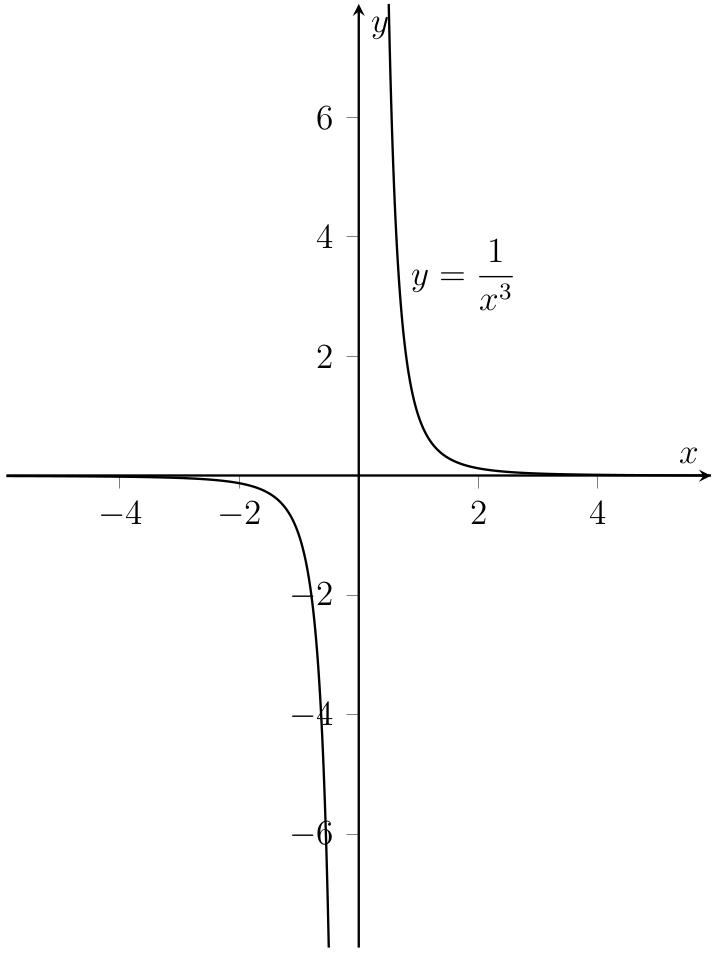
Fig. 54 Graph of \(y=\frac{1}{x^3}\) (Q23(ii)).#
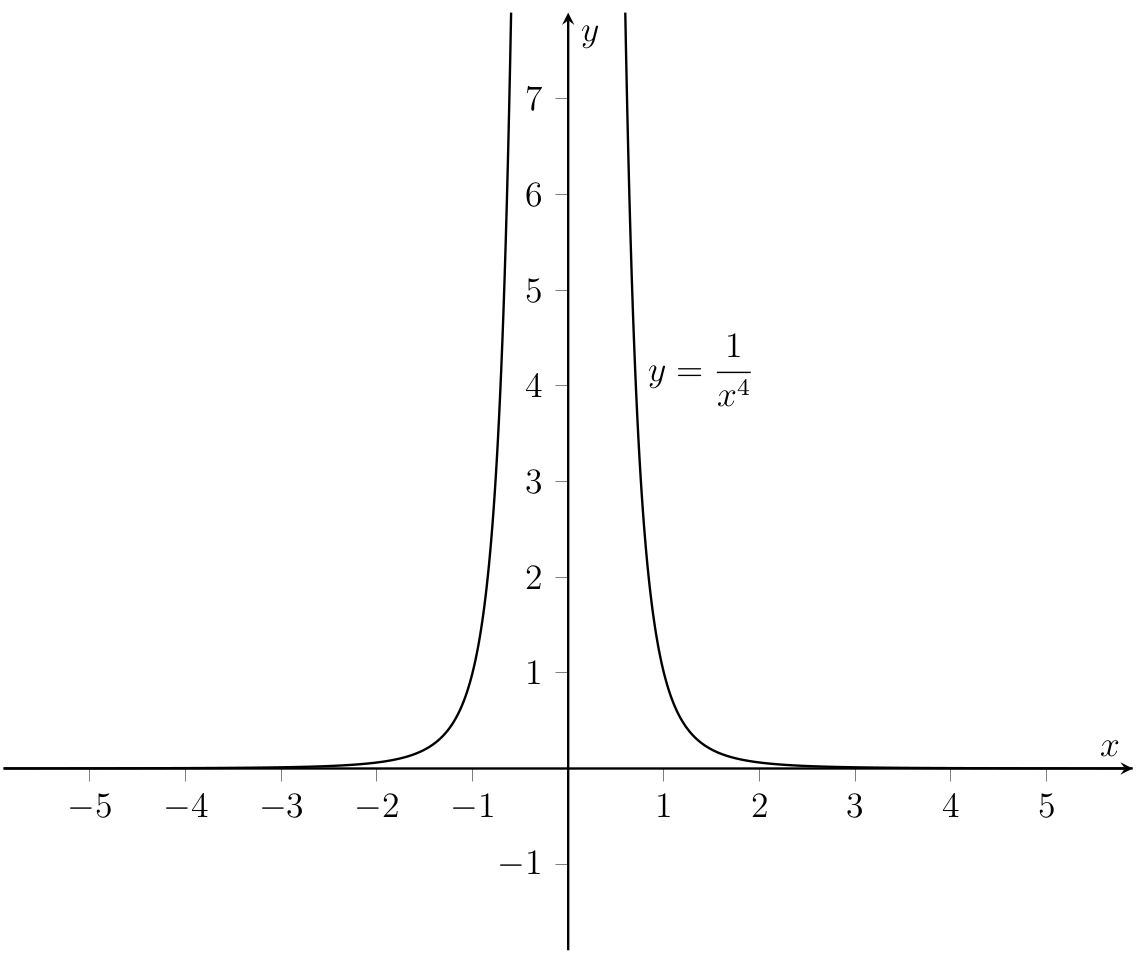
(iii) 1. \(y=\frac{1}{x^4}\) is not defined for \(x = 0\).
The graph of \(y=\frac{1}{x^4}\) does not cross the \(y\)-axis as \(y\) is not defined for \(x = 0\).
The graph also does not cross the \(x\)-axis.
\(\frac{dy}{dx} = -\frac{4}{x^5}\).
As \(-\frac{4}{x^5} = 0\) as no solution, this graph has no stationary points, i.e.~no maximum, minimum or point of inflection.
As \(x \rightarrow \infty\) we have \(y \rightarrow 0\).
As \(x \rightarrow -\infty\) we have \(y \rightarrow 0\).
As \(x \rightarrow 0^-\) we have \(y \rightarrow \infty\).
As \(x \rightarrow 0^+\) we have \(y \rightarrow \infty\).
Sketch:
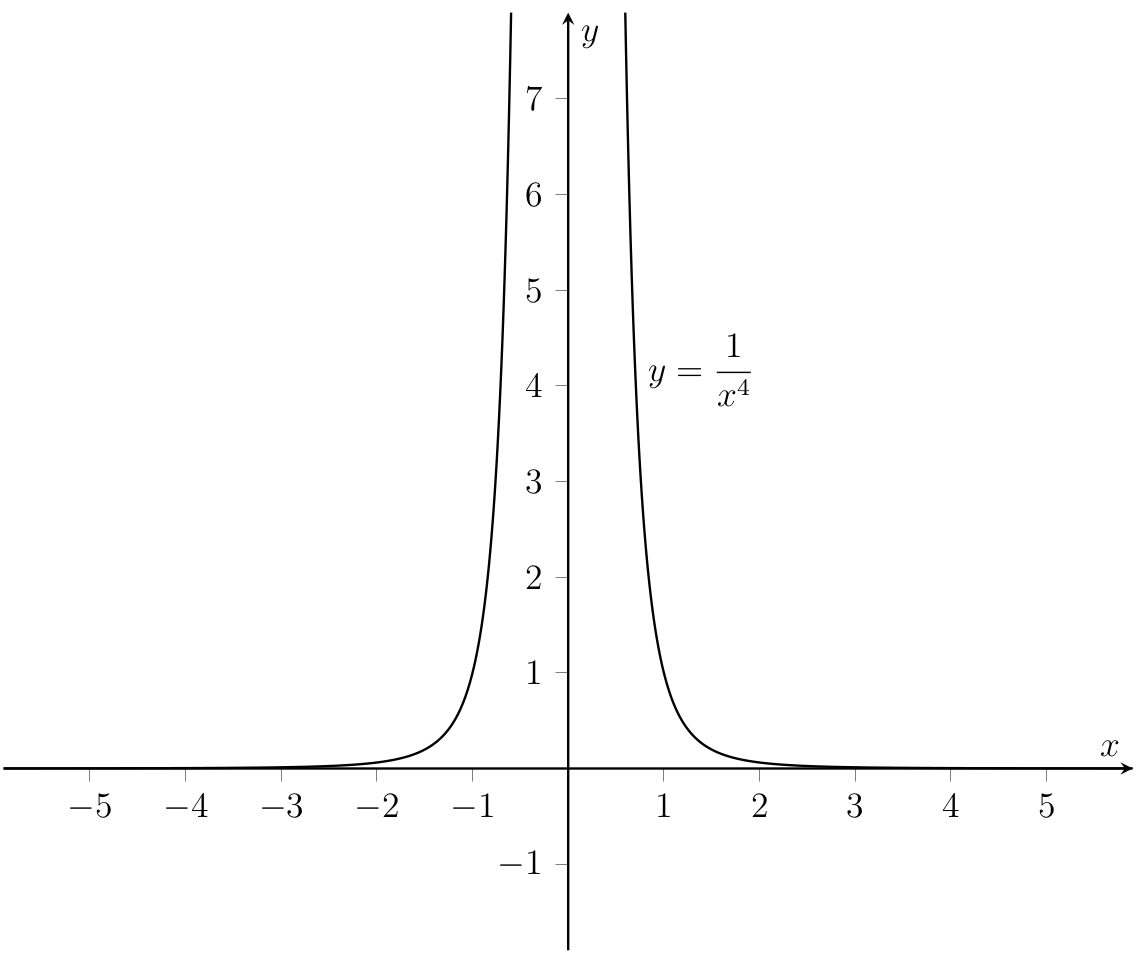
Fig. 55 Graph of \(y=\frac{1}{x^4}\) (Q23(iii)).#
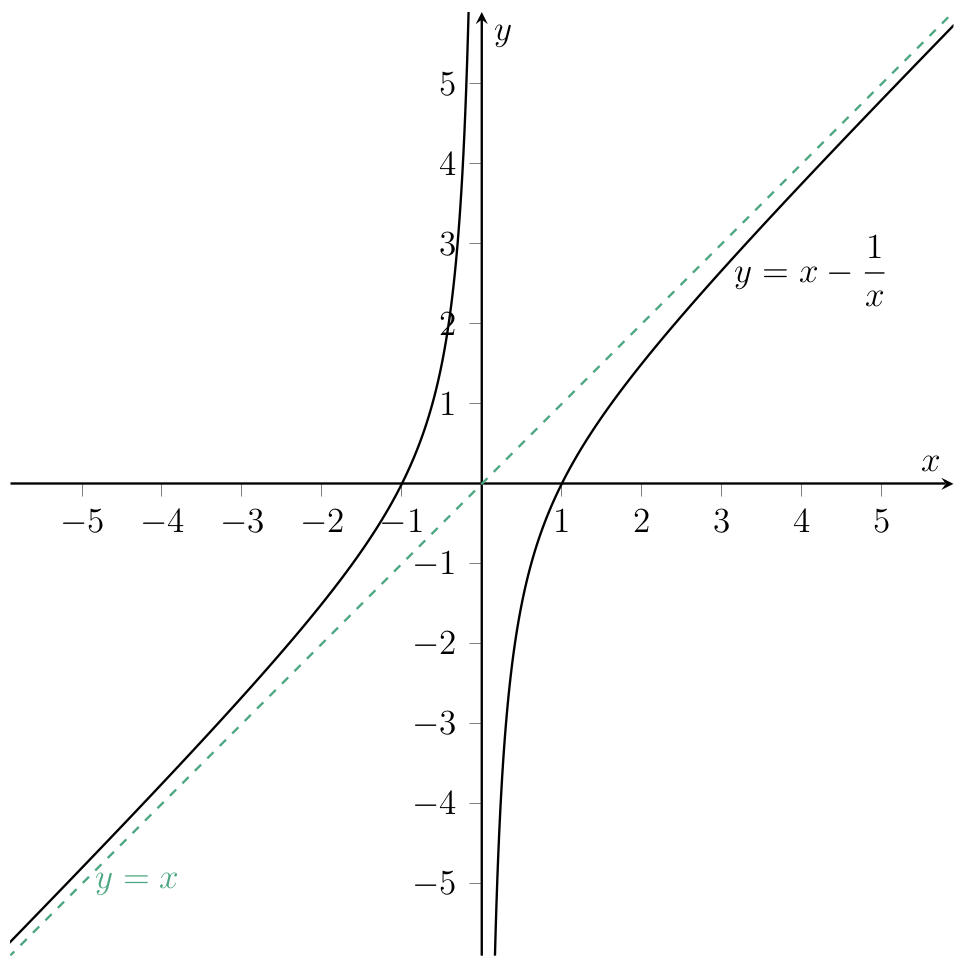
(iv) 1. \(y=x-\frac{1}{x}\) is not defined for \(x = 0\).
The graph of \(y\) does not cross the \(y\)-axis as \(y\) is not defined for \(x = 0\).
\[\begin{split} \begin{array}{crcll} &x -\frac{1} x&=&0&|\times x\\ ~\text{ so }~&x^2 -1 &=& 0, \end{array} \end{split}\]so the graph crosses the \(x\)-axis at \((-1,0)\) and \((1,0)\).
\(\frac{dy}{dx} = 1 + \frac{1}{x^2}\). As \(1 + \frac{1}{x^2} = 0\) has no solutions, there are no stationary points.
As \(x \rightarrow \infty\) we have \(y \rightarrow \infty\).
(Specifically, \(y=x-\frac{1}{x}\tilde x\) in the limits \(x\rightarrow\pm\infty\), so \(y=x\) will be an oblique asymptote for this graph.)
As \(x \rightarrow -\infty\) we have \(y \rightarrow -\infty\).
As \(x \rightarrow 0^-\) we have \(y \rightarrow \infty\).
As \(x \rightarrow 0^+\) we have \(y \rightarrow -\infty\).
Sketch:
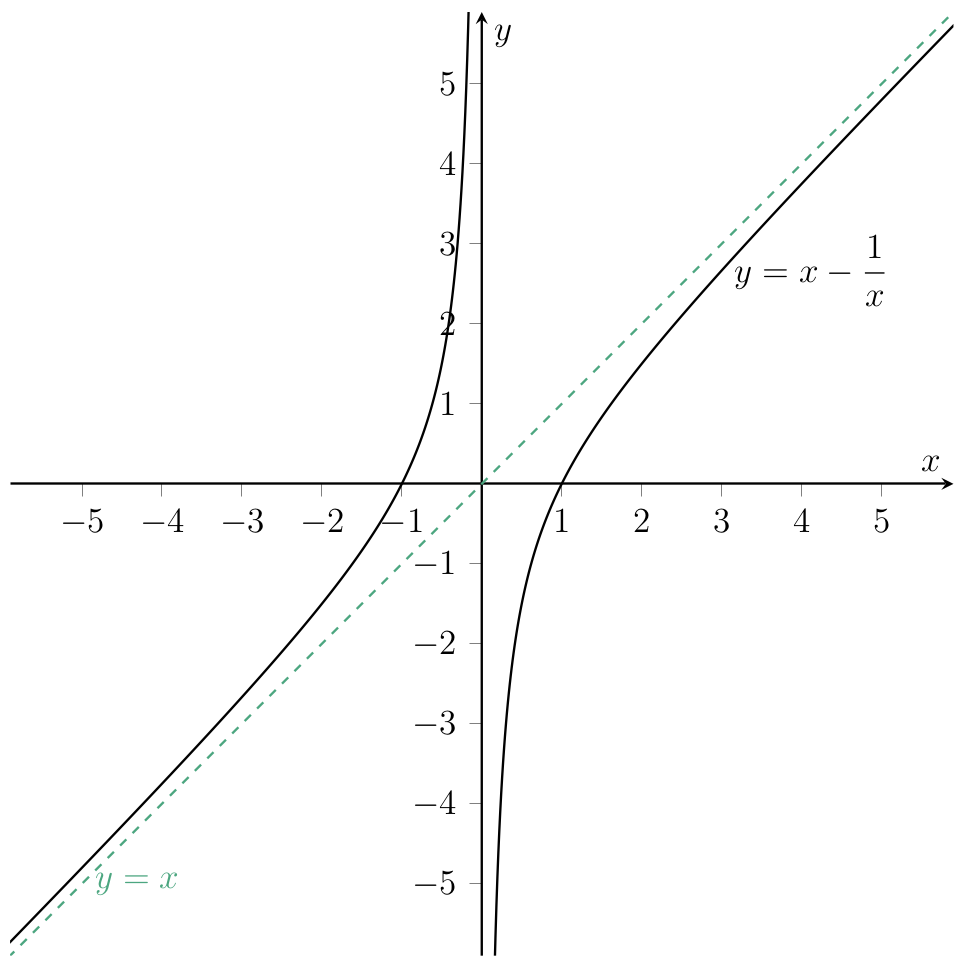
Fig. 56 Graph of \(y=x-\frac{1}{x}\) (Q23(iv)).#
(v) 1. \(y=x+\frac{4}{x^2}\) is not defined for \(x = 0\).
The graph of \(y\) does not cross the \(y\)-axis as \(y\) is not defined for \(x = 0\).
\[\begin{split} \begin{array}{crcll} &x +\frac{4}{x^2}&=&0&|\times x^2\\ ~\text{ so }~&x^3 + 4 &=& 0, \end{array} \end{split}\]so the graph crosses the \(x\)-axis at \((-\sqrt[3]{4},0)\).
\(\frac{dy}{dx} = 1 - \frac{8}{x^3}\) and \(\frac{d^2y}{dx^2} = \frac{24}{x^4}\). Thus the stationary point is \((2,3)\) and as \(\frac{d^2y}{dx^2} > 0\) at \(x = 2\) this is a local minimum.
As \(x \rightarrow \infty\) we have \(y \rightarrow \infty\).
As \(x \rightarrow -\infty\) we have \(y \rightarrow -\infty\).
As \(x \rightarrow 0^-\) we have \(y \rightarrow \infty\).
As \(x \rightarrow 0^+\) we have \(y \rightarrow \infty\).
Sketch gives
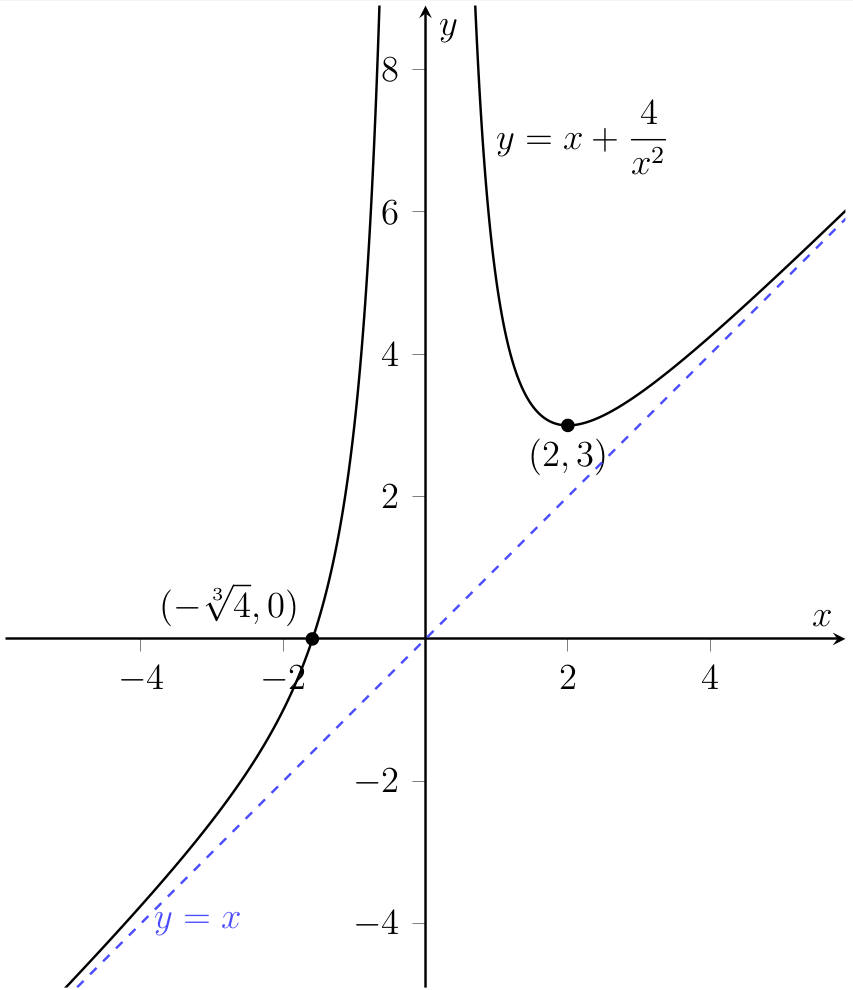
Fig. 57 Graph of \(y=x+\frac{4}{x^2}\) (Q23(v)).#
(vi) 1. \(y\) is not defined for \(x = 0\).
The graph of \(y\) does not cross the \(y\)-axis as \(y\) is not defined for \(x = 0\).
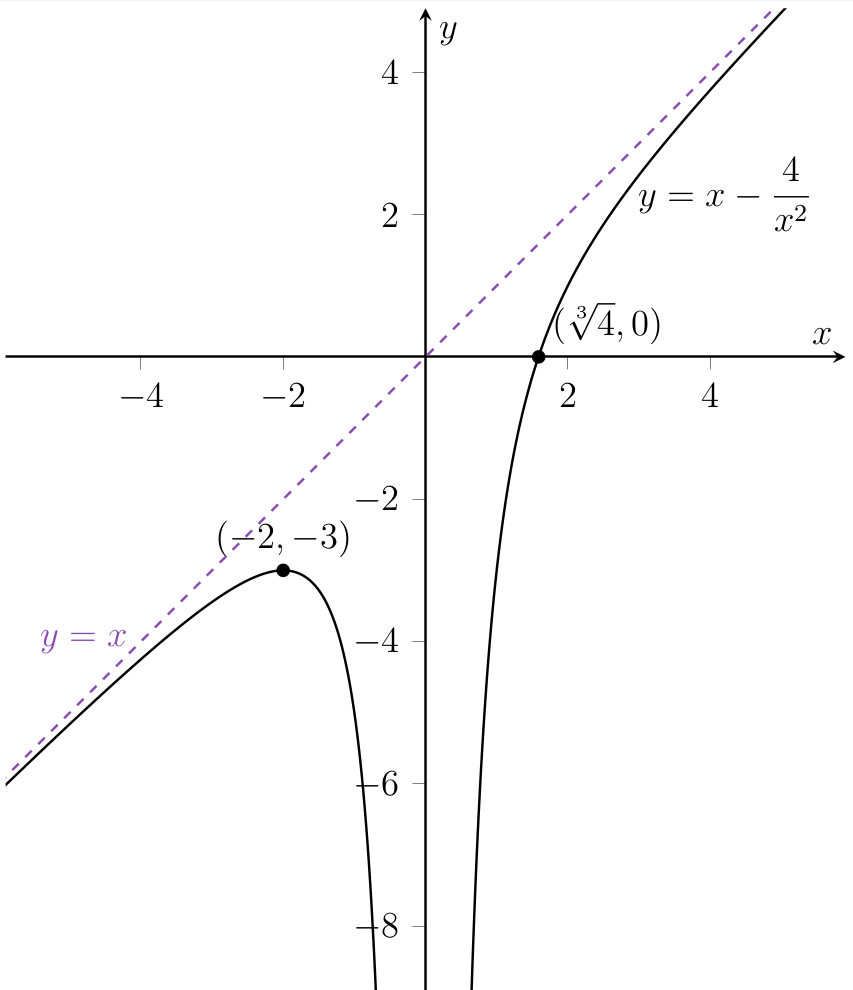
\[\begin{split} \begin{array}{crcll} &x -\frac{4}{x^2}&=&0&|\times x^2\\ ~\text{so}~&x^3 - 4 &=& 0, \end{array} \end{split}\]so the graph crosses the \(x\)-axis at \((\sqrt[3]{4},0)\).
\(\frac{dy}{dx} = 1 + \frac{8}{x^3}\) and \(\frac{d^2y}{dx^2} = \frac{24}{x^4}\). Thus the stationary point is \((-2,-3)\) and as \(\frac{d^2y}{dx^2} < 0\) at \(x = -2\) there is a local maximum.
As \(x \rightarrow \infty\) we have \(y \rightarrow \infty\).
As \(x \rightarrow -\infty\) we have \(y \rightarrow -\infty\).
As \(x \rightarrow 0^-\) we have \(y \rightarrow -\infty\).
As \(x \rightarrow 0^+\) we have \(y \rightarrow -\infty\).
Sketch gives
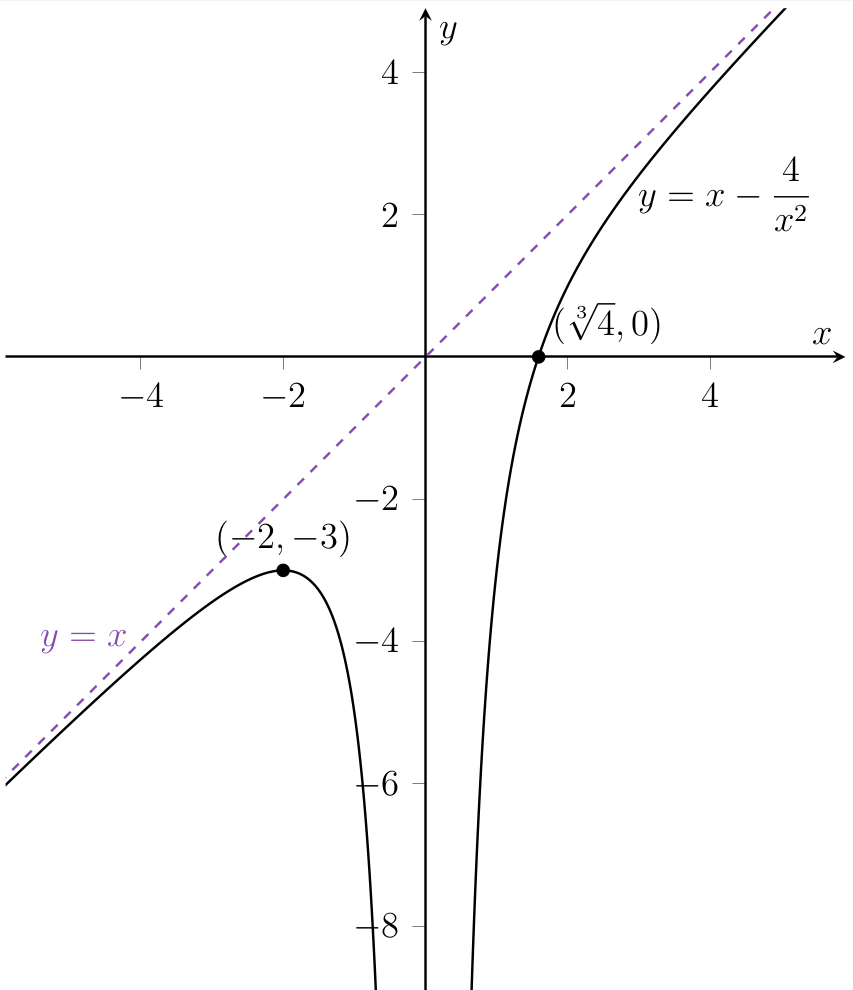
Fig. 58 Graph of \(y=x-\frac{4}{x^2}\) (Q23(vi)).#
Applications to optimisation#
24. Let \(h\) be the height of the block and \(x\) be the length of one of the sides of the square base in centimetres. Then the volume, \(V\), is given by \(V = x^2h~\mbox{cm}^3\). As we know that the sum of the height and any one side of the base is \(12~\mbox{cm}\), we have \(h+x = 12\) and so \(h = 12-x\). We substitute this into our function \(V\) to get
Then \(\frac{dV}{dx} = 24x -3x^2 = 3x(8-x)\) and \(\frac{d^2V}{dx^2} = 24 - 6x\). Now when \(x = 0\) we don’t actually have a block at all, so we ignore this possible value for \(x\). When \(x = 8\) then \(\frac{d^2V}{dx^2} = 24 - 6\times 8 < 0\) so we have a local maximum. This means that the maximum value of the block occurs when \(x=8\), and here we get
Thus the maximum volume of the block is \(256~\mbox{cm}^3\).
25. Let \(h\) be the height in metres of the ball at time \(t\). Then \(h = 15.4t -4.9t^2\). Hence \(\frac{dh}{dt} = 15.4 - 9.8 t\) and \(\frac{d^2h}{dt^2} = -9.8\). Thus there is a stationary point at \(t = \frac{15.4}{9.8} = \frac{154}{98} = \frac{11}{7}\). Since \(\frac{d^2h}{dt^2}\) is negative here, it is a local maximum. Now, when \(t=\frac{11}{7}\) we have
Thus the ball reaches its greatest height of 12.1 metres after \(\frac{11}7\) seconds.
26. To help with the calculation, we draw a picture.
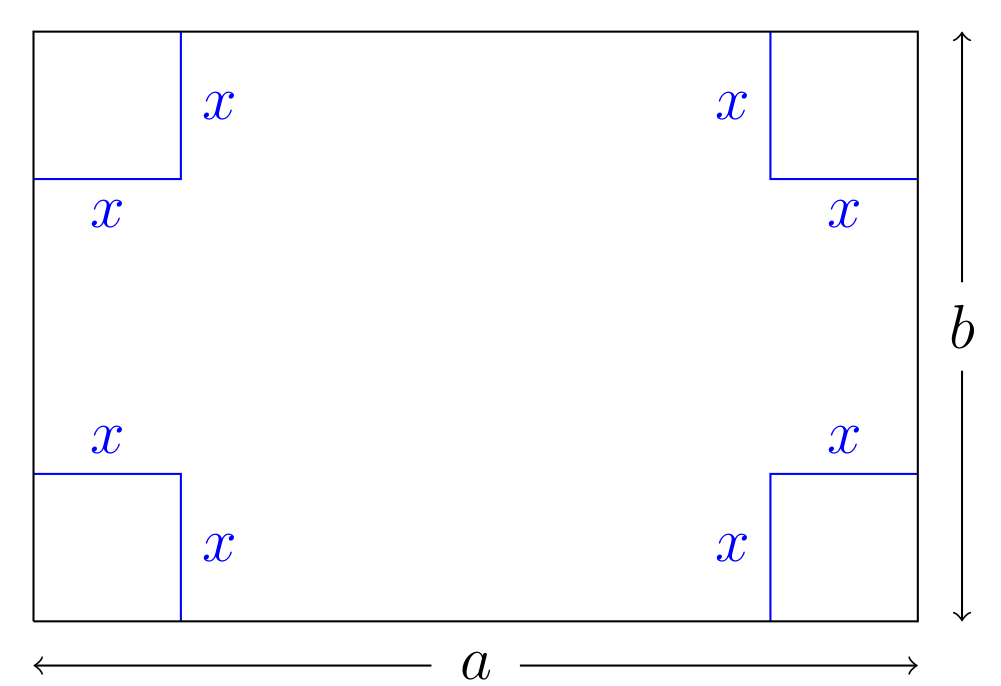
Fig. 59 An \(a\times b\text{ cm}^2\) metal sheet with \(x\text{ cm}^2\) squares removed from each corner.#
We can see that the length of the box is \((a -2x)~\mbox{cm}\), the width is \((b-2x)~\mbox{cm}\) and its height is \(x~\mbox{cm}\). Thus the box has the volume
(i) If \(a = 8\) and \(b = 5\) we get that \(V = 4x^3 -2(8+5)x^2 + 40x = 4x^3 - 26x^2 +40x\). Hence
and
It is easy to see that if \(x = \frac{10}{3}\) then \(\frac{d^2V}{dx^2} > 0\) so that there is a local minimum when \(x = \frac{10}{3}\).
If \(x =1\) then \(\frac{d^2V}{dx^2} = 24 - 52 < 0\) so that the maximum value is obtained when \(x = 1\) and then \(V = (8-2)(5-2)= 6\times 3 = 18\). Hence the maximum volume of the box is \(18~\mbox{cm}^3\).
(ii) Now,
and
To find the stationary point(s) of \(V\) we solve
Using the quadratic formula, we get \(x = \frac{a+b+ \sqrt{a^2+b^2 -ab}}{6}\) and \(x = \frac{a+b - \sqrt{a^2+b^2 - ab}}{6}\) for the two solutions.
Note that \(a^2+b^2 -ab \geq 0\) when \(a \geq 0\) and \(b \geq 0\) because \((a-b)^2 \geq 0\) which implies that \(a^2 +b^2 \geq 2ab \geq ab\).
Now when \(x = \frac{a+b+ \sqrt{a^2+b^2 -ab}}{6}\),
and so there is a local minimum for this choice of \(x\).
But when \(x = \frac{a+b - \sqrt{a^2+b^2 - ab}}{6}\) then
and so there is a local maximum when \(x=\frac{a+b - \sqrt{a^2+b^2 - ab}}{6}\), and the maximum volume is
Chapter 8#
Chain rule#
27. Let \(u = 6x^3-4x\) so \(y = u^{-2}\). Now \(\frac{du}{dx} = 18x^2 - 4\) and \(\frac{dy}{du} = -2u^{-3}\). Thus, by the chain rule,
28. These are straight applications of the chain rule. We get the following answers.
(i) \(\frac{dy}{dx}=4(2x+3)\),
(ii) \(\frac{dy}{dx}=24(3x+4)^3\),
(iii) \(\frac{dy}{dx}=-2(2x+5)^{-2}\),
(iv) \(\frac{dy}{dx}=2(3x-1)^{-\frac{1}{3}}\),
(v) \(\frac{dy}{dx}=(3-2x)^{-\frac{3}{2}}\),
(vi) \(\frac{dy}{dx}=12(3-4x)^{-4}\),
(vii) \(\frac{dy}{dx}=\displaystyle -\frac{3}{(3x+2)^2}\),
(viii) \(\frac{dy}{dx}=\displaystyle -\frac{4}{(2x+3)^{3}}\),
(ix) \(\frac{dy}{dx}=\displaystyle -\frac{3}{2(3x+1)^{\frac{3}{2}}}\),
(x) \(\frac{dy}{dx}=\displaystyle -\frac{4}{3(2x-1)^{\frac{5}{3}}}\),
(xi) \(\frac{dy}{dx}=\displaystyle -\frac{3x}{(2+x^2)^{\frac{3}{2}}}\),
(xii) \(\frac{dy}{dx}=na(ax+b)^{n-1}\).
Rates of change#
29. Let \(A\) be the surface area of the sphere in \(\mbox{cm}^2\). Then \(A = 4\pi r^2\) and so \(\frac{dA}{dr}=8\pi r\). Now, we are given that \(\frac{dr}{dt} = 1\) so that, applying the chain rule,
Hence, when \(r=2\) we get \(\frac{dA}{dr}=16\pi\), that is the surface area of the sphere is increasing by \(16\pi~\mbox{cm}^2\mbox{s}^{-1}\).
30. Let \(r\) be the radius of the circle (in cm). The area is given by \(A(r) = \pi r^2\) and so \(\frac{dA}{dr} = 2\pi r\). As the area of the circle is increasing at the rate of \(3\)cm\({}^2/\)sec, we have that \(3 = \frac{dA}{dt}\). Using the chain rule, and that \(r = 2\)cm then gives
Thus \(\frac{dr}{dt} = \frac{3}{4\pi}\).
Now we are actually interested in change of the circumference of the circle, \(C(r) = 2\pi r\). Note that
Thus the rate of change of the circumference when the radius is \(2\)cm is \(\frac{3}{2}\)cm\(/\)sec.
31. Firstly, we note that \(\frac{dy}{dx}=2x-3\). Thus, from the chain rule,
Hence, when \(x = 2\) we have \(\frac{dy}{dt} = (2\times 2-3) \times 2 = 2\).
32. Firstly, an application of the chain rule gives us \(\frac{dy}{dx} = 2(1 + \frac{1}{x^2})(x - \frac{1}{x})\) (you can check this by putting \(u=x-\frac{1}{x}\)). Hence, rearranging the chain rule formula \(\frac{dy}{dt}=\frac{dy}{dx} \frac{dx}{dt}\), we get
Hence, substituting \(x=2\) and \(\frac{dy}{dt}=1\) we get
Product rule#
33. These are all applications of the product rule \(\frac{d}{dx}(uv)=v\frac{du}{dx} + u\frac{dv}{dx}\). Some parts also use the chain rule.
(i) When \(f(x)=(x+1)(x+2)\), we have \(f'(x) = (x+2)\cdot 1 + (x+1).1 = 2x +3\).
(ii) When \(f(x)=(x^2+1)x^2\), we have \(f'(x) = x^2\cdot 2x +(x^2+1)\cdot 2x = 2x(2x^2 +1)\).
(iii) When \(f(x)=(x-2)^2(x^2-2)\),
(iv) \(f(x)=(x+1)^2(x^2-1)\), so
(v) When \(f(x)=x^3(5x+1)^2\),
(vi) When \(f(x)=2\sqrt{x}(x+1)^2\),
(vii) When \(f(x)=x^{-2}(1+3x)^2\),
(viii) When \(f(x)=x^2(1+x)^{-2}\),
Quotient rule#
34. These are all applications of the quotient rule \(\frac{d}{dx}(\frac{u}{v})=\frac{v\frac{du}{dx}-u\frac{dv}{dx}}{v^2}\) and/or chain rule.
(i) For \(\displaystyle f(x)=\frac{x}{x+1}\),
(ii) For \(\displaystyle f(x)=\frac{x}{x-1}\),
(iii) For \(\displaystyle f(x)=\frac{1+5x}{5-x}\),
(iv) For \(\displaystyle f(x)=\frac{x}{(x+3)^4}\),
and
Chapter 9#
Differentiating exponentials#
35. \(\displaystyle f'(t) = 2 \left(\frac{1}{2}\left(\frac{t}{x+t}\right)^{-\frac{1}{2}} \times\frac{1(x+t) -t(1)}{(x+t)^2}\right)= \frac{x\sqrt{x+t}}{\sqrt{t}(x+t)^2}\).
36. Using the result that \(\frac{d}{dx}(e^{f(x)})=f'(x)e^{f(x)}\) we have the following answers.
(i) \(\displaystyle \frac{dy}{dx} = -x^{-\frac{3}{2}}e^{2x^{-\frac{1}{2}}}\),
(ii) \(\displaystyle \frac{dy}{dx} = (2x+1)e^{x^2+x+1}\),
(iii) \(\displaystyle \frac{dy}{dx} = 6(3x-1)e^{(3x-1)^2}\).
37. Again we use the result that \(\frac{d}{dx}(e^{f(x)})=f'(x)e^{f(x)}\).
(i) \(f'(x) = 4e^x\),
(ii) \(f'(x) = 3e^{3x}\),
(iii) \(f'(x)=2e^{2x+1}\),
(iv) \(f'(x)=4xe^{2x^2}\),
(v) \(f'(x) = e^x(x^2+2x) = x(x+2)e^x\),
(vi) \(f'(x) = \displaystyle \frac{e^x(x-1)}{x^2}\),
(vii) \(f'(x) = 2xe^{x^2}\),
(viii) \(f'(x) = 6x^2e^{2x^3}\),
(ix) \(f'(x) = -2xe^{-x^2}\),
(x) \(f'(x) = \frac{1}{2\sqrt{x}}e^{\sqrt{x}}\).
38. Let \(f(x) = e^x\). Then \(f'(x)=e^x\). The equation for the tangent at the point \((a,e^a)\) is given by \(y = f'(a)x + c=e^a x + c\) where \(c\) is some constant. Since the tangent passes through the point \((a,e^a)\) we have \(e^a=e^a.a+c\) so that \(c = e^a -e^a.a = e^a(1-a)\). Thus the equation of the tangent line at the point \((a,e^a)\) is
Putting \(a=1\) we get that the tangent at the point \((0,1)\) has equation
Differentiating logs#
39. We get the following answers.
(i) \(\displaystyle \frac{dy}{dx} = \frac{2}{2x-1}\)
(ii) \(\displaystyle \frac{dy}{dx} = \frac{6x+ \frac{1}{2} x^{-\frac{1}{2}}}{3x^2 +x^{\frac{1}{2}}}= \frac{12x +x^{-\frac{1}{2}}}{2(3x^2+x^{\frac{1}{2}})}\)
(iii) \(\displaystyle \frac{dy}{dx} = e^{2x}\frac{1}{x} + 2e^{2x}\ln(x) = e^{2x}\left( \frac{1}{x} + 2\ln(x)\right)\)
(iv) \(\displaystyle \frac{dy}{dx} = \frac{e^{x^2}\cdot\frac{1}{x} - (\ln(x)).2xe^{x^2}}{(e^{x^2})^2} = \frac{e^{x^2}\left(1-2x^2\ln(x)\right)}{x(e^{x^2})^2} = \frac{1-2x^2\ln(x)}{xe^{x^2}}\).
40. We get the following answers.
(i) \(f(x)=\ln(x^2-2)\), so \(f'(x) = \displaystyle \frac{2x}{x^2-2}\).
(ii) \(f(x)=\ln(x\sqrt{x+1})=\ln(x)+\frac{1}{2}\ln(x+1)\), so \(f'(x) = \displaystyle \frac{1}{x} + \frac{1}{2(x+1)}\).
(iii) \(f(x)=\ln(3x)=\ln(3)+\ln(x)\), so \(f'(x) = \displaystyle \frac{1}{x}\).
(iv) \(f(x)=\ln(4x)=\ln(4)+\ln(x)\), so \(f'(x) = \displaystyle \frac{1}{x}\).
(v) \(f(x)=\ln(ax)=\ln(a)+\ln(x)\), so \(f'(x) = \displaystyle \frac{1}{x}\).
(vi) \(f(x)=\ln(3x+1)\), so \(f'(x) = \displaystyle \frac{3}{3x+1}\).
(vii) \(f(x)=\ln(2x^3)\), so \(f'(x) = \displaystyle \frac{6x^2}{2x^3} = \frac{3}{x}\).
(viii) \(f(x)=\ln(x^3-2)\), so \(f'(x) = \displaystyle \frac{3x^2}{x^3 -2}\).
(ix) \(f(x)=\ln(x-1)^3=3\ln(x-1)\), so \(f'(x) = \displaystyle \frac{3}{x-1}\).
(x) \(f(x)=4\ln(x)\), so \(f'(x) = \displaystyle \frac{4}{x}\).
(xi) \(f(x)=\ln\sqrt{\frac{1-x}{1+x}}=\frac{1}{2}\left(\ln(1-x)-\ln(1+x)\right)\), so \(f'(x)= \displaystyle\frac{1}{2}\left(\frac{-1}{1-x}-\frac{1}{1+x}\right)=\frac{1}{x^2-1}\).
(xii) \(f(x)= \displaystyle\ln(x\sqrt{x^2+1})=\ln(x)+\frac{1}{2}\ln(x^2+1)\), so \(f'(x)= \displaystyle\frac{1}{x}+\frac{x}{x^2+1}\).
(xiii) \(f(x)= \displaystyle\ln\left(\frac{(x+1)^2}{\sqrt{x-1}}\right)=2\ln(x+1)-\frac{1}{2}\ln(x-1)\), so \(f'(x)= \displaystyle\frac{2}{x+1}-\frac{1}{2(x-1)}\)
41. We get the following answers.
(i) \(f'(x) = \displaystyle 1 \ln(x) + x\frac{1}{x} = \ln(x) +1\),
(ii) \(f'(x) = \displaystyle 2x\ln(x) + x = x(2\ln(x)+1)\),
(iii) \(f'(x) = \displaystyle \frac{ \frac{1}{x}(x) - \ln(x) (1)}{x^2} = \frac{1-\ln(x)}{x^2}\),
(iv) \(f'(x) = \displaystyle \frac{x -2x\ln(x)}{x^4} = \frac{1-2\ln(x)}{x^3}\),
(v) \(f'(x) = \displaystyle \frac{\ln(x) - 1}{(\ln(x))^2}\),
(vi) \(f'(x) = \displaystyle \frac{2\ln(x)}{x}\),
(vii) \(f'(x) = \displaystyle \frac{1}{x\ln(x)}\) (chain rule!),
(viii) \(f'(x) = \displaystyle \frac{1}{x\ln(x)}\),
(xi) \(f'(x) = \displaystyle \frac{a}{ax+b}\),
(x) \(f'(x) = \displaystyle \ln(t)\).
42. We have:
Then \(\displaystyle \frac{dy}{dx} = \frac{4}{x} + \frac{30x}{3x^2 -1} - 3\times \frac{\frac{1}{2}x^{-\frac{1}{2}}}{x^{\frac{1}{2}} +2} = \frac{4}{x} +\frac{30x}{3x^2 -1} - \frac{3}{2(x+2x^{\frac{1}{2}})}\).
Chapter 10#
Differentiating standard trig functions#
43. We get the following answers.
(i) \(f'(x)=2\cos(2x-3)\),
(ii) \(f'(x)=-3\sin(3x -1)\),
(iii) \(f'(x)=-3\cos(3x)\),
(iv) \(f'(x)=15\sin(5x)\),
(v) \(f'(x)=-6 \cos\left(\frac 32x\right)\),
(vi) \(f'(x)=\cos\left( \frac 12(x+1)\right)\),
(vii) \(f'(x)=2\cos(x)\sin(x)\),
(viii) \(f'(x)=-8\sin(x)\cos(x)\),
(ix) \(f'(x)=-3\sin(x)\cos^2(x)\),
(x) \(f'(x)= 6\cos(x)\sin^2(x)\),
(xi) \(f'(x)=-12\sin(x)\cos^4(x)\),
(xii) \(f'(x)=\displaystyle\frac{\cos(x)}{2\sqrt{\sin(x)}}\),
(xiii) \(f'(x)=-6\sin(x)\cos(3x)\),
(xiv) \(f'(x)=-18\cos(3x)\sin^2(3x)\),
(xv) \(f'(x)=24\cos(2x)\sin^3(2x)\),
(xvi) \(f'(x)=\sqrt{\sin(2x)}\),
(xvii) \(f'(x)=2x\sin(x)+x^2\cos(x)\),
(xviii) \(f'(x)=\cos^2(x)-\sin^2(x)=\cos(2x)\),
(xix) \(f'(x)=\displaystyle\frac{x\cos(x)-\sin(x)}{x^2}\),
(xx) \(f'(x)=\displaystyle\frac{-2x\sin(2x)-\cos(2x)}{x^2}\),
(xxi) \(f'(x)=\displaystyle\frac{\sin(x)-x\cos(x)}{\sin^2(x)}\),
(xxii) \(f'(x)=\displaystyle\frac{2x\cos(x)+x^2\sin(x)}{\cos^2(x)}\).
Differentiating reciprocal trig functions#
44. We get the following answers.
(i) \(f'(x) = 2\sec^2 (2x)\),
(ii) \(f'(x) = -3\text{ cosec}^2 3x\),
(iii) \(f'(x) = 6\sec(2x)\tan(2x)\),
(iv) \(f'(x) = -\text{ cosec}\left(\frac{1}{2} x\right)\cot\left(\frac{1}{2} x\right)\),
(v) \(f'(x) = -2\sec^2(2x+1)\),
(vi) \(f'(x) = \sec(3x-2)\tan(3x-2)\),
(vii) \(f'(x) = 6\text{ cosec}^2(3x+2)\),
(viii) \(f'(x) = -2x\text{ cosec}^2(x^2)\),
(ix) \(f'(x) = \displaystyle \frac{\sec^2(\sqrt{x})}{2\sqrt{x}}\),
(x) \(f'(x) = 2 \tan(x) \sec^2(x)\),
(xi) \(f'(x) = 2\sec^2(x) \tan(x)\),
(xii) \(f'(x) = -6\cot^2 (x)\text{ cosec}^2(x)\),
(xiii) \(f'(x) = -6\text{ cosec}^2 (x) \cot(x)\),
(xiv) \(f'(x) = -4\tan(2x)\sec^2(2x)\),
(xv) \(f'(x) = -3\cot(3x)\text{ cosec}^2(3x)\),
(xvi) \(f'(x) = \tan(x) + x\sec^2(x)\),
(xvii) \(f'(x) = \sec(x)(\tan^2(x) + \sec^2(x))\),
(xviii) \(f'(x) = 2x\cot(x) - x^2\text{ cosec}^2(x)\),
(xix) \(f'(x) = 3(\text{ cosec}(x) - x\text{ cosec}(x)\cot(x))\),
(xx) \(f'(x) =-\text{ cosec}(x)(\cot^2(x) + \text{ cosec}^2(x))\),
(xxi) \(f'(x) = \sec^2(x)-\displaystyle\frac{\tan(x)}{x}\),
(xv) \(f'(x) = \displaystyle\frac{\sec(x)(x\tan(x)-2)}{x^3}\),
(xvi) \(f'(x) = x\sin(x)\),
(xx) \(f'(x) = 2x\sec^2(x)\tan(x)\).
Differentiating inverse trig functions#
45. We get the following answers.
(i) \(\displaystyle f'(x) = \frac{2}{\sqrt{1-4x^2}}\).
(ii) \(\displaystyle f'(x) = - \frac{3}{\sqrt{1- (3x-4)^2}}\).
(iii) \(\displaystyle f'(x) = \frac{2x}{1+x^4}\).
(iv) \(\displaystyle f'(x) = \frac{4x^3}{\sqrt{1- (x^4+3)^2}}\).
(v) \(\displaystyle f'(x) = -\frac{2\cos^{-1}(x)}{\sqrt{1-x^2}}\).
(vi) \(\displaystyle f'(x) = \frac{e^x}{1+e^{2x}}\).
(vii) \(\displaystyle f'(x) = -(\tan^{-1}(x))^{-2}\cdot\frac{1}{1+x^2} = - \frac{1}{(1+x^2)(\tan^{-1}(x))^2}\).
(viii) \(\displaystyle f'(x) = \frac{2\tan^{-1}(x)}{1+x^2}\).
Mixed examples#
46. We get the following answers.
(i) \(f'(x) = -\cos(x)\cdot\sin(\sin(x))\)
(ii) \(f'(x) = -\sin(x)\cdot\cos(\cos(x))\)
(iii) \(f'(x) = -\sin(x) e^{\cos(x)}\)
(iv) \(f'(x) = \sec(x) \tan(x) e^{\sec(x)}\)
(v) \(f'(x) = 3\sec^2 (x) e^{3\tan(x)}\)
(vi) \(f'(x) = 2\cos(2x) e^{\sin(2x)}\)
(vii) \(f'(x) = \frac{1}{2}e^{\sin(x)}\left(1 +x\cos(x)\right)\)
(viii) \(f'(x) = e^{x^2}\left(2x\cdot\text{ cosec}(x) - \cot(x) \text{ cosec}(x)\right)= e^{x^2}\text{ cosec}(x) \left(2x - \cot(x) \right)\)
(ix) \(f'(x) = \displaystyle 2\frac{\cos(x)}{\sin(x)}=2\cot(x)\)
(x) \(f'(x) = \displaystyle\frac{2x\cos(x^2)}{\sin(x)^2} = 2x \cot\left(x^2\right)\)
(xi) \(f'(x) = {\displaystyle \frac{1}{2\left(1+\left(\frac{x}{2}\right)^2\right)\tan^{-1}\left(\frac{x}{2}\right)}}\)
(xii) \(f'(x) = \displaystyle - \frac{1}{\sqrt{1-x^2}\cos^{-1}(x)}\)
(xiii) \(f'(x) = \displaystyle \frac{\cos(x) - \sin(x)}{\sin(x) + \cos(x)} -\frac{\cos(x) + \sin(x)}{\sin(x) - \cos(x)} = \frac{-2}{\sin^2(x) - \cos^2(x)}\)
(xiv) \(f'(x) = \displaystyle \frac{1}{x} - \frac{4\sin(2x)}{\cos(2x)} =\frac{1}{x} - 4 \tan (2x)\)
Chapter 11#
Parametric differentiation#
47. We start by considering some values of \(t\) to get an idea. When \(t = 0\) we get the point \((-1,1)\).When \(t = 1\) we get \((0,3)\) and when \(t = -1\) we get \((-2,1)\). This is looking like a straight line.
To find the cartesian equation of the curve, we have \(t = x+1\) so that \(y = 2(x+1)+1 = 2x + 3\). Note that this is a straight line, as expected.
We have two ways to find \(\frac{dy}{dx}\). Firstly, we have \(\frac{dy}{dt}=2\) and \(\frac{dx}{dt}=1\) so we get
Alternatively we could just start with \(y=2x+3\) to see that \(\frac{dy}{dx}=2\).
48. Plotting points, this looks like a circle with center \(0\) and radius \(1\). Eliminating \(t\), we have \(x=\cos(t), y=\sin(t)\) so that \(x^2+y^2=\cos^2(t) + \sin^2(t)=1\). That is, the cartesian equation for the curve is \(x^2+y^2=1\) which confirms that this is the parametrization of a circle with radius 1, centre 0.
We have \(\frac{dx}{dt} = -\sin(t)\) and \(\frac{dy}{dt} = \cos(t)\). Thus, for \(t\) not a multiple of \(\pi\), we get
49. By solving the equation of \(x = at + b\) for \(t\) we get \(t = \frac{x-b}{a}\) (note that we are told that \(a \neq 0\)). Substituting this into the equation for \(y\) then gives
which is an equation describing a straight line (as \(\frac{c}{a} \neq 0\) since \(c\neq 0\)).
50. Using the quotient rule we have
Thus
51. \(\frac{dx}{dt} = -t (1+t^2)^{-\frac{3}{2}}\) and\(\displaystyle \frac{dy}{dt} = \frac{\sqrt{1+t^2} - t^2(1+t^2)^{-\frac12}}{1+t^2} = \frac{\frac{1+t^2 -t^2}{(1+t^2)^{\frac{1}{2}}}}{1+t^2} =(1+t^2)^{-\frac{3}{2}}\). Thus
52. Using the quotient rule we have
Thus
Implicit differentiation#
53. Using implicit differentiation, working term by term, we get
Hence \(\displaystyle \frac{dy}{dx}(2y-6x-2) =6y -2x -3\). Thus we get
for \(2y-6x-2 \neq 0\).
54. Using implicit differentiation, working term by term, we get
Hence \(\displaystyle \frac{dy}{dx}(2(x+y)) = -2(x+y)\) so that
for \(x+y\neq 0\).
The points \((\sqrt{2},0)\) and \((0,-\sqrt{2})\) do lie on the curve since \((\sqrt{2})^2+2(\sqrt{2})(0)+0=2\) and \(0+2(0)(\sqrt{2})+(\sqrt{2})^2=2\). By the above, the gradient at each of the points is \(-1\).
55. Using implicit differentiation, differentiating term-by-term, we get
and so
Note that when \(x = 1\) we have \(2\times 1^2 + 3y^2 = 14\), that is \(y^2 = 4\) so that \(y = \pm 2\). Thus the two points in question are \((1,2)\) and \((1,-2)\). At \((1,-2)\) we get \(\frac{dy}{dx} = -\frac{2(-1)}{3(2)} = \frac{1}{3}\) and at \((1,2)\) we get \(\frac{dy}{dx} = -\frac{2(1)}{3(2)} = -\frac{1}{3}\).
56. We find \(\frac{dy}{dx}\) by using implicit differentiation. Working term by term we have
so that \(\displaystyle \frac{dy}{dx}(3(1-y^2)) =11-3x^2 +8x\) and hence
for \(y\neq \pm 1\).
We find that \(11-3x^2 + 8x = -(3x-11)(x+1)\) so that \(\frac{dy}{dx}=0\) if and only if \(x=-1\) or \(\frac{11}{3}\). Thus the \(x\)-coordinates of the stationary points of the curve are \(x = -1\) or \(x=\frac{11}{3}\).
57. Note that the curve is undefined at \(x=0\). For \(x\neq 0\) we use implicit differentiation to get
Hence we have \(\displaystyle \frac{dy}{dx}= -\frac{y}{x}\).
Thus the gradient of the tangent to the hyperbola at \((2,3)\) is \(\frac{dy}{dx}\left|_{x=2,y=3}\right.= -\frac{3}{2}\).
58. Using implicit differentiation we get
so that
and hence
59. (i) Using implicit differentiation we get
so that
and hence
(ii) After expanding out the bracket we use implicit differentiation we get
so that
and hence
(iii) Using implicit differentiation (along with the chain rule) we get
so that
Hence
and therefore
60. (i) Taking natural logarithms, \(\ln(y) = \ln(5^x) = x\ln(5)\). Thus implicit differentiation gives \(\frac{1}{y} \frac{dy}{dx} = \ln(5)\) and so \(\frac{dy}{dx} = 5^x\ln(5)\).
(ii) Taking natural logarithms, \(\ln(y) = \ln(2^{x^2}) = x^2\ln2\). Thus implicit differentiation gives \(\frac{1}{y} \frac{dy}{dx} = 2x \ln2\) so that \(\frac{dy}{dx} = 2^{x^2}2x\ln2\).
(iii) Taking natural logarithms, \(\ln(y) = (3x) \ln7\) and this \(\frac{1}{y} \frac{dy}{dx} = 3\ln7\) which means that \(\frac{dy}{dx} = (3\ln7)7^{3x}\).
(iv) Let \(y = a^x\) and take natural logarithms to get
Thus implicit differentiation gives
so that
(v) Taking natural logarithms, \(\ln(y) = \ln3^{2x-1} = (2x-1)\ln3\). Thus implicit differentiation gives \(\frac{1}{y} \frac{dy}{dx} = 2\ln3\) and so \(\frac{dy}{dx} = 3^{2x-1}(2 \ln3)\).
(vi) Taking natural logarithms, \(\ln(y) = \ln(x2^x) = \ln(x) + x\ln2\). Thus \(\frac{1}{y} \frac{dy}{dx} = \frac{1}{x} + \ln2\) and so \(\frac{dy}{dx} = x2^x(\frac{1}{x} + \ln2) = 2^x + 2^xx\ln2\).
(vii) Taking natural logarithms, \(\ln(y) = \ln(1)0^x = x \ln(1)0\) and so \(\frac{dy}{dx} = 10^x \ln(1)0\).
(viii) Taking natural logarithms, \(\ln(y) = \ln(a^{tx}) = tx \ln(a)\) and thus \(\frac{dy}{dx} = a^{tx}t\ln(a)\).
(ix) Let \(y = x^{2x}\) and take natural logarithms to get
We saw in the notes that \(\frac{d}{dx}(x\ln(x)) = \ln(x)+1\) so that, by using implicit differentiation,
Hence
(x) Let \(y = x^{\sin(x)}\) and take natural logarithms to get
We use the product rule to differentiate \(\sin(x)\cdot\ln(x)\) with \(u = \sin(x)\) and \(v = \ln(x)\). We have \(\frac{du}{dx} = \cos(x)\) and \(\frac{dv}{dx} = \frac{1}{x}\) and thus
Thus we get, by implicit differentiation,
Hence
Chapter 12#
Indefinite integration#
61. If we differentiate \(\displaystyle \frac{1}{5} x^5 +\frac{1}{3} x^3 + \frac{2}{3}x^{\frac{3}{2}} - x^{-1} + C\) for any constant \(c \in \mathbb{R}\) we get \(x^4 +x^2 + x^{\frac{1}{2}} + x^{-2}\). Thus the answer is
for any constant \(c\in \mathbb{R}\).
62. We have
63. Make sure you include the constant of integration!
(i) We get the following answers:
\(\displaystyle \int \frac{1}{2}dx = \frac{1}{2} x + C\).
\(\displaystyle \int \frac{1}{2} x^2dx = \frac{1}{6} x^3 + C\).
\(\displaystyle \int (2x+3)^2 dx = \int 4x^2 + 12x + 9dx = \frac{4}{3} x^3 + 6x^2 + 9x + C\).
\(\displaystyle \int x^{-5} dx = -\frac{1}{4} x^{-4} + C\).
\(\displaystyle \int \frac{-2}{x^4}dx = \int -2x^{-4} dx = \frac{2}{3}x^{-3} + C\).
(ii)
\(\displaystyle \int atdt = \frac{a}{2}t^2 + C\).
\(\displaystyle \int \frac{1}{3} t^3 + \pi dt = \frac{1}{12} t^4 + \pi t+C\).
\(\displaystyle \int (t+1)(t-2) dt = \int t^2 -t -2 dt = \frac{1}{3} t^3 - \frac{1}{2} t^2 - 2t + C\).
\(\displaystyle \int \frac{1}{t^{n+1}} dt =\int t^{-(n+1)} dt = \frac{1}{-(n+1)+1} t^{-(n+1)+1} + C = -\frac1{n}t^{-n} + C\) for \(n \neq 0\).
\(\displaystyle \int \frac{1}{t^2} + 3 + 2t dt = \int t^{-2} + 3 + 2tdt = - t^{-1} + 3t + t^2 + C\).
(iii)
\(\displaystyle \int -ay^2 dy = -\frac{a}{3}y^3 +C\).
\(\displaystyle \int \frac{k}{y^2} dy = \int ky^{-2} dy= -ky^{-1} + C\).
\(\displaystyle \int \frac{(y^2+2)(y^2 -3)}{y^2} dy =\int \frac{y^4 -y^2 - 6}{y^2} dy= \int y^2 - 1 - \frac{6}{y^2} dy = \frac{1}{3} y^3 - y + 6y^{-1} + C\).
64. We get the following answers by integrating then substituting the given point to find the constant of integration.
(i) \(f(x) = x^3 -x^2+1\).
(ii) \(f(x) = x^{-\frac{7}{6}} + 3x^2-4x^{-2} +2\).
(iii) \(f(x) = x^{\frac{1}{2}} - \pi x^2\).
(iv) \(f(x) = (\ln2)x^{\frac{1}{3}} - 5x^{-1} + \frac{7}{3}x^6 +e\).
(i) \(\cos(x)\) is the antiderivative of \(\sin(x)\), so by linearity, \(\displaystyle \int 3\cos(x)dx = 3\sin(x) + C\).
(ii) By linearity,
(iii) We have that \(\displaystyle \frac{d}{dx}\big(\tan(x)\big)=\sec^2(x)\), so \(\displaystyle \int\sec^2(x)dx=\tan(x)+C\).
(iv) \(\displaystyle \frac{d}{dx}\left(e^x\right)=e^x\), so \(\displaystyle \int e^xdx=e^x+C\).
(v) \(\displaystyle \int\frac{1}{x^2+1}dx = \arctan(x)+C\),
(vi) Recall \(\displaystyle \frac{d}{dx}\big(\ln(x)\big) = \frac{1}{x}\), so \(\displaystyle \int\frac{1}{x}dx=\ln(x)+C\).
(vii) \(\displaystyle \int\text{ cosec}(x)\cot(x) = \text{ cosec}(x)+C\).
(viii) \(\displaystyle\int\frac{1}{\sqrt{1-x^2}}dx=\sin^{-1}(x)+C\), where \(x<1\).
Area and definite integration#
66. Let \(A(x)\) be the area under the curve from \(0\) up to \(x\). Then \(A(x) = \int x^2 dx = \frac{1}{3} x^3 + C\). Thus
(i) \(\displaystyle S = A(6) - A(3) = \frac{6^3}{3} + C - \left(\frac{3^3}{3} + C\right) = 2\times 6^2 - 3^2 = 63\).
(ii) \(S = A(b) - A(a) = \frac{1}{3}(b^3 - a^3)\).
(iii) \(S = A(x) - A(0) = \frac{x^3}3\).
67. We get the following.
(i) \(\displaystyle \left[ \frac{x^4}{4}\right]_{\frac{1}{2}}^2 = \frac{2^4 }{4} - \frac{(\frac{1}{2})^4}{4} =\frac{255}{64}\).
(ii) \(\Big[ 3x^3 - 4x\Big]_{-1}^1 = 3-4 -(-3+4) = 6-8 = -2\).
(iii) \(\displaystyle \left[ \frac{1}{6}x^3 - 3x^2 + \frac{1}{2} x\right]_{-2}^{-1} = -\frac{1}{6} - 3 - \frac{1}{2} - \left(-\frac{2^3}6 - 3(4) - 1\right) = \frac{32}{3}\).
(iv) \(\displaystyle \left[ x^3 - \frac{1}{x^2}\right]_{-4}^{-3} = (-3)^3 - \frac{1}{9} - \left((-4)^3 - \frac{1}{16}\right) = \frac{5321}{144}\).
68. The equation \(x + 4y - 20 = 0\) is equivalent to \(y = 5 - \frac{x}{4}\) and thus we get the picture
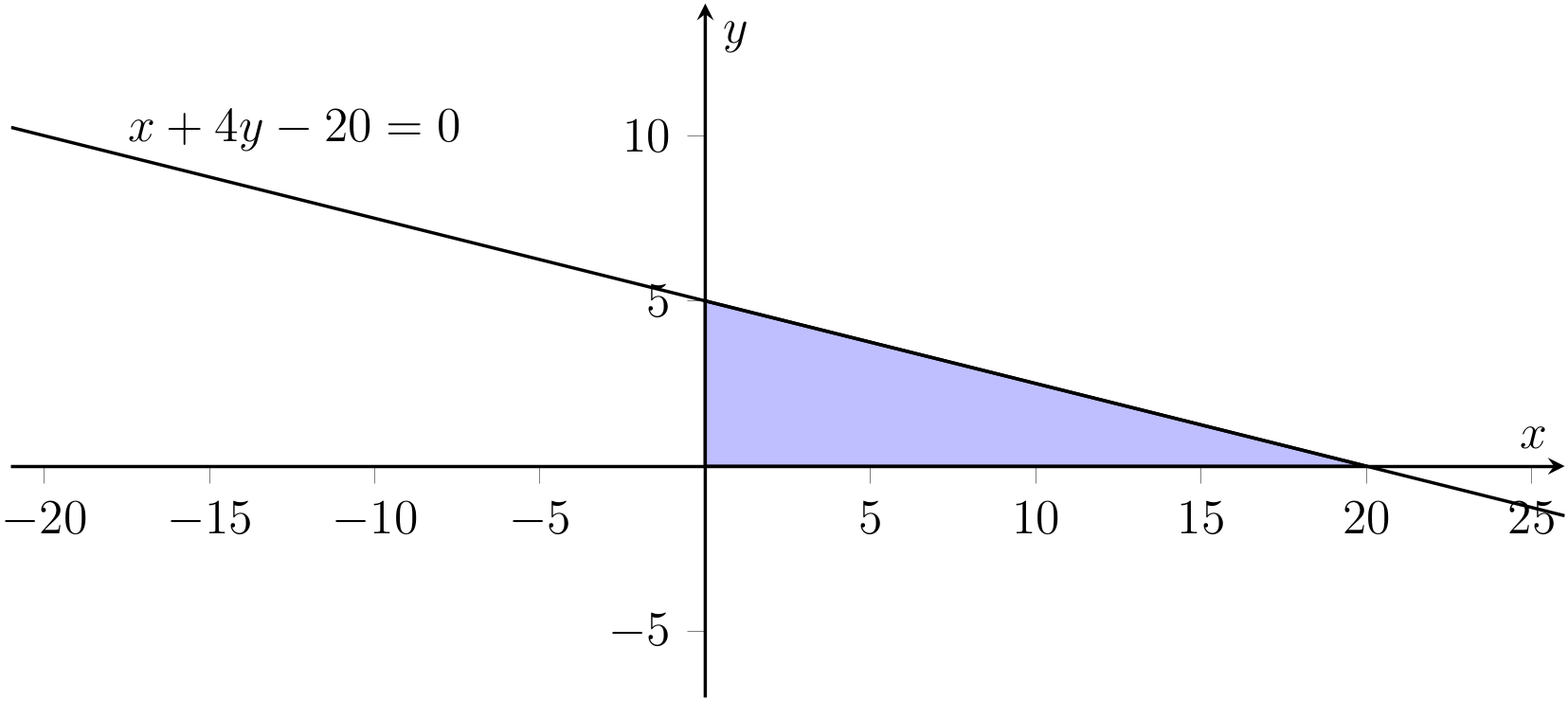
Fig. 60 Shaded region bounded by \(x+4y-20=0\) and the coordinate axes.#
The limits for the integral are given when \(x = 0\), and when \(y = 0\) which is the case when \(x = 20\). Thus the area is
69. (i) Note that \(y = x^2 + 2 > 0\) for all \(x \in \mathbb{R}\). Thus the area is given by
(ii) Note that between \(x = -2\) and \(x = -1\) the graph is fully above the \(x\)-axis as the picture below shows.
(x-2).png)
Fig. 61 Shaded region bounded by \(y=x^2(x-1)(x-2)\), \(x=-2\) and \(x=-1\).#
Thus the area is given by
(iii) As \(y = \frac{3}{x^2} > 0\) for all \(x \in \mathbb{R}\), we have that the area is given by \(\displaystyle \int_1^6 3x^{-2} dx = \left[ -3x^{-1}\right]_1^6 = -\frac{3}{6} - (-3) = 3-\frac{1}{2} = \frac{5}{2}\).
70. We sketch the graph and see that the area we are interested in is above the \(x\)-axis:
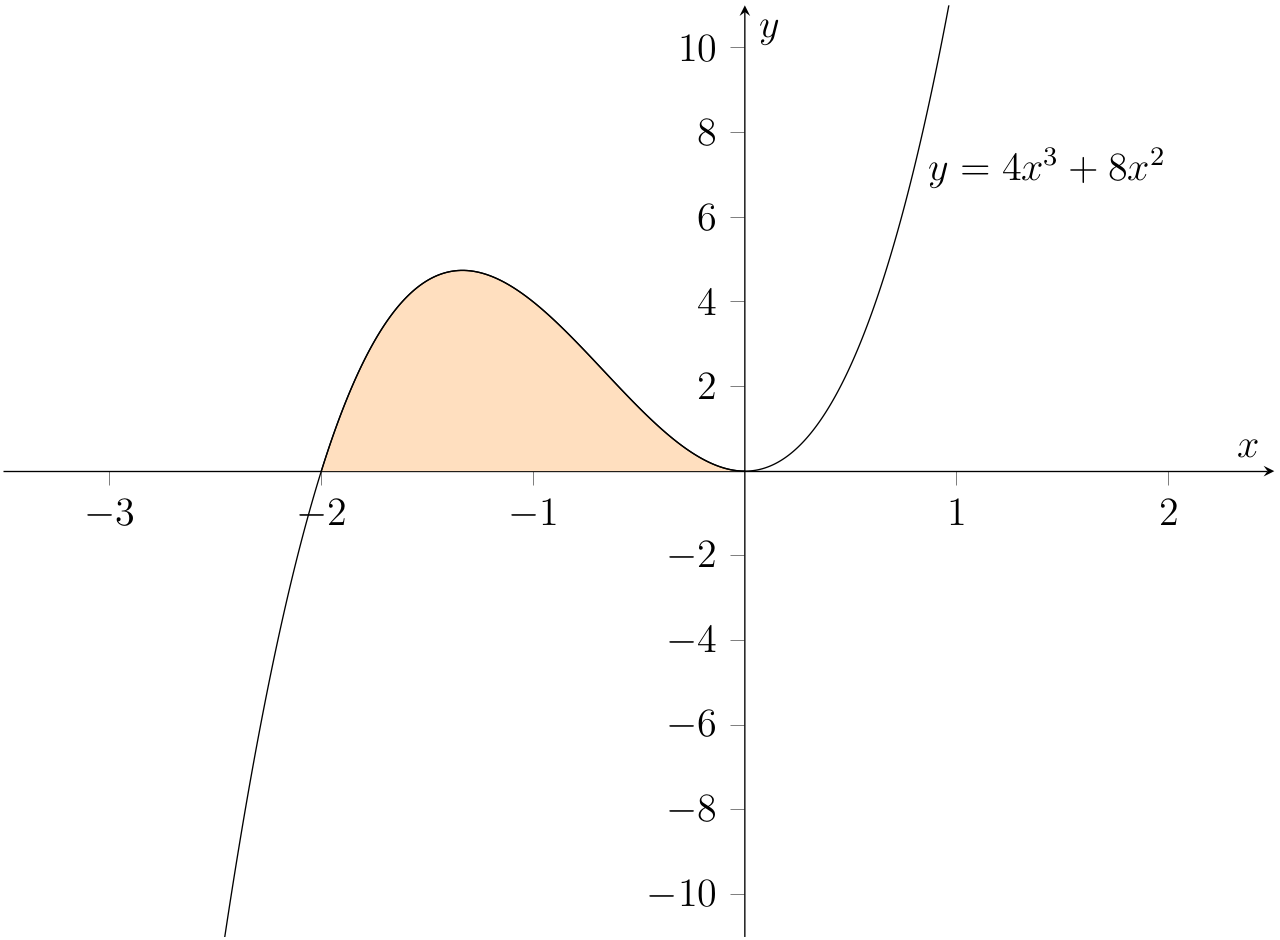
Fig. 62 Shaded region bounded by \(y=4x^3+8x^2\) and the coordinate axes.#
Thus the area is \(\displaystyle \int_{-2}^0 4x^3 +8x^2 dx = \left[ x^4 + \frac{8}{3}x^3\right]_{-2}^0= -\left(16 - \frac{8}{3}(8)\right)= \frac{64}{3} - \frac{48}{3}= \frac{16}{3}\).
71. We factorise to get \(x^2 - 5x + 6 = (x-3)(x-2)\). Thus the graph crosses the \(x\)-axis at \(x=2\) and \(x=3\). Since the coefficient of \(x^2\) is positive, we have the following picture.
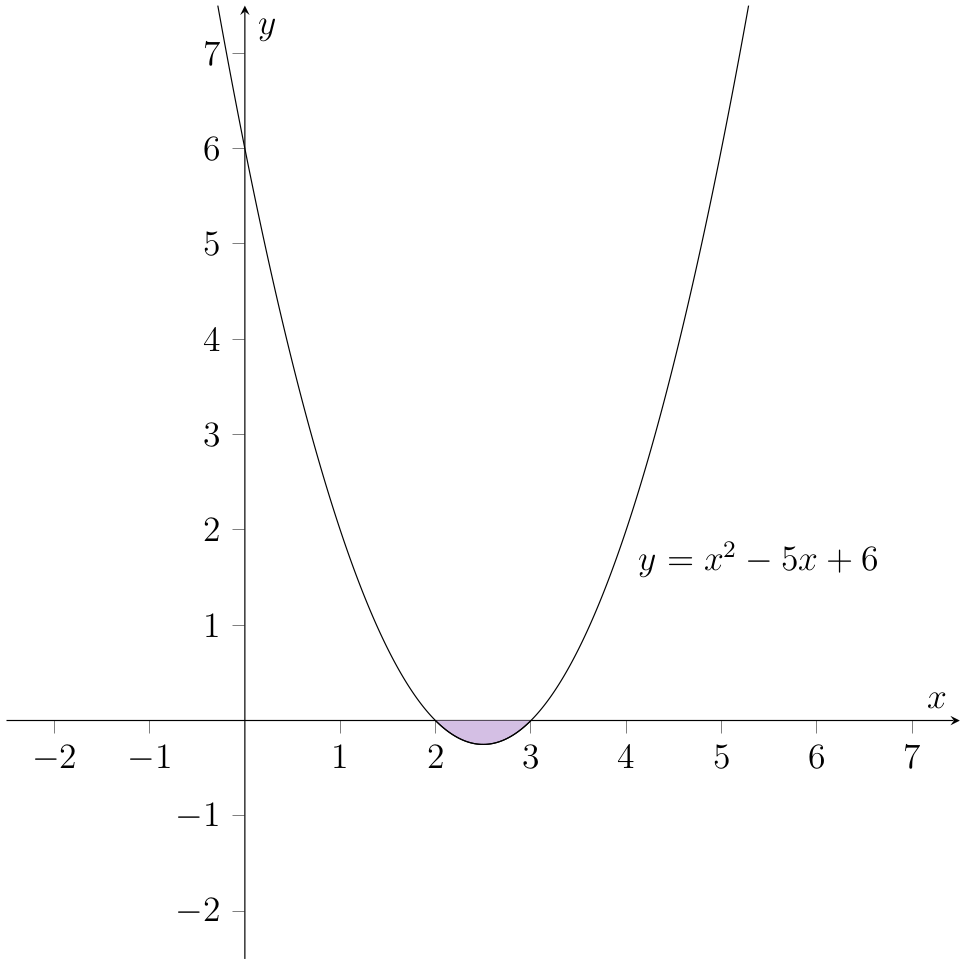
Fig. 63 Region bounded by \(y=x^2-5x+6\) and the \(x\)-axis.#
Thus the limits for our integral are \(x = 2\) and \(x =3\). Hence, since the region is below the \(x\)-axis, letting \(S\) denote the area, we get
Thus the area cut off below the \(x\)-axis is \(S = \frac{1}{6}\).
72. (i) We sketch the graph and the given straight line to see what the area will look like:
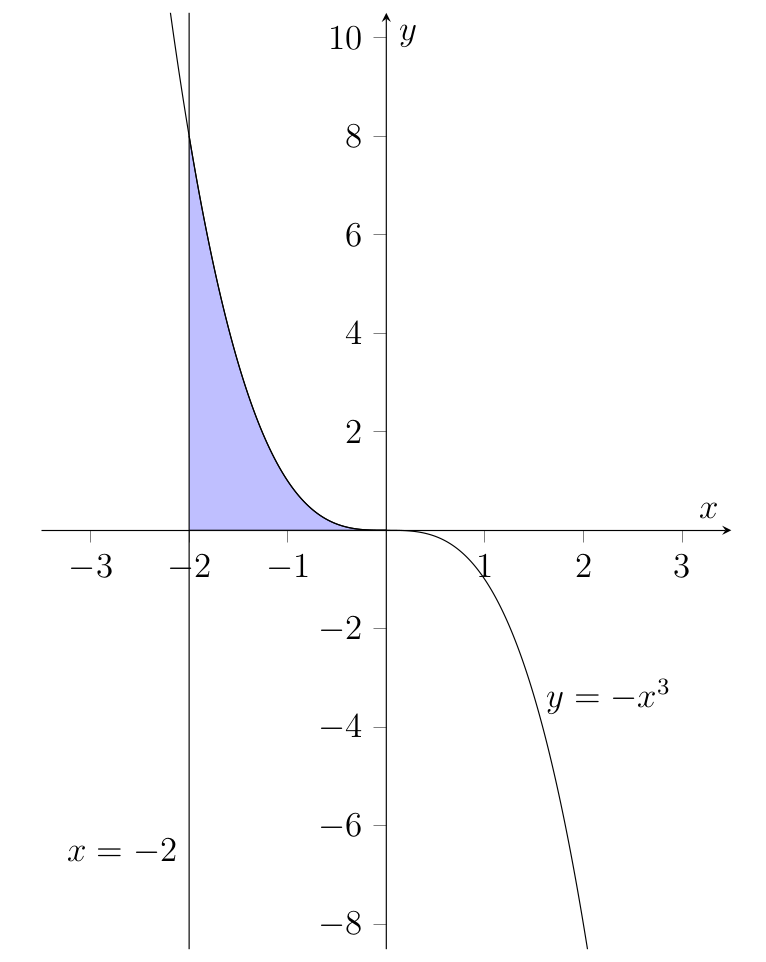
Fig. 64 Region bounded by \(y=-x^3\), \(x=-2\) and the \(x\)-axis.#
We see that the required area is
(ii) We sketch the graph and the given straight line to see what the area will look like:
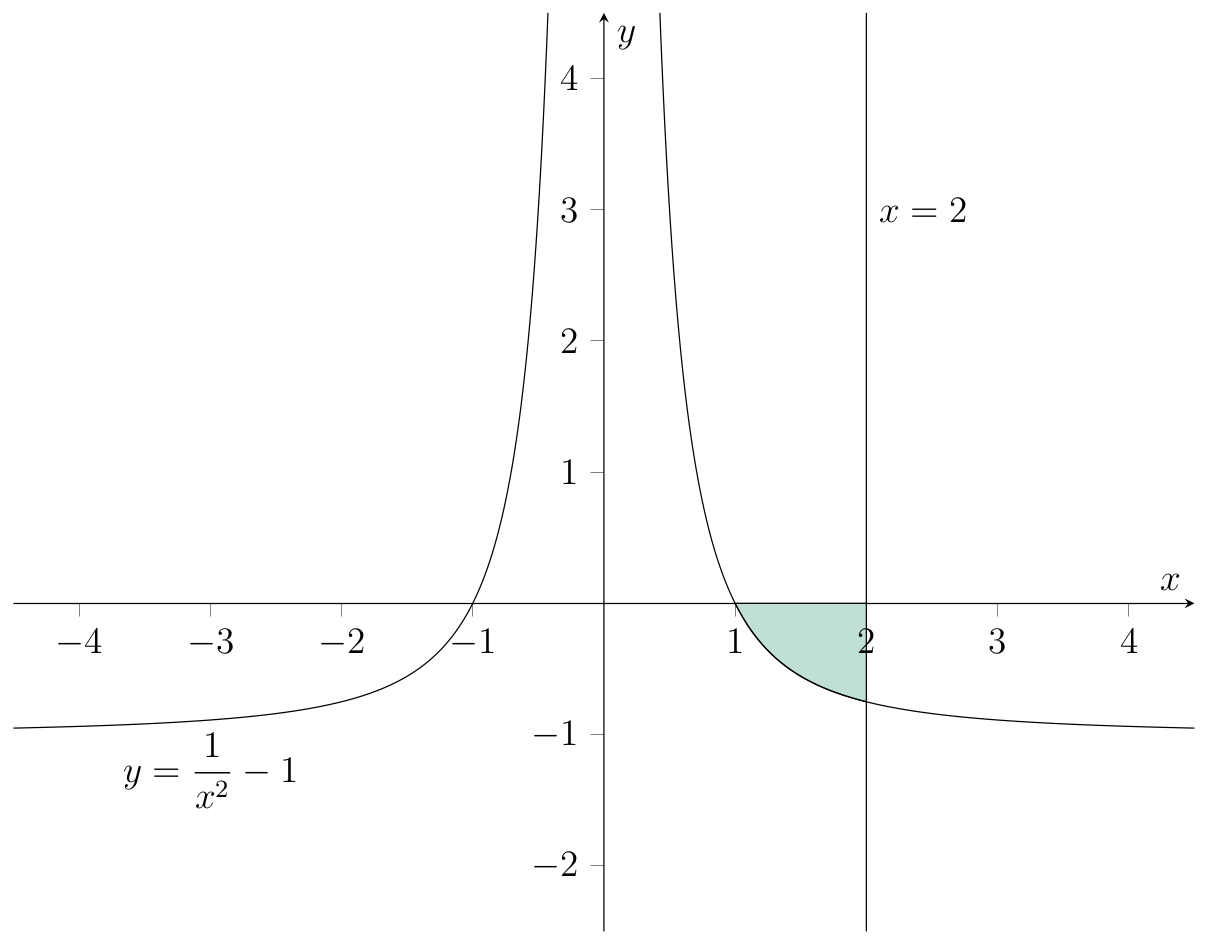
Fig. 65 Region bounded by \(y=\frac{1}{x^2}-1\), \(x=2\) and the \(x\)-axis.#
So here the required area is
73. We sketch the graph of the curve and the given straight line to see what the area will look like. To do this we complete the square to get \(y= x^2 -4x + 6 = (x-2)^2 +2\). Thus the curve has a minimum at \((2,2)\) and is as follows.
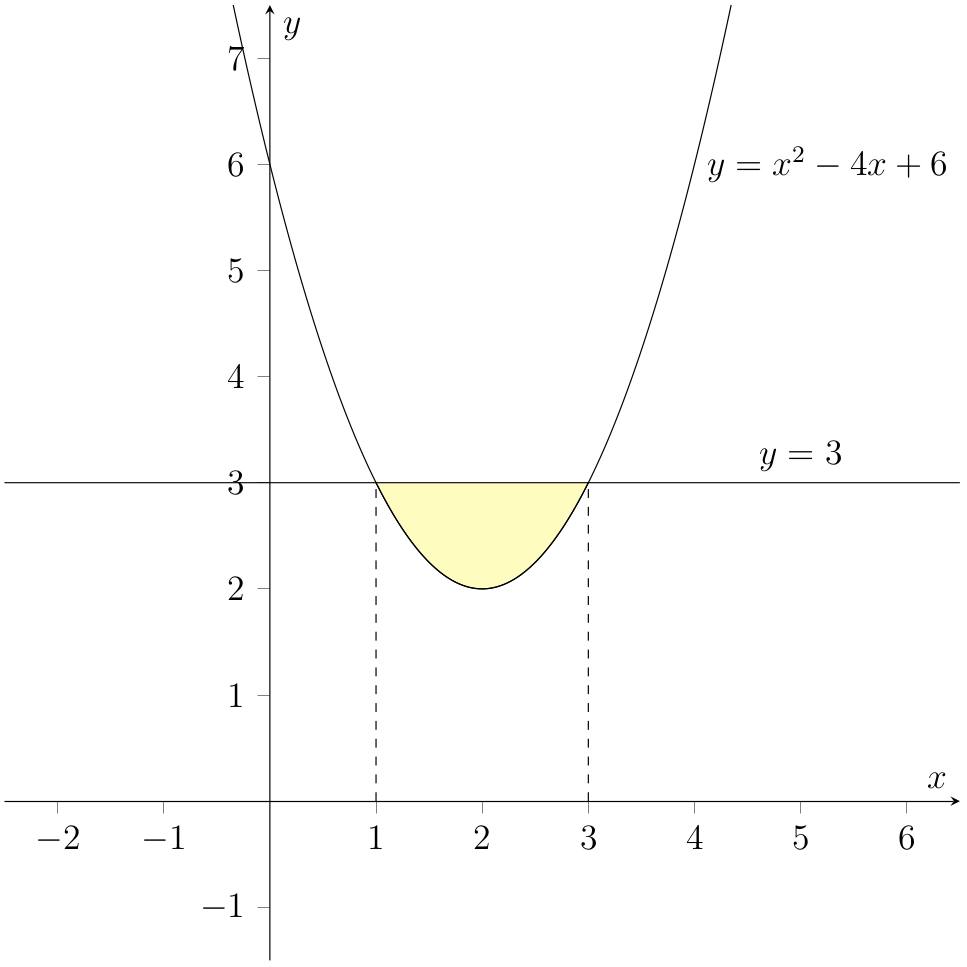
Fig. 66 Region bounded by \(y=x^2-4x+6\) and \(y=3\).#
To find the points of intersection we solve \(3 = x^2 - 4x + 6\) to get \(x^2-4x+3=0\) which gives \((x-1)(x-3)=0\) so that \(x=1\) or \(x=3\). Thus the required area, S, is given by
74. A rough sketch gives the following. Note that \(x-y+1=0\) is the same as \(y=x+1\).
(x-2).png)
Fig. 67 Region bounded by \(y=(x+1)(x-2)\) and \(x-y+1=0\).#
The curve intersects the straight line when \((x+1)(x-2) = (x+1)\), that is, when \((x+1)(x-3) = 0\) so that \(x = -1\) or \(x = 3\). Thus we required area, \(S\), is
75. (i) We get \(\displaystyle \int_{\ln2}^{\ln3} 2e^xdx = \Big[ 2e^x \Big]_{\ln2}^{\ln3} = 2e^{\ln3} - 2e^{\ln2} = 2(3)-2(2) = 2\).
(ii) We get \(\displaystyle \int_1^e \frac{1}{x}dx = \Big[ \ln|x| \Big]_1^e = \ln|e| - \ln|1| = \ln(e) - \ln(1) =1-0 = 1\).
(iii) We have \(\displaystyle\frac{d}{dx}\left(e^{-2x}\right) = -2e^{-2x}\), so \(\displaystyle\int e^{-2x}dx = -\frac{1}{2}e^{-2x}+C\). Hence
76. (i) \(\displaystyle \int_0^{\frac{\pi}{2}} \cos(x)dx = \Big[\sin(x)\Big]_0^{\frac{\pi}{2}} = \sin\left(\frac{\pi}{2}\right) - \sin(0) = 1 - 0= 1\).
(ii) \(\displaystyle \int_0^{\pi} \sin(x)dx = \Big[ -\cos(x) \Big]_0^\pi = -\cos(\pi) + \cos(0)= -(-1) +1 = 2\).
(iii) \(\displaystyle \int_{-\frac{\pi}{2}}^{\frac{\pi}{2}} \cos(x)dx = \Big[ \sin(x)\Big]_{-\frac{\pi}{2}}^{\frac{\pi}{2}} = \sin\left(\frac{\pi}{2}\right) - \sin\left(-\frac{\pi}{2}\right) = 1 - (-1) = 2\).
77. Using the standard integrals from the notes we have the following.
(i) \(\displaystyle \int_0^{\frac{\pi}{4}} \sec^2(x) dx = \Big[ \tan(x) \Big]_0^{\frac{\pi}{4}} = \tan \frac{\pi}{4} - \tan 0 = 1 - 0 = 1\).
(ii) \(\displaystyle \int_0^{\frac{\sqrt{3}}2} \frac{1}{\sqrt{1-x^2}}dx = \Big[\sin^{-1}(x) \Big]_0^{\frac{\sqrt{3}}2} = \sin^{-1}\left(\frac{\sqrt{3}}2\right) - \sin^{-1}(0) = \frac{\pi}{3} -0 = \frac{\pi}{3}\).
(iii) \(\displaystyle \int_0^1 \frac{1}{1+x^2}dx = \Big[ \tan^{-1}(x)\Big]_0^1 = \tan^{-1} 1 - \tan^{-1} 0 = \frac{\pi}{4} - 0 = \frac{\pi}{4}\).
Chapter 13#
Integration by substitution#
78. Let \(u = x^2\) so that \(\frac{du}{dx} = 2x\) and thus \(\frac{dx}{du} = \frac{1}{2x}\). Then, using integration by substitution,
(i) Let \(u = x^2 -3\) so that \(dx = \frac{du}{2x}\). Then
(ii) Let \(u = 3x-1\). Then
(iii) Let \(u=x^2+2x-5\), then \(\frac{du}{dx} = 2x+2\), so
(iv) Let \(u=2x^2-7\), then \(\frac{du}{dx}=4x\), and so
(v)
(vi) For \(\int (x^3 +1)^2dx\), we can’t use substitution: if we put \(u=x^3+1\), then \(\frac{du}{dx}=3x^2\), and we’d get
There is no way to get this integral wholey in terms of \(u\).
Instead, we expand and integrating term by term:
(vii) Let \(u=x^3-3x\). Then \(\frac{du}{dx} = 3x^2-3\). For the limits, when \(x=3\) we have \(u=18\), and when \(x=4\), \(u=52\). Hence
(viii) For \(\int_0^1 (2x^2 -1)^3 dx\), we need to just expand and integrate again — substitution won’t work, as there is no ``\(\frac{du}{dx}\)’’ factor to use for converting the \(dx\) integral into a \(du\) integral.
We have
80. (i) \(\displaystyle \int 3\cos(3x) dx = \sin(3x)+C\).
(ii) \(\displaystyle\int \sin(2x+3) dx = -\frac{1}{2}\cos(2x +3) + C\).
(iii) Note
This means, if we let \(u=\text{ cosec}(x)\), then \(\frac{du}{dx}=-\text{ cosec}(x)\cot(x)\), and so
(iv) \(\displaystyle \int \sec^2(x) \tan^2(x) dx = \frac{1}{3} \tan^3(x)+ C\).
(v) Let \(u = \sec(x)\). Then \(\frac{du}{dx} = \tan(x)\sec(x)\). Thus
(vi) \(\displaystyle \int x \text{ cosec}^2(x)^2dx = - \frac{1}{2} \cot(x)^2 + C\).
\(\displaystyle \int \tan(x)dx = \int \frac{\sin(x)}{\cos(x)} dx = -\ln|\cos(x)| + C = \ln\left|\frac{1}{\cos(x)}\right| + C = \ln|\sec(x)| + C\).
\(\displaystyle \int \cot(x) dx = \int \cos(x) (\sin(x))^{-1} dx = \ln|\sin(x)| + C\).
82. It is easy to see, either by inspection or by using a substitution, that
and similarly, for \(a \neq 0\),
Definite integration by substitution#
83. (i) Let \(u = 1-x^2\) so that \(\displaystyle\frac{du}{dx} = - 2x\) and \(\displaystyle\frac{dx}{du} =-\frac{1}{2x}\).
We next change the limits. When \(x = 0\) we have \(u = 1 - (0)^2 = 1\) and when \(x = \frac{1}{2}\) we have \(u = 1 - (\frac12)^2 = \frac{3}{4}\). Thus we get
(ii) Let \(u = x^2 -1\). Then \(\displaystyle\frac{du}{dx}=2x\) and so \(\displaystyle\frac{dx}{du} = \frac{1}{2x}\).
Changing the limits, when \(x = -1\) we have \(u = 0\) and when \(x = 0\) we have \(u = -1\). Thus
(iii) This is easy to solve by multiplying out the bracket.
Or let \(u = x+2\) so that \(du = dx\), the lower limit is \(u = 1\), the upper limit is \(u = 2\) and
(iv) Let \(u = x^2 +1\) so that \(dx = \frac{du}{2x}\), the upper limit is \(u = 5\) and the lower limit is \(u = 2\). Then
(v)
(vi)
(vii) \(\displaystyle\int_{-\frac\pi2}^0 \cos(x) \sin(x) dx = \left[\frac{1}{2} \sin^2(x)\right]_{-\frac{\pi}{2}}^0 = -\frac{1}{2}\).
(viii) \(\displaystyle \int_0^{\frac{\pi}{3}} \sin(3x) \cos^2(3x) dx = -\frac{1}{9} \left[\cos^3(3x)\right]_0^{\frac{\pi}{3}} = -\frac{1}{9}(-1 - 1) = \frac{2}{9}\).
(ix) \(\displaystyle \int_0^{\frac{\pi}{2}} \cos(x) \sqrt{\sin(x)} dx = \frac{2}{3} \left[\sin^{\frac{3}{2}}x\right]_0^{\frac{\pi}{2}} = \frac{2}{3}\).
(x) \(\displaystyle \int_\pi^{2\pi} \frac{\cos{\sqrt x}}{\sqrt{x}} dx = 2 \left[\sin \sqrt{x}\right]_\pi^{2\pi} = 0\).
84. The graph
.png)
Fig. 68 Area enclosed by the curve \(\displaystyle y = \frac{x}{\sqrt{x^2-1}}\), the \(x\)-axis, \(x = 2\) and \(x = 3\).#
shows that the graph of the function is above the \(x\)-axis between \(2\) and \(3\). Thus the required area is given by
85. (i) \(\displaystyle\int\frac{1}{4x} dx = \frac{1}{4} \ln|x| + C\).
(ii) \(\displaystyle \int \frac{1}{2x+8}dx = \frac{1}{2} \ln|2x+8| + C\).
(iii) \(\displaystyle \int \frac{2x+1}{x^2 +x -2} dx = \ln|x^2 +x -2| +C\).
(iv) \(\displaystyle \int \frac{2x-3}{3x^2 -9x + 4} dx = \frac{1}{3} \ln|3x^2 -9x +4| + C\).
(v) \(\displaystyle \int \frac{x}{x+2}dx = \int 1 - \frac{2}{x+2} dx = x - 2\ln|x+2| + C = x - \ln(x+2)^2\). Or let \(u = x+2\) so that
(vi) \(\displaystyle \int \frac{3x}{2x+3} dx = \int \frac{3}{2} - \frac{9}{2} \times \frac{1}{2x+3} dx = \frac{3}{2} x - \frac{9}{4} \ln|2x+3| + C\). Or let \(u = 2x +3\) so that
(vii) \(\displaystyle \int \frac{2x}{3-x} dx = \int -2 + \frac{6}{3-x} dx = -2x - 6\ln|3-x| + C\). Or let \(u = 3-x\) so that
(viii) \(\displaystyle \int \frac{x-1}{2-x} dx = \int -1 + \frac{1}{2-x} dx = - x - \ln| 2-x| + C\). Or let \(u =2-x\) so that
(ix) \(\displaystyle \int\cot\left(\frac{x}{2}\right)dx = 2\ln\left|\sin\left(\frac{x}{2}\right)\right| + C\).
(x) \(\displaystyle \int \cot(2x+1) dx = \frac{1}{2} \ln| \sin(2x+1)| + C\).
(xi) \(\displaystyle \int - \tan\left(\frac{x}{3}\right) dx = 3\ln\left|\cos\left(\frac{x}{3}\right)\right| +C\).
(xii) \(\displaystyle \int \frac{1}{x^2 +a^2} dx = \frac{1}{a^2}\int \frac{1}{(\frac{x}{a})^2+1}dx =\frac{1}{a}\tan^{-1}\left(\frac{x}{a}\right)+ C\).
(xiii) \(\displaystyle \int \frac{1}{\sqrt{a^2 -x^2}} dx = \frac{1}{a} \int \frac{1}{\sqrt{1-(x/a)^2}} dx= \sin^{-1}\left(\frac{x}{a}\right) + C\).
(xiv) \(\displaystyle \int \frac{1}{1+x^2} dx = \tan^{-1}(x) + C\).
(xv) \(\displaystyle \int \frac{x}{1+x^2} dx = \frac{1}{2} \ln(x^2+1) + C\) as \(x^2 + 1 \geq 1\) for all \(x \in \mathbb{R}\).
(xvi) \(\displaystyle \int \frac{1+x}{1+x^2} dx = \int \frac{1}{1+x^2} + \frac{x}{1+x^2} dx = \tan^{-1} x + \frac{1}{2} \ln(1+x^2) + C\).
(xvii) \(\displaystyle \int \frac{x}{1-x^2} dx = -\frac{1}{2} \ln|1-x^2| + C\).
(xviii) \(\displaystyle \int \frac{1+x}{\sqrt{1-x^2}} dx = \int\frac{1}{\sqrt{1-x^2}} + \frac{x}{\sqrt{1-x^2}} dx = \sin^{-1} x - (1-x^2)^{\frac{1}{2}} + C\).
(xix) \(\displaystyle \int \frac{1}{1-x} dx = -\ln|1-x| + C = \ln\frac{1}{1-x} + C\) as \(x < 1\) and so \(1-x > 0\).
(xx) \(\displaystyle \int \frac{1}{1-x} dx = -\ln|1-x| + C = \ln\left| \frac{1}{1-x}\right| + C\).
(xxi) Let \(u = 1+x\) so that
86. (i) \(\displaystyle \int_e^{e^2} \frac{5}{x} dx = 5\).
(ii) \(\displaystyle \int_3^4 \frac{1}{2x-3} dx = \left[\frac{1}{2} \ln|2x-3|\right]_3^4 = \frac{1}{2}(\ln(5) - \ln3)\).
(iii) \(\displaystyle \int_5^6 \frac{2x-3}{3x^2 -9x + 4} dx = \frac{1}{3} \left[\ln|3x^2 -9x +4|\right]_5^6 = \frac{1}{3} (\ln(5)8 - \ln34)\).
(iv) \(\displaystyle \int_{-\frac{\pi}{4}}^{\frac{\pi}{4}} \tan(x) dx = \int_{-\frac{\pi}{4}}^{\frac{\pi}{4}} \sin(x)(\cos(x))^{-1} dx= - \left[\ln| \cos(x)|\right]= - \ln\left(\cos\left(\frac{\pi}{4}\right)\right) + \ln\left(\cos\left(- \frac{\pi}{4}\right)\right)~=~0\).
(v) \(\displaystyle \int_0^{\frac{1}{2}} \frac{x}{\sqrt{1-x^2}} dx = -\left[(1-x^2)^{\frac{1}{2}}\right]_0^{\frac{1}{2}} = \frac{\sqrt{3}-2}{2}\).
(vi) \(\displaystyle \int_{-\frac{1}{2}}^{\frac{1}{2}}\frac{1}{\sqrt{1-x^2}} dx = \left[\sin^{-1} x \right]_{-\frac{1}{2}}^{\frac{1}{2}}= \sin^{-1} (\frac{1}{2}) - \sin^{-1}(-\frac{1}{2})\).
(vii) \(\displaystyle \int_2^3 \frac{1}{(1-x)^2} dx= \left[(1-x)^{-1}\right]_2^3 = -\frac{1}{2} + 1 = \frac{1}{2}\).
(viii) Let \(u = 1-x\) so that \(\displaystyle \int_2^3 \frac{x}{(1-x)^2} dx = - \int_{-1}^{-2}\frac{1-u}{u^2}du = \left[\ln|u| + u^{-1}\right]_{-1}^{-2} = \ln2 - \frac{1}{2} -(\ln(1) - 1) = \ln2 + \frac{1}{2}\).
Integration using partial fractions#
87. Note that all the fractions here are proper. Which quadratic factorises can be seen in the solutions.
(i)
(ii)
(iii)
(iv) \(\displaystyle \int \frac{x}{16-x^2} dx = - \frac{1}{2} \int \frac{-2x}{16-x^2} dx = -\frac{1}{2} \ln|16-x^2| + C = \frac{1}{2} \ln\left| \frac{1}{16-x^2}\right| + C\). Or
(v)
(vi) \(\displaystyle \int \frac{x-2}{x^2-4x-5} dx = \frac{1}{2} \int\frac{2x-4}{x^2-4x-5} dx = \frac{1}{2} \ln|x^2-4x-5| + C\). Or,
(vii)
as \(x^2 + 3 \geq 3\) for all \(x \in \mathbb{R}\).
(viii)
88. Note that the fraction is improper, so we need a long division first. Also \((x+2)^2 +1\) does not factorise.
89. (i) The fraction is proper and \(x^2-9 = (x-3)(x+3)\). We get
so that
(ii) This fraction is proper and we get
so that
Integration by parts#
90. (i) For \(\int x\cos(x) dx\), let \(u = x\) and \(v' = \cos(x)\) so that \(u' = 1\) and \(v = \sin(x)\). Then
(ii) Let \(u=2x\) and \(v'=\sin(x)\), then \(u'=2\) and \(v=-\cos(x)\), so
(iii) Let \(u=x\), \(v'=\sin(x)\), then
(iv)
(v) We integrate by parts with \(u = x^2\) and \(v' = \cos(x)\) so that \(u' = 2x\) and \(v = \sin(x)\). Thus
Hence
(vi) Use by parts with \(u=x\), \(v'=\sin(x)\):
91. (i)
(ii) Let \(u = x\) and \(\frac{dv}{dx} = e^{2x}\) so that \(\frac{du}{dx} = 1\) and \(v = \frac{1}{2} e^{2x}\). Then
(iii)
Thus
(iv)
(v)
(vi)
(vii)
(viii) Let \(u = t^2\) and \(v' = te^{-t^2}\). Then
92. (i)
(ii)
(iii)
(iv)
93. We can differentiate \(\tan^{-1} x\) so we let \(u = \tan^{-1} x\) and \(v' = 1\) so that \(u' = \frac{1}{1+x^2}\) and \(v = x\). Then, by integration by parts,
We integrate \(\displaystyle \int \frac{x}{1+x^2} dx\) by substitution. For this, let \(u = 1+x^2\) so that \(\frac{du}{dx} = 2x\) and \(dx = \frac{du}{2x}\). Thus
as \(x^2+ 1 > 0\) for all \(x \in \mathbb{R}\).
Thus
For \(\int x \tan^{-1}x dx\), we again differentiate \(\tan^{-1} x\) and get
94. (i) We integrate by parts with \(u = e^x\) and \(v' = \cos\left(\frac{1}{2}x\right)\) so that \(u' = e^x\) and \(v = 2\sin\left(\frac{1}{2}x\right)\). Then
We now integrate \(\int e^x \sin\left(\frac{1}{2}x\right) dx\) by parts. We choose \(u = e^x\) and \(v' = \sin\left(\frac{1}{2}x\right)\). If we choose it the other way round, we will simply reverse what we did in the first integration by parts! Now \(u' = e^x\) and \(v = -2\cos\left(\frac{1}{2}x\right)\). So
Thus
and rearranging gives
so that
(ii)
Thus
(iii)
so that
(iv)
so that
Trig powers integration#
95. (i)
(ii)
(iii)
(iv)
96. There are two possibilities to find the integral \(\displaystyle \int x(x+1)^7 dx\).
The first method is substitution: let \(u = x+1\) so that \(du = dx\). Then
The second method is integration by parts:
97. Let \(x= \sin\theta\) so that \(dx = \cos\theta d\theta\). Then
Now
Thus