
Homework 3#
Released: 4pm Monday Week 6. Due: 4pm Monday Week 7.
General feedback#
Thank you to everyone who completed this work!
Your work is now marked with personalised feedback. Please take some time to view it on Crowdmark and compare with the more general comments and model solution below. If you are unsure about why you have received the comments or marks that you have, please get in touch.
The mark scheme myself and Simon used to mark is roughly the following:
Up to 1 mark for part (i). To get this mark, you had to write down the correct pair of simultaneous inequalities, with valid justification.
Up to 3 marks for part (ii): 1 mark for each individual inequality solution, and the third mark for combining them.
Up to 6 marks for part (iii), solving the simultaneous equations. 1 mark for finding the x values, 2 marks for applying the inequality solution from (ii) (or equivalent discussion of validity), 2 marks for corresponding y values, and 1 mark for a valid check).
High marks were awarded for using a correct method, correct mathematical notation, with appropriate explanation, written in a clear, easy to follow fashion. Method marks were lost if we couldn’t follow your argument, and/or for notational issues. A full model solution with mark scheme can be viewed below.
The most common issue with this piece of work was in the articulation of arguments, especially in part (ii). For quadriatic inequalities, a lot of people began by calculating roots. This works when accompanied by clear reasoning about how the roots relate to the inequalities — ideally with reference to a graph. Without this context, you are claiming that the inequality has only two distinct solutions, which is incorrect. Similarly with part (iii), the simultaneous equations, we could not award method marks unless you provide reasoning to go along with your equations. If you would like a reminder of how to approach simultaneous quadratic inequalities, see the example at the start Lecture 16 (encore recordings and handwritten notes are on Blackboard). For more about simultaneous quadratic inequalities, see Homework 1 feedback.
Next steps: Review your work on Crowdmark, think about the comments, get in touch with Rosie if you would like to talk about anything, and work on applying any feedback to your revision practice.
If you would like me to take a look at any more written work as you prepare for the January exams, please get in touch, or attend my office hours (online or in person), which will now continue throughout January.
Quick links:
Question#
Consider the simultaneous equation
(i) Write down a pair of quadratic inequalities that must be satisfied in order for these equations to make sense. [Hint: What can you say about the signs of each side of the equations?] (1 mark)
(ii) Solve the pair of inequalities from part (i). (3 marks)
(iii) Find all the solutions to the original simultaneous equations.
Your answer should include a check. You should also clearly state for which values your calculations are valid. (6 marks)
Model solution with mark scheme#
Hidden in case you want to re-attempt the question as revision.
Click to view solution
(i) \(y^2\geq 0\) for all \(y\), so in order for the equations to make sense, we need both of the inequalities
to hold. (1 mark)
(ii) We label the inequalities as
Inequality (1) has solution \(x \geq 1\) or \(x \leq -1\). (1 mark)
For inequality (2), let \(q(x) = 9x^2 + 26x + 14\). We solve \(q(x)\geq 0\) by first identifying the roots of \(q(x)\). The quadratic formula tells us they are \begin{align*} x = \frac{-26\pm\sqrt{26^2-4\times 9\times 14}}{18} &= \frac{-26\pm 2\sqrt{13^2-9\times 14}}{18} \ &= \frac{-13\pm\sqrt{169-126}}{9} = \frac{-13\pm\sqrt{43}}{9}. \end{align*} Note that as the leading coefficient of \(q(x)\) is positive, its graph will have a global minimum point, between its two roots.
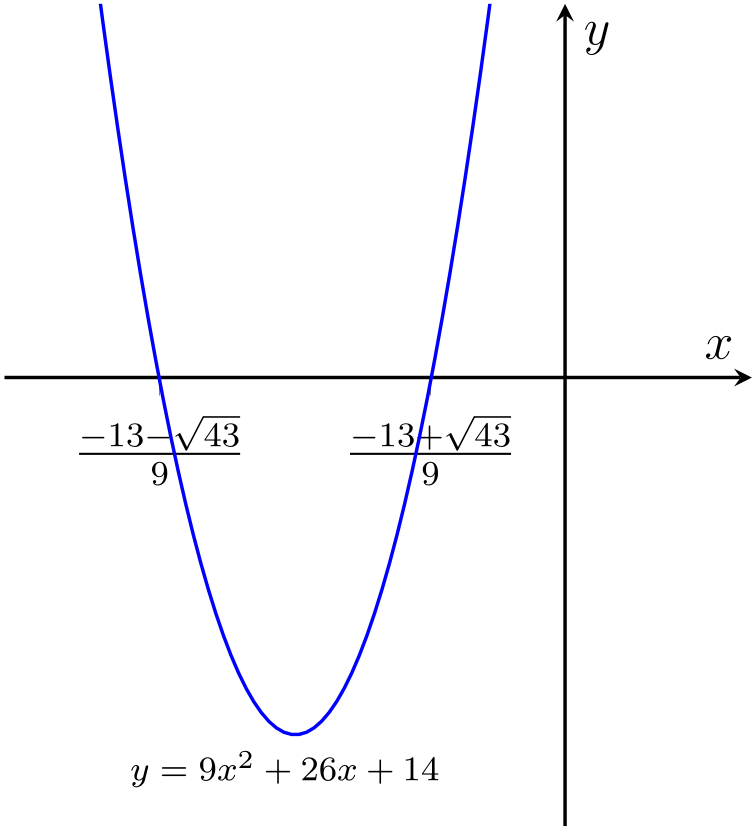
Fig. 69 Graph of \(y=9x^2 + 26x + 14\)#
Therefore \(q(x)\geq 0\) when \(x \leq -\frac{13+\sqrt{43}}{9} \text{ or } x \geq \frac{-13+\sqrt{43}}{9}\). (1 mark)
Both inequalities (1) and (2) hold when (\(x\geq 1\) or \(x\leq -1\)) and (\(x \leq -\frac{13+\sqrt{43}}{9} \approx -2.17\) or \(x \geq \frac{-13+\sqrt{43}}{9} \approx - 0.72\)). In other words, when \(x \geq 1\) or \(x \leq -\frac{13+\sqrt{43}}{9}\). (1 mark)
(iii) Label the equations
Clearly \(y^2 = y^2\) and thus we can equate the right hand sides to get
That is,
and so \(x = -\frac 34\) or \(x = - \frac 52\). (1 mark)
Now \(x = - \frac 34\) cannot be a solution as we saw in part (ii) that we need \(x \geq 1\) or \(x \leq -\frac{13+\sqrt{43}}{9}\). (1 mark)
On the other hand, \(x = -\frac 52\) is in the range of possible answers as \(-\frac 52 = -2.5 < -\frac{13+\sqrt{43}}{9} \approx -2.17\). (1 mark)
So using equation (1) and \(x = - \frac 52\), we get that \(y^2 = \left(-\frac 52\right)^2 - 1 = \frac{25}{4} - 1 = \frac{21}{4}\) so that \(y = \frac{\sqrt{21}}2\) or \(y = - \frac{\sqrt{21}}2\). (1 mark)
Thus the above simultaneous equation has the two solutions \(\left(x = - \frac 52 \text{ and } y = \frac{\sqrt{21}}2\right)\quad \text{ or } \quad \left(x = - \frac 52 \text{ and } y = -\frac{\sqrt{21}}2\right)\).(1 mark)
Check: We check our solution by using equation (2) (since it was used least recently). When \(x = - \frac 52\) and \(y = \pm \frac{\sqrt{21}}2,\) then
and
(1 mark)