
1. Revision of Background Knowledge#
In this section, we will be revising
fractions (numerical and algebraic)
Solving equations in one variable
Changing the subject of an equation
Simultaneous linear equations.
Fluency and agility in your numerical and algebraic calculations will directly impact your ability to access more advanced topics later in the module.
Warning
It is essential that you continue to practice these skills, using the problem booklet and homework assignments.
Please do this even if you feel they are already familiar to you. Many before you have assumed they can skip work on the more basic topics and rely on what they remember from school or college, but the expectations at university are different. You can only get a feel for what is required if you keep practising and handing in homework assignments for feedback. Do not make the same mistake as others before you!
1.1. Fractions#
A fraction, is a quotient of two numbers.
If \(a\) and \(b\) are numbers, and if \(b\neq 0\), the fraction \(\frac{a}{b}\) is defined to be the number you get when you divide \(a\) by \(b\).
The number on top is called the numerator, and the number on the bottom is called the denominator. Since division can often be hard to do exactly, fractions are used to help keep calculations accurate.
We will also be dealing with algebraic fractions, that is fractions where the numerator and denominator are both functions of some variable or “unknown” (we will usually use \(x\) ).
For example, \(\frac{x+1}{x^2+7}\) is an algebraic fraction, whereas \(\frac{2}{3}\) is a numerical fraction. Since the variable \(x\) is just a stand-in for an actual number, the rules for dealing with both types of fractions are the same.
Note
For accuracy, answers should be given as fractions, and not decimals, where possible.
This is because converting from fractions to decimals typically requires rounding, and repeated rounding in extended calculation can introduce significant errors (called ‘rounding errors’).
You are also likely to lose marks in an exam if your solution is not exact.
1.1.1. Multiplying fractions#
Two fractions are multiplied together by multiplying the two numerators together to get a new numerator, and multiplying the denominators together to get a new denominator. For example, if we wanted to multiply the fractions \(\frac{3}{5}\) and \(\frac{2}{7}\), we would calculate
Here, we have multiplied the two numerators on the left-hand side to get the numerator on the right-hand side, and done the same thing with the denominators, so that the denominator on the right-hand side is the product of the two denominators on the left-hand side. To finish off the calculation, we multiply out
Exercise
Calculate the following
(i) \(\frac{1}{2}\times\frac{3}{4}\)
(ii) \(\frac{3}{5}\times\frac{2}{7}\)
(iii) \(\frac{3}{10}\times\frac{9}{5}\)
(iv) \(\left(\frac{2}{7}\right)^2\)
(v) \(\frac{-1}{4}\times\frac{3}{7}\)
(vi) \(\frac{6}{5}\times\frac{4}{5}\)
Solution (click)
(i) \(\frac{3}{8}\), (ii) \(\frac{6}{35}\), (iii) \(\frac{27}{50}\), (iv) \(\frac{4}{49}\), (v) \(\frac{-3}{28}\), (vi) \(\frac{24}{25}\).
1.1.2. Equivalent Fractions and lowest terms#
Two fractions are called equivalent if they are equal in value. For example, the fractions \(\frac{2}{6}\) and \(\frac{1}{3}\) are equivalent, because we can calculate
This can also be understood pictorially:
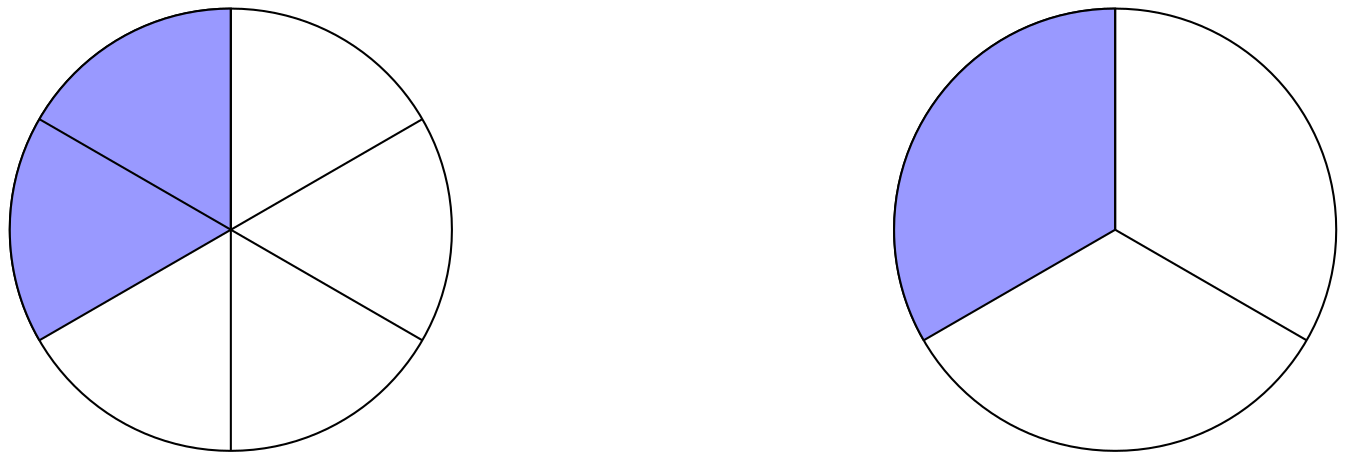
Fig. 1.1 \(\frac{2}{6}=\frac{1}{3}\).#
In Fig. 1.1, the first circle is divided into sixths, and the second is divided into thirds. Because of the way the circles have been divided, the shaded region in the first circle covers two segments, so is two sixths of the circle, whereas the same area in the second circle covers just one segment out of three, and represents one third of the circle.
You can always get from one fraction to another equivalent fraction by multiplying or dividing the top and bottom by the same thing.
This is useful when simplifying your answer. If you notice that the numerator and denominator of a fraction share a common factor, then you can cancel this factor from the top and bottom. For example,
To show that two fractions are equivalent, begin with one fraction, and multiply or divide top and bottom by the same thing until you arrive at the other fraction.
Example 1.1
Show that \(\frac{8}{12}\) and \(\frac{56}{84}\) are equivalent fractions.
Solution (click)
We have
Lowest terms#
We saw earlier that some fractions, such as \(\frac{2}{6}\) can be written in a form that is more simple, such as \(\frac{1}{3}\), by noticing that the numerator and denominator share a common factor of 2. Many fractions can be simplified this way, and it is often desirable to write fractions in their simplest form, by cancelling common factors. This is called expressing a fraction in its lowest terms.
Example 1.2
Suppose we wanted to write \(\frac{6}{14}\) in its simplest form.
We first look for common factors shared by the numerator, 6, and denominator, 14. Both numbers are even, which means that 2 is a common factor. In fact, we find that
Substituting back into the original fraction gives
From here, we can cancel 2 from the denominator, to get
Alternatively, a more explicit calculation gives
The numbers 3 and 2 are coprime — that is, they share no common factors. This means that \(\frac{3}{2}\) is in its simplest form, and we have completed the problem.
Example 1.3
Let’s simplify \(\frac{42}{56}\).
The numerator and denominator are both even, so we can begin by cancelling 2 from the top and bottom:
Now we want to simplify \(\frac{21}{28}\). Notice that both \(21\) and \(28\) are multiples of 7 — in fact,
The numbers 3 and 4 have no common factors, and hence
is our final answer.
Exercise
Express the following fractions in their simplest form
(i) \(\frac{4}{8}\)
(ii) \(\frac{20}{50}\)
(iii) \(\frac{18}{54}\)
(iv) \(\frac{33}{39}\)
(v) \(\frac{-15}{45}\)
(vi) \(\frac{64}{76}\)
Solutions (click)
(i) \(\frac{4}{8}=\frac{1}{2}\), (ii) \(\frac{20}{50}=\frac{2}{5}\), (iii) \(\frac{18}{54}=\frac{1}{3}\), (iv) \(\frac{33}{39}=\frac{11}{13}\), (v) \(\frac{-15}{45}=\frac{-3}{15}\), (vi) \(\frac{64}{76}=\frac{16}{19}\)
Fractions and negative numbers#
When working with fractions with negative numerators or denominators the minus sign can be moved from top to bottom and back again. For example, \(\frac{-4}5\) and \(\frac {4}{-5}\) are both the same thing. We usually write them as \(-\frac45\). One consequence is we have results such as \(\frac{-2}{-3}=\frac{2}{3}\).
Exercise
Calculate the following, leaving your answer in its simplest form.
(i) \( \frac{2}{5}\times\frac{5}{6}\)
(ii) \(\frac{9}{14}\times\frac{-8}{15}\)
(iii) \(\frac{-6}{5}\times\frac{-7}{28}\)
Solution
(i) \(\frac{2}{5}\times\frac{5}{6}=\frac{1}{3}\), (ii) \(\frac{9}{14}\times\frac{-8}{15}=-\frac{8\times 3}{14\times 5}=\frac{24}{70}\), (iii) \(\frac{-6}{5}\times\frac{-7}{28}=\frac{6}{5\times 4}=\frac{3}{10}\).
1.1.3. Dividing Fractions#
The reciprocal of a fraction is the fraction raised to \(-1\), and is the fraction you get by swapping the numerator and denominator. For example, the reciprocal of \(\frac{2}{5}\) is
Dividing by a fraction is the same as multiplying by its reciprocal. For example,
It is good practice to leave answers in their simplest form, using the techniques discussed above. In the above example, our final answer would be \(\frac{3}{5}\), since
and \(3\) and \(5\) have no common factors.
Simplifications can be made as you go. Doing so will help to keep the numbers you deal with small, and make calculation easier.
Example 1.4
Suppose we want to calculate \(\frac{1}{3}\div\frac{2}{9}\). Dividing by \(\frac{2}{9}\) is the same as multiplying by \(\frac{9}{2}\), so we would first write
This is where it is good to spot simplifications. Since \(9=3\times 3\), we can cancel some 3s, and write
Since \(3\) and \(2\) have no common factors, the answer is in its simplest form.
Example 1.5
Let’s calculate \(\frac{6}{16}\div\frac{5}{12}\). First, notice that
and so
Cancelling 4 from the top and bottom,
Hence our answer is
The answer is in its simplest form, because \(9\) and \(10\) have no common factors.
Exercise
Calculate the following, leaving your answer in its simplest form.
(i) \(\frac{4}{5}\div\frac{3}{2}\)
(ii) \(\frac{7}{8}\div\frac{1}{2}\)
(iii) \(\frac{6}{11}\div\frac{4}{3}\)
(iv) \(\frac{6}{9}\div\frac{5}{12}\)
(v) \(\frac{-8}{18}\div\frac{9}{10}\)
(vi) \(\frac{-13}{27}\div\frac{-5}{9}\)
Solution
(i) \(\frac{4}{5}\div\frac{3}{2}=\frac{8}{15}\),
(ii) \(\frac{7}{8}\div\frac{1}{2}=\frac{7}{8}\times 2=\frac{7}{4}\),
(iii) \(\frac{6}{11}\div\frac{4}{3}=\frac{6}{11}\times\frac{3}{4}=\frac{9}{22}\),
(iv) \(\frac{6}{9}\div\frac{5}{12}=\frac{2}{3}\times\frac{12}{5}=\frac{8}{5}\),
(v) \(\frac{-8}{18}\div\frac{9}{10}=\frac{-4}{9}\times\frac{10}{9}=-\frac{40}{81}\),
(vi) \(\frac{-13}{27}\div\frac{-5}{9}=\frac{13}{27}\times\frac{9}{5}=\frac{13}{15}\).
Fractions where the denominator and/or numerator is a fraction#
Consider the fraction \(\displaystyle\frac{\phantom{2}7\phantom{2}}{\frac 5{12}}\). We want to write this in a simpler form. One way to do this is to multiply top and bottom by \(12\) to get
So \(\displaystyle\frac{\phantom{2}7\phantom{2}}{\frac 5{12}}\) is the same as \(\displaystyle \frac {84}{5}\).
A second way to approach it is to use the rule above for dividing fractions. Then we have
This second method is perhaps most useful when both the numerator and the denominator are fractions. For example,
Division by 0#
An important point to remember is that it is not allowed to have a fraction with \(0\) as the denominator. Such a fraction is called undefined (see what your calculator gives for \(\frac{3}{0}\)). This has not been such an issue so far when looking at numerical fractions, but will become very important when we consider algebraic fractions, as we must ensure we exclude values of \(x\) that give a zero denominator.
1.1.4. Adding and Subtracting Fractions#
To express the sum of two fractions as a single fraction, it is essential that they share a \textbf{common denominator}. For example, suppose we wanted to calculate
Reading this aloud might help: “One fifth plus two fifths” suggests the answer should be “three fifths”, in much the same way as adding 1cm to 2cm would give 3cm. Symbolically, we write
However, to calculate
we first would need to express each fraction in terms of the same denominator.
Here is an exercise to practise adding fractions when the denominators are the same.
Exercise
Calculate the following, leaving your answer in its simplest form.
(i) \(\frac{1}{5}+\frac{2}{5}\),
(ii) \(\frac{1}{6}-\frac{5}{6}\),
(iii) \(\frac{7}{15}-\frac{13}{15}\).
Solution
(i) \(\frac{3}{5}\), (ii) \(-\frac{2}{3}\), (iii) \(-\frac{2}{5}\).
If the denominators are different, we must first convert to a common denominator before adding the numerators. To use the units analogy again, adding centimetres and centimetres is straight-forward, whereas adding centimetres to inches first requires some conversion of units before we can arrive at an answer.
Example 1.6
Calculate \(\displaystyle \frac{1}{2}+\frac{1}{3}\).
Solution.
We can use equivalent fractions to transform this sum into one where all denominators are the same. This is called finding a common denominator for the fractions.
We have
Therefore
In Example 1.6, we began with a sum of halfs and thirds, which transformed into a sum of sixths. Pictorially, the inital sum may be represented as
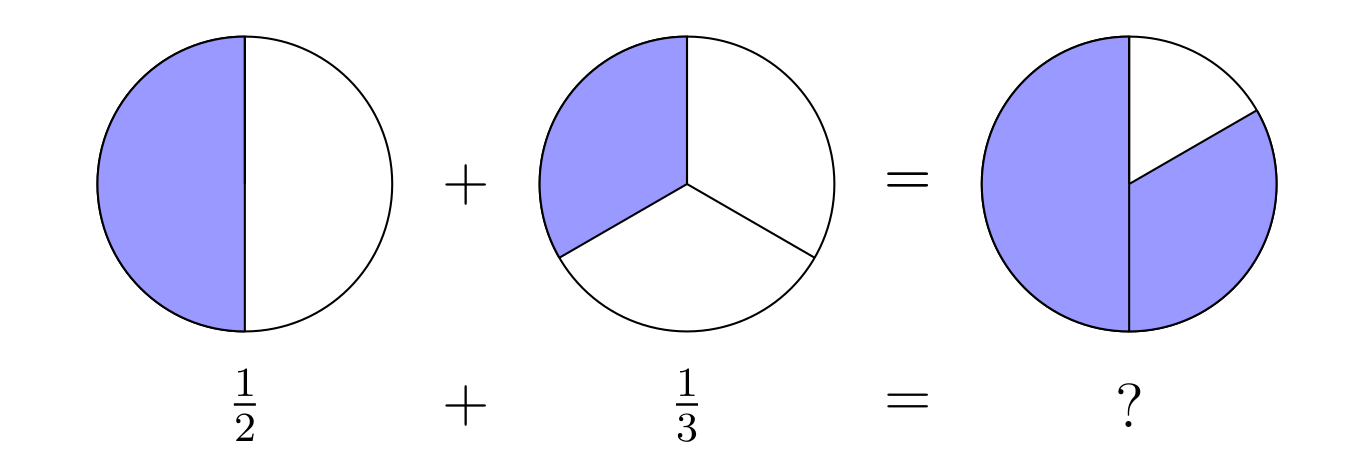
Fig. 1.2 Visualisation of the sum \(\frac{1}{2}+\frac{1}{3}\).#
Without converting to sixths, it is not clear what fraction is being represented on the right-hand side. Expressing each fraction in terms of sixths allows us to count segments and arrive at the solution:
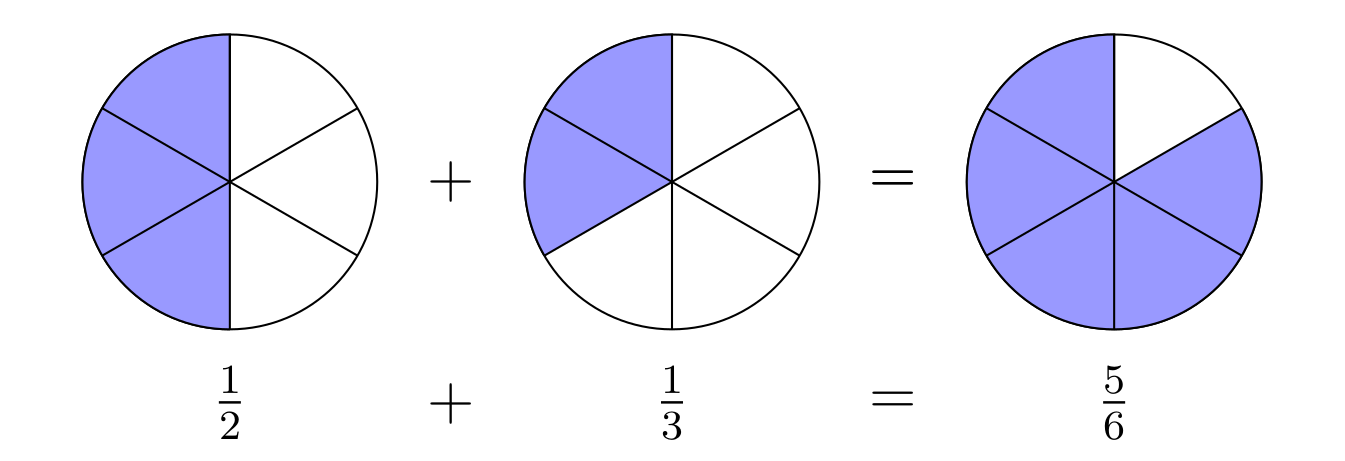
Fig. 1.3 Visualisation of the sum \(\frac{1}{2}+\frac{1}{3}=\frac{5}{6}\).#
The reason 6 worked so well as the common denominator in the last example is because it is small. In fact, it is the lowest common multiple of \(2\) and \(3\) — the smallest number divisble by both 2 and 3. The lowest common multiple is always a good candidate when seeking a common denominator of two fractions.
Example 1.7
Calculate
Solution.
Before adding, we must first express both fractions in terms of a common denominator. As mentioned above, a good candidate for a common denomator is the lowest common multiple. Thinking through 3 and 5 times tables,
and
we see that the lowest common multiple of 3 and 5 is 15. So we want to write (\ref{eq:eg1}) as a sum of fifteenths. We have \(15=3\times 5\), and so to express \(\frac{2}{3}\) in terms of fifteenths, we multiply top and bottom by 5:
Similarly, to convert \(\frac{2}{5}\) into fifteenths, multiply top and bottom by 3:
Substituting back into (1.1),
The last thing to do is check that our answer is in its simplest form, which it is, since 16 and 15 have no common factors. (Note: This is an advantage of using the lowest common multiple for the common denominator, rather than a larger common multiple. Have a think about why!)
Example 1.8
Calculate
Solution.
This is a subtraction, rather than an addition, but we can proceed in exactly the same way. The first step is to calculate the lowest common multiple of the denominators \(9\) and \(6\). Comparing 9 and 6 times tables, we see that \(\text{lcm}(9,6)= 18\), and so we want to express both fractions as eighteenths.
We have
and
Substituting back into (1.2),
This answer is in its simplest form, since 13 and 18 have no common factors.
Exercise
Calculate the following, expressing your answer in lowest terms.
(i) \(\frac{1}{2}-\frac{1}{3}\),
(ii) \(\frac{2}{5}+\frac{3}{10}\),
(iii) \(\frac{4}{3}-\frac{4}{5}\),
(iv) \(\frac{3}{7}+\frac{1}{3}\),
(v) \(\frac{11}{12}-\frac{5}{8}\),
(vi) \(\frac{3}{26}-\frac{18}{39}\).
Solution
(i) \(\frac{1}{2}-\frac{1}{3}=\frac{3}{6}-\frac{2}{6}=\frac{1}{6}\),
(ii) \(\frac{2}{5}+\frac{3}{10}=\frac{4}{10}-\frac{3}{10}=\frac{1}{10}\),
(iii) \(\frac{4}{3}-\frac{4}{5}=\frac{16}{15}-\frac{12}{15}=\frac{4}{15}\),
(iv) \(\frac{3}{7}+\frac{1}{3}=\frac{9}{21}-\frac{7}{21}=\frac{2}{21}\),
(v) \(\frac{11}{12}-\frac{5}{8}=\frac{22}{24}-\frac{15}{24}=\frac{7}{24}\),
(vi) \(\frac{3}{26}-\frac{18}{39}=\frac{3}{2\times 13}-\frac{6}{13} = \frac{3-2\times 6}{2\times 13}=-\frac{9}{26}\).
1.1.5. Summary of fractions terminology#
The numerator of a fraction is the number (or expression) on the top. For example, the numerator of \(\frac{2}{3}\) is \(2\).
The denominator of a fraction is the number (or expression) on the bottom. As an example, the denominator of \(\frac{2}{3}\) is \(3\).
A common denominator of two fractions is a number (or expression) that is divisible by the denominators of both of the fractions.
Thus a common denominator for \(\frac{3}{4}\) and \(\frac{1}{6}\) is \(12\) since \(12\) is divisible by both \(4\) and \(6\). Note that a common denominator is not unique; for example `24’ is also a common denominator for \(\frac{3}{4}\) and \(\frac{1}{6}\). Usually we try to find the smallest common denominator as it is easier to work with small numbers.
A fraction is in lowest terms when the numerator and denominator share no common factor.
That is, there is no number (or expression) which divides both the top and bottom of the fraction. For example, \(\frac{3}{19}\) is in lowest terms while \(\frac{2}{4}\) is not as 2 divides both the numerator and denominator.
Any fraction can be made into one in lowest terms by cancelling (see below).
Two fractions are said to be equivalent if they are the same when reduced to lowest terms (that is, if they are equal in value).
A numerical fraction is proper or bottom heavy if the denominator is bigger than the numerator. For example, \(\frac{1}{2}\) is proper.
A numerical fraction is improper or top heavy if the numerator is at least as big as the denominator. For example, \(\frac{2}{2}\) and \(\frac{4}{3}\) are improper fractions.
An improper fraction can be written as a mixed number, that is an integer added to a proper fraction. For example, \(2\frac{2}{9} = \frac{20}{9}\).
To make things as easy as we can, we usually reduce fractions to their lowest terms, e.g.~we write \(\frac{1}{2}\) rather than \(\frac{2}{4}\) — this cuts down on arithmetic.
When calculating with fractions it is better to convert them to, or leave them as, improper fractions instead of mixed numbers. For example, we write \(\frac{3}{2}\) rather than \(1\frac{1}{2}\). (Note: This might be different to what you have been told at school, but a mixed number is the only incident where a missing symbol is not assumed to be a multiplication.)
1.1.6. Simplifying algebraic fractions#
All of the techniques we have discussed so far for numerical fractions carry over to the setting of algebraic fractions.
Working with algebraic fractions can involve multiplying out complicated brackets and factorizing, as we see in the following examples.
Example 1.9
Express each of the following as a single fraction, simplifying your answer as much as possible.
(i) \(\frac{2p + 3q}{p+q} + \frac{4p-5q}{p-q}\),
(ii) \(\frac{a-b}{2a} - \frac{a+b}{3b}\).
Solution.
(i) Note the denominators are \(p+q\) and \(p-q\), so we use common denominator \((p+q)(p-q)\). We have:
Note
We have left the denominator factorised; that is we have not expanded it out. The most useful form for expressions is when they are factorised. If we had expanded out the denominator, we would have had to re-factorise: a waste of time!
(ii) This time the denominators are \(2a\) and \(3b\), so we use \((2a)(3b)\) as the common denominator.
The same principles of common denominators and simplification apply to sums of more than one fraction.
Example 1.10
Simplify
Solution.
We aim to get all three of the fractions in terms of one common denominator, \((2p+q)(p-3q)(4p+3q)\). Remember, the goal is not to multiply out the denominator, but leave it factorised!
We have,
Remember: Always leave the denominator factorised (unless you have a very good reason!).
Remark 1.1
Simplifying a fraction often requires cancelling. But remember that we can’t cancel in sums, only products. Often we will end up with fractions like \(\frac{X+Y-Z}{V\times W}\) where the main operations in the numerator are \(+\) and \(-\). In order to get these into a suitable form we will need to factorise the numerator (as well as the denominator). Always first try to take out any common factors and then factorise further using the binomial formulae or similar tricks.
1.2. Equations#
Equations can be defined as mathematical sentences which contain an equal sign. They may involve one or more variables (or unknowns). Equations can be true, false, or true for only some values of the variable(s).
For example:
The equation \(2x + 2 = 2(x+1)\) is true for all values of \(x\). (In such a case we say that the left-hand and right-hand sides are identically equal.)
The equation \(2x + 2 = 2x\) is true for no value of \(x\), since \(2x+2>2x\) whatever value \(x\) takes.
The equation \(2x + 2 = x\) is true for one value of \(x\), namely \(x=-2\).
When working with equations the golden rule is:
This allows us to infer new equations from old ones, and the solutions of the equation will remain the same. You can think of an equation as a see-saw with the equal sign as the middle. To keep the see-saw balanced you have to do the same thing to both sides of it.
Note. When solving equations, one has to be very careful about 0. Division and multiplication by 0 tend to lead to very wrong results
1.2.1. Solving equations#
Solving an equation involves finding the value or values of the variables for which the equation is true. Let’s look at a few examples.
Example 1.11
Let’s solve the equation \(3x - 1 = 1 -x\) for \(x\).
By adding \(x\) to each side we get
and then, by adding 1 to each side, we get
Now we can divide both sides by 4 to get
Thus the solution to the equation is \(x=\frac{1}{2}\).
Note. The above is a text-book solution, but did take quite a while to write down. A shorter way is to write it as follows:
Here, the things down the right-hand side are notes to show each step that we have made. As we get more familiar with working with algebraic expressions we will omit them, but for now it may be helpful to use them to keep track.
Example 1.12
We try to solve the equation \( \frac 1x -2 = \frac 3{2x}\).
The first thing to notice is that the equation does not make sense when \(x = 0\) and we should state that clearly before starting. Another rule of thumb is try and get rid of fractions with \(x\) involved in the denominator first. The simplest way of clearing fractions is to multiply both sides of the equation by a common denominator. Remember, of course, to multiply both sides and to use brackets. What follows is our solution which uses the notation we introduced earlier.
For \(x\neq 0\) we have
Example 1.13
Solve the following equations
(i) \(3x - 1 = 2\),
(ii) \(\frac{x-1}{5} = 1\)
(iii) \(\frac x5 - 1 = 1\)
(iv) \(\frac{x-1}x = \frac 25\)
(v) \(\frac 1x - \frac 3{2x} = 5\).
Solution.
(i) We have
(ii) We have
(iii) We have
(iv) For \(x \neq 0\), we have
(v) For \(x \neq 0\), we have
1.2.2. Changing the subject of an equation#
Given an equation involving more than one variable, we often need to express one of the variables in terms of the others. This is known as making that variable the subject of the equation. We must do this in a way which leaves us with the same solutions by using the rules of the previous section.
Example 1.14
Make \(y\) the subject of
We have
Example 1.15
Make \(x\) the subject of
For \(x\neq -2\) (otherwise we multiply by \(0\))
for \(y \neq -1\) (otherwise we divide by \(0\)).
Example 1.16
Make \(y\) the subject of the following equations:
(i) \(x = 3y -4\),
(ii) \(xy + 1 = y-x\),
(iii) \(x = \frac{2y + 5}{3y -2}\),
(iv) \(x = 1 -y\)
(v) \(\frac{1}{x} = \frac{1}{y} + 2\).
Solution (i)
Solution (ii)
Solution (iii)
Solution (iv)
Solution (v)
For \(x \neq 0\) and \(y \neq 0\), we have
Method: To make \(x\) the subject (or to solve an equation for \(x\)).#
Step 1: Get rid of denominators. Do this by multiplying every term by the same (non-zero) term. For example, if you have a term of the form (a/b) then multiply every term by (b); then (a/b) becomes (b × a/b = a) (cancelling the (b)s). Repeat as necessary to get rid of all the denominators.
Step 2: Multiply out any brackets which involve terms with \(x\) in.
Step 3:Take all terms involving \(x\) to the left hand side of the equation and all the other terms to the right hand side.Step 4: Factorise \(x\) out from the left-hand side. For example, if the equation looks like \(Ax+ Bx+ Cx = D\) the next step is to write this as \(x(A+B+C)= D.\)
Step 5: Divide both sides by bracket multiplying the \(x\). Here we must note that the thing we are dividing by must be non-zero. For example, from \(x(A+B+C)=D\) we get \(x = \frac D{A+B+C}\) for \(A+B+C \neq 0.\)
Exercise
Make \(x\) the subject of the equation
Solution
For \(x\neq -3\) and \(z\neq 0\) we have
1.3. Simultaneous Linear Equations#
Consider \(n\) variables and \(m\) equations which relate the variables to each other. Assume that each variable does not occur in a power other than 1. We want to find all values for the \(n\) variables which fulfil all \(m\) equations at the same time. This is called a system of linear simultaneous equations.
There are in general three methods for solving these types of problems:
Replacement method: Solve one equation for one variable and {\em replace} the found expression/value in all the other equations;
Equating method: Solve all the equations for the same variable and then {\em set the results equal to each other};
Gauss Elimination (also known as addition method): Eliminate the variables by multiplying equations by non-zero numbers and then adding equations together.
While the first two methods work well when one has two equations with two unknowns, the last method is the best when one has to deal with large numbers of equations and unknowns. It is a process which can be easily programmed on any computer and research has been done to ensure that mistakes due to small or large numbers are minimized. Gauss actually said that this method (named after him, obviously) is so easy one can think about something else while one does it. And this is true, only I then get my mental arithmetic wrong!
Now let’s look at an example.
Example 1.17
Solve the simultaneous equations
Remark 1.2
Note that there are two variables here, \(x\) and \(y\). Each equation on its own has many solutions. For example, the equation \(2x + 3y = 4\) has solutions \(x= 0\) and \(y = \frac 43,\) or \(x = -1\) and \(y=2,\) or \(x = 152\) and \(y = -100,\) and so on. We have to find values for \(x\) and \(y\) which are simultaneously solutions of both equations.
Our method is to eliminate one of the unknowns by algebraic manipulation.
Solution.
For convenience we number the equations
Suppose we decide to eliminate \(x.\) If we multiply the whole of equation \((1)\) by \(5\) and \((2)\) by \(2\) we get (remembering to multiply both sides of each equation)
Why have we done this? Well, now \((3)\) and \((4)\) have the same coefficient for \(x\). Hence, if we subtract the whole of equation \((4)\) from \((3)\) then \(x\) is eliminated and we are left with \(27y = 6\). This tells us that \(y = \frac{6}{27} = \frac{2}{9}\). It follows that this is the only possible value of \(y\) that solves both \((1)\) and \((2)\) and we need to find the corresponding \(x\) value. Put \(y = \frac 29\) into equation \((1)\) to get \(2x + \left(3 \times \frac 29\right) = 4,\) so \(2x + \frac 23 = 4.\) This gives \(2x = 4 - \frac 23 = \frac{12}{3} - \frac{2}3 = \frac{10}3\) and hence \(x = \frac{10}{2\times 3}= \frac 53\).
We should, at this point, check these values are also a solution of \((2)\), by putting them in to the left-hand side of \((2)\).
as required. Hence the simultaneous equations \((1)\) and \((2)\) have precisely one solution, namely \(x = \frac 53\) and \(y = \frac 29.\)
Warning
For a check to be valid,
Always use the equation you haven’t used last.
NEVER begin with what you want to show.
For example, if instead of (1.3) we’d written \(\left(5 \times \frac53\right) - \left(6 \times \frac 29\right) = 7\), and then “deduced” that \(7=7\), this part of our answer would receive no marks. This is because “\(7=7\)” is already known, and “\(\left(5 \times \frac53\right) - \left(6 \times \frac 29\right) = 7\)” is what we have been asked to prove.
Ask a tutor for help if you are having difficulty understanding this point.
1.3.1. Geometric picture#
In Example 1.17 we are trying to work out where the lines \(2x+3y = 4\) and \(5x - 6y = 7\) intersect, i.e. meet. If we draw the two lines in the same coordinate cross, we can see that the intersection is at \((\frac 53, \frac 29)\). Clearly, it is impossible to really read up these numbers, but it does give one a good idea what is happening.
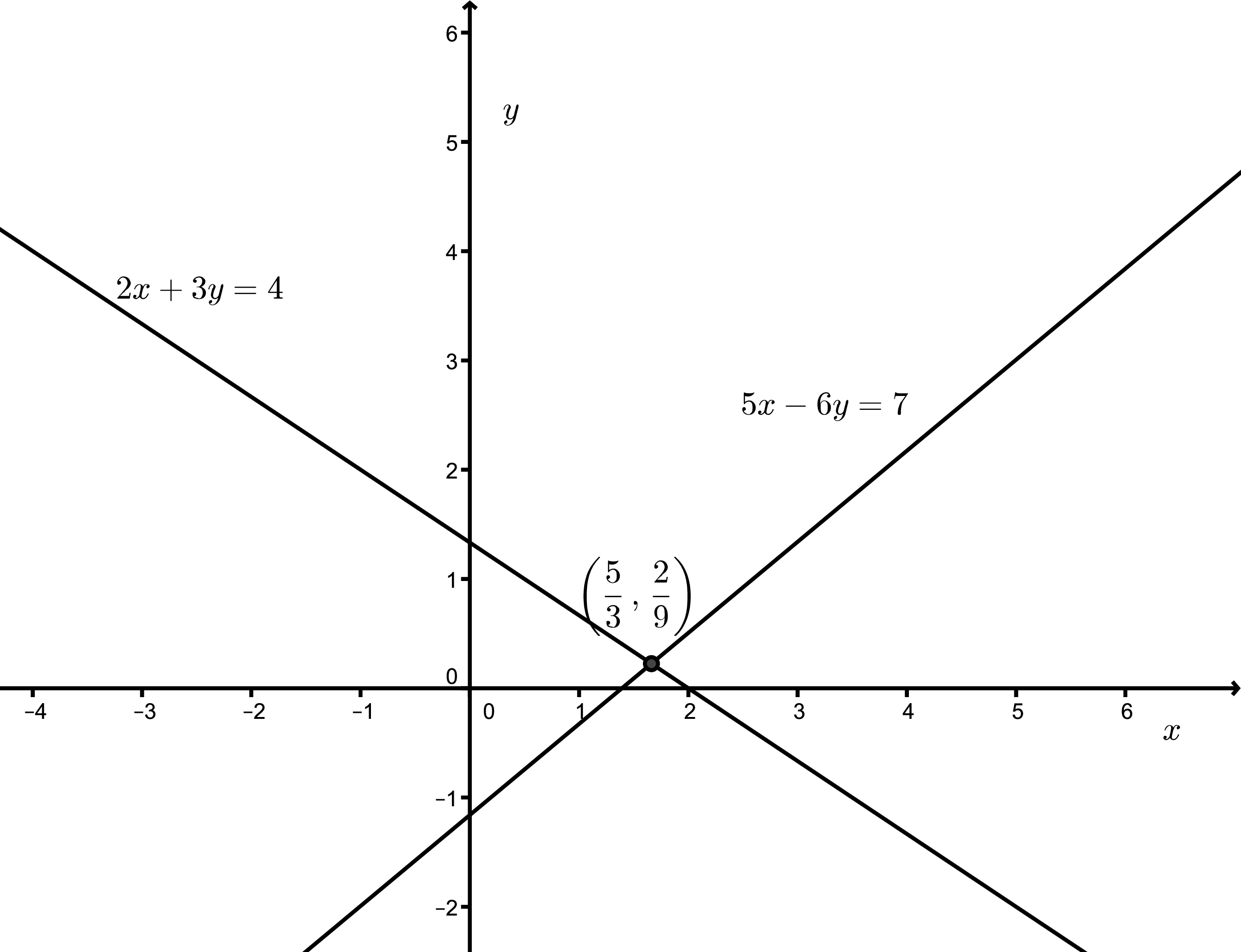
Fig. 1.4 Graph of the lines \(2x+3y=4\) and \(5x-6y=7\), which intersect at the point \(\left(\frac{5}{3},\frac{2}{9}\right)\).#
Exercise
Solve the simultaneous equations
Your answer should include a check, taking into account the warning underneath (1.3).
Solution
We label our equations as
We eliminate \(x\). Note that \(4\) and \(6\) are both factors of \(12\). Thus, multiplying \((1)\) by \(3\) and \((2)\) by \(2\), we get
Now add \((3)\) and \((4)\) to get \(23y = 92\) and so \(y = \frac{92}{23} = 4\). Put \(y = 4\) into \((1)\) to get \(-4 x + 3 \times 4 = 24.\) Therefore \(-4 x = 24 -12 = 12\) and so \(x = - 3.\)
We check that \(x = -3\) and \(y = 4\) is a solution of \((2)\).
So the simultaneous equations \((1)\) and \((2)\) have precisely one solution, namely \(x = -3\) and \(y = 4\).
Remark 1.3
It is possible that simultaneous equations can have no solutions or infinitely many. However, most of the time (especially in this course) there will be a unique solution.