
Introduction#
MPS002(1) vs MPS002(2)#
MPS002 is a 40 credit module with two lecturers. To aid lecture planning, the syllabus is split in two halves, called MPS002(1) and MPS002(2).
Note
This is a division of the syllabus, not the students. If you are registered to take MPS002, yYou need to attend everything from both halves of the module. All assessments test you on both halfs of the syllabus, mixed together.
These lecture notes and associated problem booklet correspond to Rosie’s lectures, MPS002(1), only. Wodu will share a separate set of lecture notes and problems for MPS002(2).
Contact hours#
Every week you will have 6 lectures and 2 tutorials, split split between MPS002(1) and MPS002(2). Monday and Tuesday classes are MPS002(1) with Rosie; Wednesday and Thursday classes are on MPS002(2) with Wodu.
Each session is 50 minutes long. You should aim to arrive 5-10 minutes before the start of each class, so the class can begin on time.
Lectures#
Lectures involve teaching in large groups with a lecturer teaching you the material from the front. All the lecturer will do is explain and show you material — you are expected in your spare time to work through examples to ensure you understand the material and include it into your long term memory. It can seem like a lot of information is presented to you at once; for this reason it is essential that you spend time reviewing notes after each lecture and practicing problems from the problem booklet.
You can think of the lectures as providing the essential tools that you will need, but reviewing notes, solving problems and attending tutorials is where the “true” learning is going to happen.
That said, your lecturers and tutors want to make sessions as useful as possible for you, so if you ever have any suggestions for changes that would benifit the learning of you and your peers, please let us know.
• Take notes, or consider annotating these printed notes, which the lectures will (roughly) follow.
• Ask questions when something doesn’t make sense. There is a very high chance that other people in the room are wondering the same thing!
Tutorials#
Typically with maths, it is difficult to know if you have fully understood lectured topics until you have attempted some associated problems. Each week there will be a set of “Problems of the Week”, to work on in the tutorial, and finish off independently. Solutions are available to check your answers.
Tutorials are an opportunity to tackle problems in a supportive environment, with help available from a course tutor. Attending tutorials is an essential part of the learning cycle, and you should use them to make sure you have fully understood the material covered that week lectures.
Assessment for MPS002#
Assessment for MPS002 is all non-calculator, and there is no formula booklet. See here for more about this.
Formative assessment (homework)#
You will quickly find that maths at university demands a higher standard of writing and presentation than you probably found was acceptable at school or college. To help ease this transition, MPS002 involves regular pieces of written homework that you should complete and hand in for individual feedback.
A typical piece of homework will be one or two short questions that you are expected to write up clear solutions to, paying particular attention to principles of good mathematical presentation (see below).
Engagement with the homeworks tends to correlate with overall success in MPS002. We strongly encourage that you complete them, as it is one of the fastest ways to improve on this course, and maximise your chance of success.
Homework submission is via Crowdmark, which you can read about here.
Summative assessment#
STACK quizzes (10%)#
In addition to written homeworks, each week you will have a online STACK quiz to complete, which tests knowledge and understanding of the material covered in lectures that week.
Both MPS002(1) and MPS002(2) will be assessed, and the marks you get in these quizzes contribute 10% to your final mark for the module as a whole.
January exams (20%)#
You will sit two exams in January for MPS002.
Written exam:
1.5 hours long,
Sat in an exam hall on campus.
Multiple choice exam (MCQ)
1 hour long
Sat in a University computer room, in a special browser designed for online exams
Your combined mark from these exams constitutes 20% of your final mark for MPS002.
Spring exams (70%)#
There are also two exams at the end of the year (usually in May or June). These follow the same structure as the January assessments, but are slightly longer, and examine all the material from both semesters of teaching for MPS002.
Written exam: 2 hours long
MCQ exam: 1.5 hours
The summer examinations count for the majority of your final grade for MPS002 (70%).
MPS002 exams are all non-calculator, and there is no formula booklet. See below for the rationale for doing this.
Remark on Mathematical Writing#
Mathematics is a skill well-known to be highly valued by employers. This has less to do with the specific topics taught at GCSE or A-level (depending on the job), than it does the important transferable skills that develop through mathematical training. To name a few, these include
Problem solving skills,
Learning to spot patterns (which means that you will be able to reuse a way to solve something similar for example),
Checking your answers for plausibility,
Organising an argument so that someone else can follow your line of thought,
To use it as a practical tool for solving and describing problems coming from other areas (like science or medicine).
In this course, it is important that you learn these skills in addition to the just numerical answers as you will need those when you go into your degree course. In particular, when solving problems, it is essential that you learn to write mathematical arguments on the page, rather than just symbols or expressions like you may have at school or college. At university, we are far more interested in how you think, not just whether you can get to the right number or expression in the end. A mathematical education means learning to communicate technical arguments and convince other people that your solution is correct. This will become increasingly important as the maths you learn becomes more advanced, as it will be less obvious at a glance whether or not you are on the right lines. At school, this isn’t an issue, as the maths never gets that hard for teachers to do in their heads. We are preparing you for university mathematics that cannot be checked so easily, and you will find it hard to access these more advanced topics without first learning to write mathematics well.
Eventually, you may find yourself solving ptoblems no one has solved before, and then truly the only way to convince others you are right is with the power of clear mathematical or technical reasoning!
Principles of good mathematical writing#
1. Whatever you write needs to make sense in the English language.
This includes any symbols, which are just shorthands for words. A good test is to read your answer back to yourself aloud and ask yourself, “Are there any words missing? Are there any extra words that don’t belong?”. Doing this will also help you to think more carefully when tackling problems, which can in turn help you spot your own mistakes and see your way more quickly to the solution.
2. Choose a layout that is easy for others (and your future self!) to read.
Usually, the best choice is a single column of “main calculation”, with logic flowing from the top of the page to the bottom. Things to avoid: multiple columns or clouds of symbols.
3. Each claim you make needs to be correct and clearly follow from previous work. Moreover, this reasoning should be clear from what is written on the page — you shouldn’t have to fill in any blanks for someone reading over your work. You could check you’re on the right track with this by asking a friend or teacher to read your work for you and see if they follow your argument.
4. Symbols need to be used correctly.
The biggest culprits here are “\(=\)” and various arrows — we’ll look at the role of equals signs this in more detail when we come to revise equations (see Section 1.2).
In mathematics, every symbol has a specific meaning. If you aren’t sure about the meaning of a symbol you are using, you should ask one of your tutors, or use a word instead.
5. Fewer symbols and more words is usually best for readability.
This is contrary to what popular media might suggest about mathematicians. We actually mostly write in complete sentences, otherwise no one would understand each other.
6. What you practice is what you will do.
Even if it’s just “for you”, it’s worth getting into good presentational habits early. This includes tutorial problems, and any other independent problem solving.
Advice for approaching foundation year mathematics#
Mathematics is not a subject you can cram into your head just before an exam. The goal this year is to build the mathematical fluency necessary for Level 1 mathematics, where it will be assumed you are comfortable with the A-level syllabus and able to do certain calculations quickly and without referring to a calculator of formula sheet. So even if you were able to cram and pass your exams this year, it would not be in your best interest to do so.
Mathematics is a “vertical” subject, in the sense that every topic builds on everything that has come before. This means that if you struggle in one chapter, the rest of the course will not make sense. Everything we use in Semester 1 will be needed in Semester 2. Thus it is important for you to ensure that you do not fall behind with your understanding, and seek help whenever you encounter something that isn’t making sense.
Monitoring your understanding#
The best way to check you are on top of things is to do regular practice of mathematical problems. When someone explains mathematics, each step seems to be clear and obvious — only by doing problems yourself will you be able to see if you understand the methods involved and if you can remember the methods used. Each week, there will be a set of “Problems of the Week” for MPS002(1), which you should complete to test you understand the material covered that week.
These questions will also be what we focus on in the Tuesday tutorial sessions. Completing the weekly STACK quizzes and written homeworks will also help you to gauge how you are finding things, and you can always ask for help or for someone to check your work, if you are unsure. Tutorials give you a chance to practise the material, see how you deal with it and ask for help before you fall so much behind that you are not able to catch up anymore.
Homework and tutorials#
In the homeworks or tutorials, we are not expecting you to get your answer always right or to complete each question perfectly, though this of course is good to try to aim for. Even in tutorial sessions, you should practice writing your answers so that another person can understand what you are trying to do. With homework, we want you to put time into presentation, and you may find you generally need to first write your work in rough and then re-write it on a clean sheet of paper so that it is clearly presented written. Then, when it comes to revision, you can just look at your work and straightaway follow your own line of thought.
Working on your presentation for the homeworks and tutorials means that when it comes to exam time, you will be able to write the solutions in a clear way without having to first write a draft. This course is not setting exam questions which are new, the problem type will have been seen before. So once you learnt how to lay out a solution to a problem, it is easy to provide a well written solution.
Calculators#
MPS002 does not allow the use of calculators in exams. This is a decision we review every year, and experience has shown us that students benefit morcane from learning to do maths without relying on a calculator. Calculators can do a lot nowadays, and we found that allowing them can hold people back from developing the mental agility and mathematical fluency needed for Level 1. Calculators can also obscure the underlying structure of mathematics, and more than anything we are interested in how you think. You will be able to use a calculator in Level 1, once you have mastered this years’ material.
Where to get help#
MPS002 is a challenging module, and for the best chance of success, you will need to ask for help sometimes.
Office hours#
Wodu and I run office hours, which are protected time each week set aside for seeing students. All lecturers have at least one hour per week set aside as office hours, and you can attend these for help with any aspect of the module you are finding challenging.
To attend an office hour, you don’t need to book — just drop in during one of the allocated times and the lecturer should be free to answer your questions. Some lecturers also provide a link where you can book an appointment, but this is not typically required.
Office hours are a great chance to get tailored one-to-one support from the people who design your course, and we strongly encourage you to make use of these.
For MPS002 office hours, see Blackboard for the most up to date information.
MASH#
“Maths and Stats Help”, or MASH for short, is the University’s maths support service, located in the 301 Academic Skills Centre on Glossop Road (opposite the back of the Students Union building).
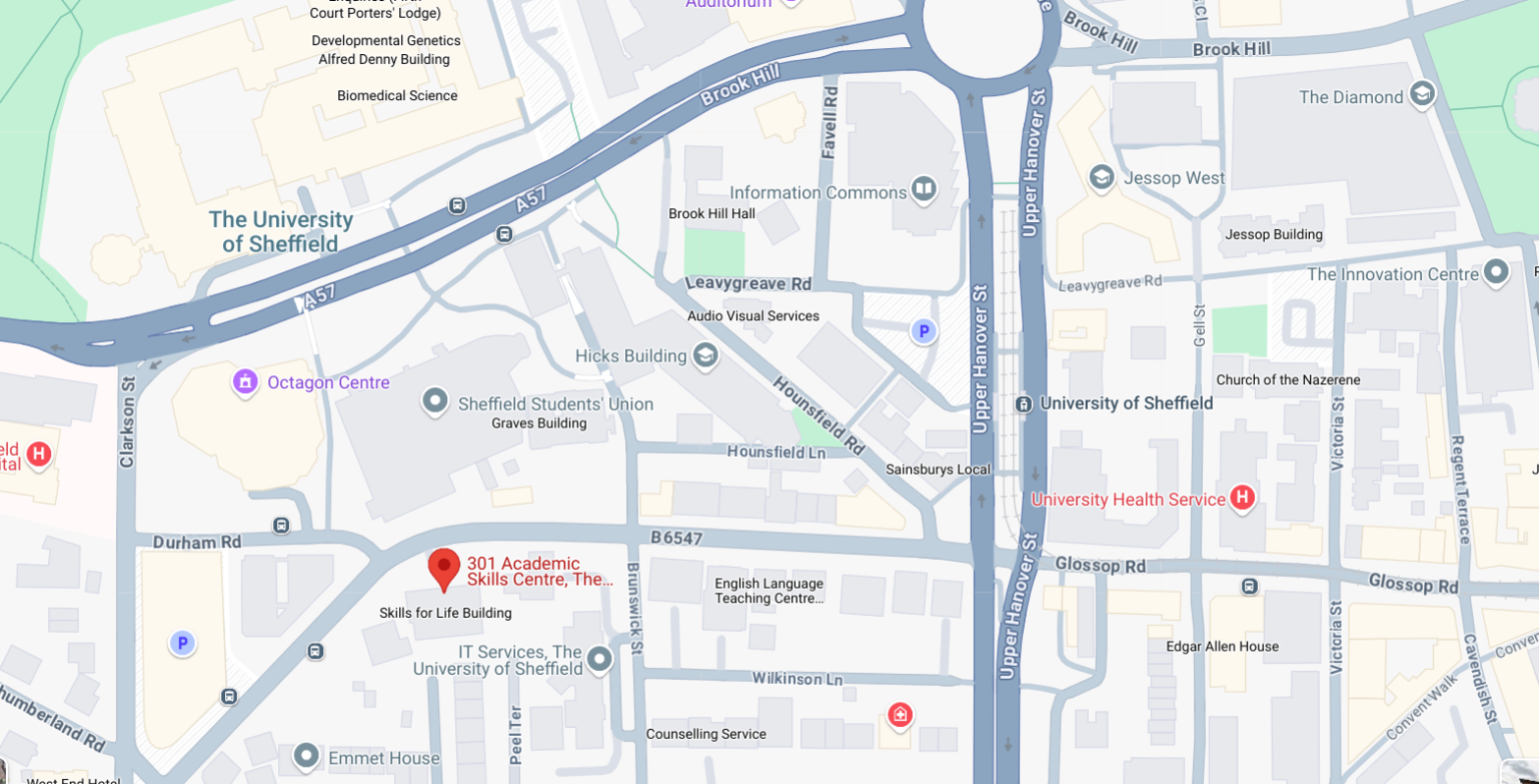
Fig. 1 Map: 301 Academic Skills Centre#
MASH is a service designed to help students with any mathematical component of their course — you can show up and ask for help with absolutely any maths you can think of. It is staffed by maths support specialists, and the service does not have any direct connection to your course lecturers or programme. Everyone is extremely friendly and approachable, and I highly recommend giving it a try — the earlier in the year the better.
To book an appointment, you can visit the MASH space itself, or book online here.