
2. Quadratics#
In this section we revise how to
factorise quadratics;
complete the square;
solve quadratic equations, by
factorization;
completing the square;
using the quadratic formula;
draw the graph of a quadratic;
understand the discriminant of a quadratic;
solve linear and quadratic inequalities
2.1. Definition#
A quadratic (over the real numbers \(\mathbb{R}\) in the variable \(x\)) is an expression
where \(x\) is an unknown and \(a\), \(b\) and \(c\) are real numbers with \(a \neq 0\).
The numbers \(a\), \(b\) and \(c\) are called the coefficients* of the quadratic.
We call \(a\) the leading coefficient and \(c\) the constant term (or constant or coefficient of the constant term). The number \(b\) is the coefficient of \(x\) of the quadratic \(q(x) = ax^2 + bx + c\).
2.2. Factorising Quadratics#
We start by looking at factorising quadratics. Over the real numbers, not all quadratics can be factorised and most of them cannot be factorised only using integers. Thus it is important that you read the question properly as the wording might tell you not to attempt factorisation with the methods shown next.
There are lots of different, but very similar approaches to factorising quadratics. I will give one in the lecture, the other seems to be longer, but will stay in the notes in case someone prefers it.
If we can factorise a quadratic (over \(\mathbb{R}\)) \(q(x) = ax^2 + bx + c\), we mean we can write \(q(x) = (\alpha x + \beta)(\gamma x + \delta)\) for some real numbers \(\alpha\), \(\beta\), \(\gamma\) and \(\delta\). This tells us that
so that
Thus to factorise \(q(x)\) all we need to do is find \(\alpha\), \(\beta\), \(\gamma\) and \(\delta\). We will only consider here the case when \(\alpha\), \(\beta\), \(\gamma\) and \(\delta\) are integers.
2.2.1. Quadratics with leading coefficient 1#
If \(a = 1\) then, as we work over \(\mathbb{Z}\); we must have \(\alpha=\gamma=1\). Thus we need to look at
so that \(\beta\delta = c\) and \(\beta+\gamma = b\). So we need to consider all the factorisations of \(c\) into two numbers which sum to \(b\).
Example 2.1
Factorise \(x^2 + 11x + 28\).
Solution.
We need to find \(\beta\) and \(\gamma\) such that \(\beta\gamma = 28\) and \(\beta + \gamma = 11\). This tells us that both \(\beta\) and \(\gamma\) must be positive and we have
as possible numbers for \(\beta\) and \(\gamma\). Clearly \(4 + 7 = 11\) so \(\beta = 4\) and \(\gamma = 7\) would do. Thus
We can write this in a more obvious way which includes a check:
Example 2.2
Factorise \(q(x) = x^2 - 29x + 28\).
Solution.
We need to find \(\beta\) and \(\gamma\) such that \(\beta\gamma = 28\) and \(\beta + \gamma = -29\). This tells us that both \(\beta\) and \(\gamma\) must be negative and we have
as possible numbers for \(\beta\) and \(\gamma\). Clearly \(-1 + (-28) = -29\) so \(\beta = -1\) and \(\gamma = -28\) would do. Thus
or
Example 2.3
Factorise \(q(x) = x^2 - 27x - 28\).
Solution.
We need to find \(\beta\) and \(\gamma\) such that \(\beta\gamma = -28\) and \(\beta + \gamma = -27\). This tells us that exactly one of \(\beta\) and \(\gamma\) must be negative and we have
as possible numbers for \(\beta\) and \(\gamma\).
Clearly \(1 + (-28) = -27\) so \(\beta = 1\) and \(\gamma = -28\) would do. Thus
or,
2.2.2. Quadratics with leading coefficient not 1#
We will use the same idea of splitting the middle term and factorising to deal with this case. So we are using the method which gives us the check.
But a very good habit to get into is to check the hcf of the coefficients before you start. This will cut down the number of possibilities to consider. An example will be shown later. Let’s consider an example.
Example 2.4
Factorise \(14x^2 + 31x + 15\).
Solution.
Firstly, we note that the highest common factor of the coefficients of \(14x^2 + 31x + 15\) is \(1\).
We want to write \(14x^2 + 31x + 15 = (\alpha x + \beta)(\gamma x + \delta)\) for some \(\alpha,\beta,\gamma,\delta\in\mathbb{Z}\).
To do this, we multiply the leading coefficient and the constant term together, that is in our case \(14\) and \(15\) and get \(210\) Now we find two numbers \(A\) and \(B\) such that \(AB = 210\) and \(A + B = 31\), which means both \(A\) and \(B\) need to be positive. (Note: This is exactly like the case of \(a = 1\).)
Now
and clearly \(10 + 21 = 31\). So we have \(A = 10\) and \(B = 21\). Thus we can write
Example 2.5
Factorise \(10x^2 + 34x - 24\).
Solution.
Note that the highest common factor of \(10\), \(34\) and \(24\) is \(2\). Thus we can first write \(10x^2 + 34x - 24 = 2(5x^2 + 17x - 12)\) and use our method on \(5x^2 + 17x - 12\).
So we multiply the leading coefficient and the constant term together, that is in our case \(5\) and \(-12\) and get \(-60\). Now we find two numbers \(A\) and \(B\) such that \(AB = -60\) and \(A + B = 17\). Note we need either \(A\) or \(B\) to be negative.
Now
and clearly \(-3 + 20 = 17\). So we have \(A = -3\) and \(B = 20\). Thus we can write
Example 2.6
Factorise \(-x^2 - 5x - 4\).
Solution.
We have a highest common factor of \(-1\) here, so we can write
2.3. Completing the Square#
We will first look at quadratics of the form \(x^2 + bx + c\), that is quadratics with leading coefficient 1.
Note that
Comparing \(x^2 + \beta x + \frac{\beta^2}{4} = (x+\frac{\beta}{2})^2\) with our original expression \(x^2 + bx + c\) we see that if we choose \(\beta = b\) instead of the \(c\) we get an extra \( + \frac{\beta^2}{4}\). So
as we took away the extra \( + \frac{\beta^2}{4}\) we got from the square bracket. This is the formula for completing the square.
I tend to remember it as words instead of the formula and then it reads like this:
“Open bracket \(x\) + half the number in front of \(x\) close bracket all squared \(-\) (always a minus) half the number in front of \(x\) all squared + the left over.”
Now let’s do some examples.
Example 2.7
Complete the square for the following quadratics.
(i) \(x^2 + 6x + 5\);
(ii) \(x^2 - 8x +3\).
Solution.
(i) Halving the coefficient of \(x\) we get \((x+3)^2=x^2+6x+9\), which is close to our original quadratic. Hence we see that \(x^2+6x + 5 = (x+3)^2 - 9 + 5 = (x+3)^2 - 4\). Here, \((x+3)^2-4\) is called the completed square form for the quadratic.
Or in the way I remember it: \(x^2 +6x + 5 = \left(x + \frac 62\right)^2 - \left(\frac 62\right)^2 +5 = (x+3)^3 -(3)^2 + 5 = (x+3)^2-9+5 = (x+3)^2 -4\).
(ii) Again, halving the coefficient of \(x\) we get \((x-4)^2 = x^2 - 8x + 16\). Hence we have
Or in the way I remember it: \(x^2 -8x + 3 = \left(x + \frac {-8}2\right)^2 - \left(\frac {-8}2\right)^2 + 3 = (x-4)^3 -(-4)^2 + 3 = (x-4)^2-16+3 = (x-4)^2 -13\).
Exercise
Complete the square for the following quadratics:
(i) \(x^2 - 7x - 5\);
(ii) \(x^2 + 3x + 6\).
Solution
(i) We have
(ii) We have
Now we consider a quadratic of the form \(ax^2 + bx + c\) where \(a \neq 0\).
The nice thing is that we don’t have to re-invent the wheel again, we reduce the problem to one we already know. Let’s see how that works on an example:
Example 2.8
Complete the square of the quadratic \(3x^2 + 30x +7\).
Solution.
We have
Exercise
Complete the square of the quadratic \(4x^2 - 18x -3\).
Solution
We have
Method
To complete the square of \(ax^2 +bx +c\) for \(a \neq 0:\)
Write \(ax^2 + bx + c\) as \(a \left[x^2 + \frac ba x\right] +c;\)
Complete the square in the bracket to get \(a\left[\left(x + \frac b{2a}\right)^2 - \left(\frac{b}{2a}\right)^2\right] +c;\)
Rearrange to get \(a\left(x+\frac b{2a}\right)^2 - a\times\left(\frac b{2a}\right)^2 +c\) and simplify the expression \(- a\times\left(\frac b{2a}\right)^2 +c\).
Exercise
Fill in the missing number in each case:
(i) \((x+3)^2 = x^2 + \Box x + 9\)
(ii) \((x-5)^2 = x^2 - \Box x +\Box\)
(iii) \((3x+2)^2 = 9x^2 + \Box x + 4\)
(iv) \((x+ \Box)^2 = x^2 + 10x +\Box\)
(v) \((x - \Box)^2 = x^2 - 14x + \Box\)
(vi) \((2x+\Box)^2 = \Box x^2 + 12x + \Box\)
(vii) \((x+\frac 12)^2 = x^2 + \Box x + \Box\)
(viii) \((\frac 12 x- \Box)^2 = \Box x^2 - x + \Box\)
(ix) \((\Box x^2 +3)^2 = 100x^4 + 60x^2 + \Box\)
(x) \((\frac 13 x + \Box y)^2 = \Box x^2 + \frac 13 xy + \Box y^2\)
Exercise
Express in completed square form:
(i) \(x^2 + 14 x+ 50\)
(ii) \(x^2 +10 x +40\)
(iii) \(t^2 -6t +13\)
(iv) \(p^2 - 4p + 3\)
(v) \(q^2 +20 q +80\)
(vi) \(4x^2 +12x +10\)
(vii) \(25z^2 + 70z+ 60\)
(viii) \(9v^2 -6v -4\)
(ix) \(2x^2 +28x-2\)
(x) \(5w^2 -20w + 12.\)
2.4. Solving Quadratic Equations#
2.4.1. Solving quadratics by factorising#
Example 2.9
Solve \(x^2 + x - 12 =0 \).
Solution.
We are trying to find values of \(x\) that satisfy the equation. Note that, with \(x^2\) being the highest term occurring, we may have up to two solutions.
We factorise to get \(x^2 + x - 12 = (x -3)(x+4)\) as in Section 2.2.1. Now, we notice that, for any two numbers \(a\) and \(b\), \(ab = 0\) if and only if either \(a = 0\) or \(b = 0\). It follows that \((x-3)(x+4)=0\) if and only if either \(x-3=0\) or \(x+4=0\). Hence, \(x^2+x-12=0\) if and only if \(x=3\) or \(x=-4\). That is, the solution to \(x^2 + x - 12 =0\) is \(x = 3\) or \(x = -4\).
Exercise
Solve \(3x - 2x^2 = 1\).
Solution
We rearrange \(3x - 2x^2 = 1\) to get \(2x^2 - 3x +1 = 0\). Now \(2x^2 - 3x +1\) factorises as \((2x -1)(x -1)\). So either \(2x -1= 0\) or \(x-1=0\). That is, either \(x=\frac 12\) or \(x = 1\). Thus the solutions to \(3x - 2x^2 = 1\) are \(x = \frac 12\) or \(x = 1\).
2.4.2. Solving quadratics by completing the square#
Example 2.10
Solve \(x^2 + 4x + 1 = 0\).
Solution.
By completing the square we get
We can now take the square root on both sides, being careful to remember that there are positive and negative roots. Hence we get \(x+2 =\pm \sqrt{3}\), so that \(x = -2 +\sqrt{3}\) or \(x=-2-\sqrt{3}\).
Example 2.11
Solve \(2x^2 + 5x -4 = 0\).
Solution.
Again, we begin by completing the square to get
So the solutions are \(x = \frac {-5 +\sqrt{57}}4\) or \(x = \frac{ -5 -\sqrt{57}}4\).
Exercise
Solve, by factorisation,
Solve, by completing the square,
2.4.3. The quadratic formula#
It turns out that we can quite easily derive a formula for solving quadratic equations.
Example 2.12
Solve the equation \(ax^2 + bx + c = 0\) where \(a \neq 0\).
Solution.
Since \(a \neq 0\) we can divide both sides of our equation by \(a\) to
get \(x^2 + \frac ba x + \frac ca = 0\). Now, completing the square and rearranging we
have\renewcommand{\arraystretch}{2}
Thus the solutions of \(ax^2 + bx + c = 0\) where \(a \neq 0\) are given by \(x = \frac{-b + \sqrt{b^2 - 4ac}}{2a}\) or \(x = \frac{-b - \sqrt{b^2 - 4ac}}{2a}\).
Note
Looking at the formula, we have to be a little careful. If \(b^2 - 4ac < 0\) then the formula says that we need to take the square root of a negative number, which is undefined. This means that there are no real number solutions to the equation. At some point you will meet complex (or imaginary) numbers which deal with this situation.
We write \(\Delta = b^2 -4ac\) and call this the discriminant of the quadratic. We will look at it in more depth later.
Theorem 2.1 (The Quadratic Formula)
The solutions of the quadratic equation
where \(a \neq 0\) are given by
Example 2.13
Solve \(8x^2 - 14 x + 3 = 0\) by using the quadratic formula.
Solution.
Here we put \(a = 8,\) \(b = -14\) and \(c = 3\). Then, using the quadratic formula, the solutions are given by
So the solutions are \(\displaystyle{x = \frac{14+10}{16} = \frac{24}{16} = \frac{3}{2}}\) or \(\displaystyle{x = \frac{14 - 10}{16} = \frac{4}{16} = \frac 14.}\)
Exercise
Solve by using the Quadratic Formula:
Solve, where possible, by any suitable method:
2.4.4. More factorising quadratics#
If we know the solutions of the quadratic equation \(ax^2 + bx + c = 0\), we can use them to factorise it. This is an example of the Factor Theorem that we will see later on.
The main idea is that if \(x=\alpha\) is a solution to \(ax^2+bx+c=0\) then \((x-\alpha)\) is a factor of the quadratic. We will illustrate the method in the example below.
Example 2.14
Factorise \(6x^2-7x-20\).
Solution.
We could, of course, use the methods from earlier on in the course, but instead we will start by finding the
solutions. Let \(a=6\), \(b=-7\) and \(c=-20\). Then the quadratic formula gives
So the solutions are \(x=\frac{5}{2}\) and \(x=-\frac{4}{3}\). Now, we note that
We see that this equation is the same as ours except that every term is divided by \(6\) — the coefficient of \(x^2\) from our original expression. Hence
Finally, if we can we should make the numbers in the bracket into integers. For this, note that \(6=2\times 3\) so that
which is factorised nicely.
Note
A common mistake in the last example is to write
that is take the \(6\) into each bracket. That isn’t the way that multiplication works! As a numerical example \(6\times (2)\times(3) \neq (6\times 2)\times (6\times 3)\).
Exercise
Factorise \(6897x^2+2042x-299\).
(Hint: first find the solutions like in the previous example)
2.5. The Graph of a Quadratic Function#
2.5.1. The graph of \(y = x^2\)#
There are two ways of drawing a graph: firstly by {\em plotting} and secondly by using some mathematical insight to {\em sketch} it. When we meet a function for the first time, we have to plot it, but once we know its basic shape, we can use rules how to sketch it. You are expected to {\em sketch} the graphs you will encounter in any exam and not to plot it except if explicitly stated otherwise.
Now we don’t know the graph of a quadratic (at least I haven’t told you how it looks like). So we need to start by plotting the graph of the easiest quadratic we can think of, namely \(y = x^2\). For this we make a table of values.
\(x\) |
\(-3\) |
\(-2\) |
\(-1\) |
\(-\frac{1}{2}\) |
\(0\) |
\(\frac{1}{2}\) |
\(1\) |
\(2\) |
\(3\) |
|---|---|---|---|---|---|---|---|---|---|
\(y=x^2\) |
\(9\) |
\(4\) |
\(1\) |
\(\frac{1}{4}\) |
\(0\) |
\(\frac{1}{4}\) |
\(1\) |
\(4\) |
\(9\) |
Next, we draw the axes and mark the scale on each one. We then plot the points we found onto our graph.
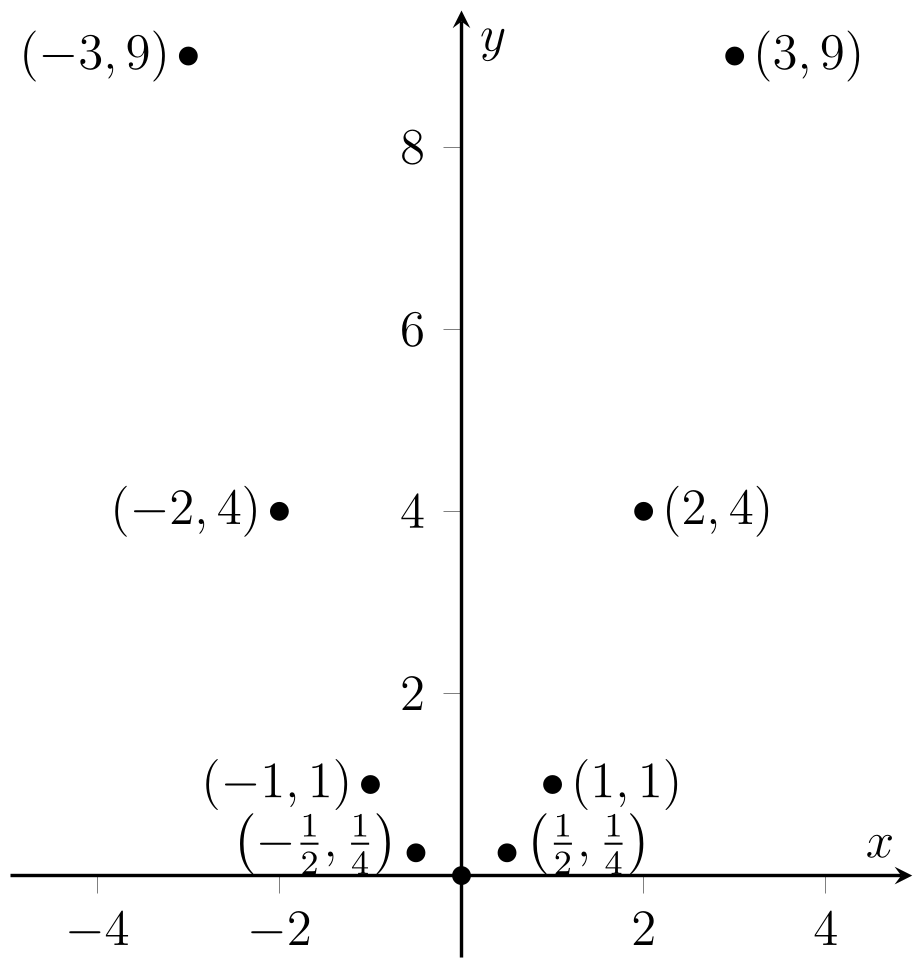
Fig. 2.1 A plot of points \((x,x^2)\) for \(x=0,\pm\frac 12,\pm 1,\pm 2,\pm 3\).#
As we can put {\em any} real number for \(x\) into the formula \(y = x^2\), we join the points with a smooth curve:
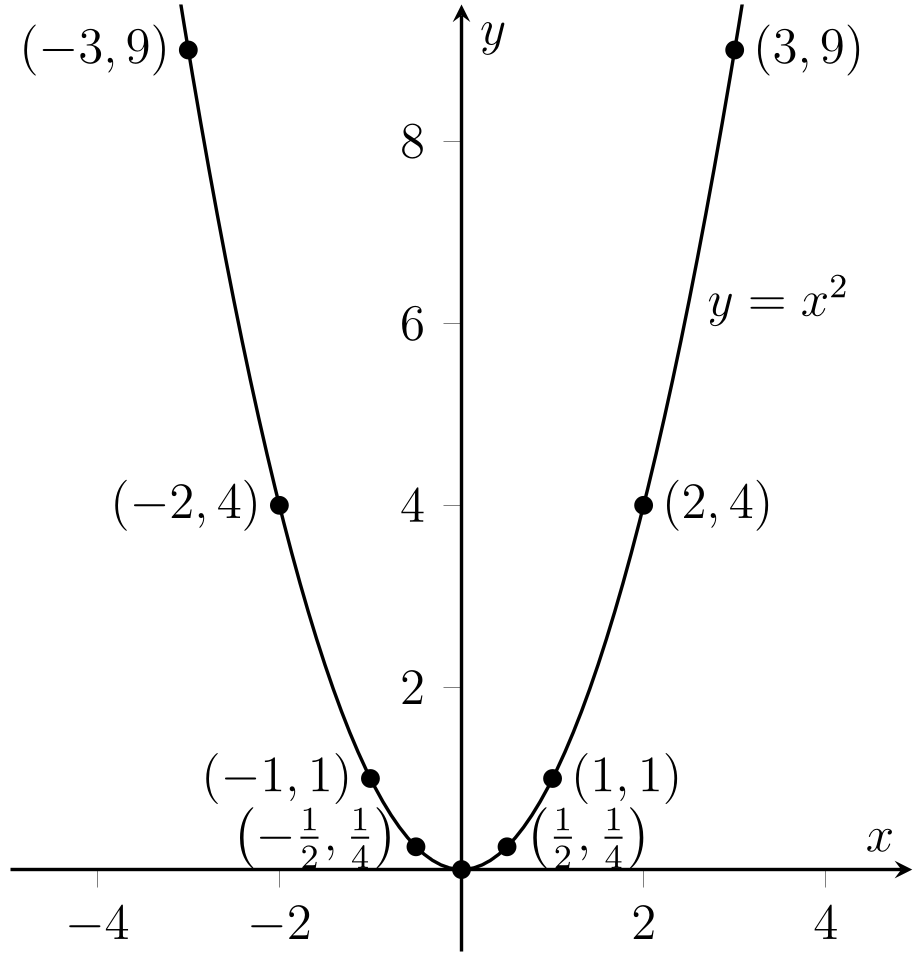
Remark 2.1
When drawing a graph you should always make sure that both the axes and the graph itself are labelled. The positive ends of the coordinate cross get a little arrow head and you need a scale on both axes. You don’t need the same scale on both axes, but they both need a scale.
This is the shape of (the graph of) the standard quadratic and you need to remember it.
2.5.2. Sketching some basic quadratics#
If we want to sketch a graph, we do not usually plot points and connect them with a smooth curve but instead use theory and algebra, as we will see shortly. One of the key things to remember about sketching graphs of quadratic functions is that they all share the same shape, known as a {\em parabola}.
Example 2.15
We’ve already seen the basic shape of one quadratic graph, namely \(y=x^2\). Note that it had a {\em minimum point} at \((0,0)\) and went up towards infinity either side of this minimum.
We next look at the graph of \(y=-x^2\). Note that this is a very similar function: all that has changed is the sign of \(y\). That is, where \(y\) was positive previously it is now negative. When you think of it, to work out \(y = -x^2\) you first work out \(x^2\) and then multiply that result by \(-1\). So the graph of \(y = -x^2\) looks like
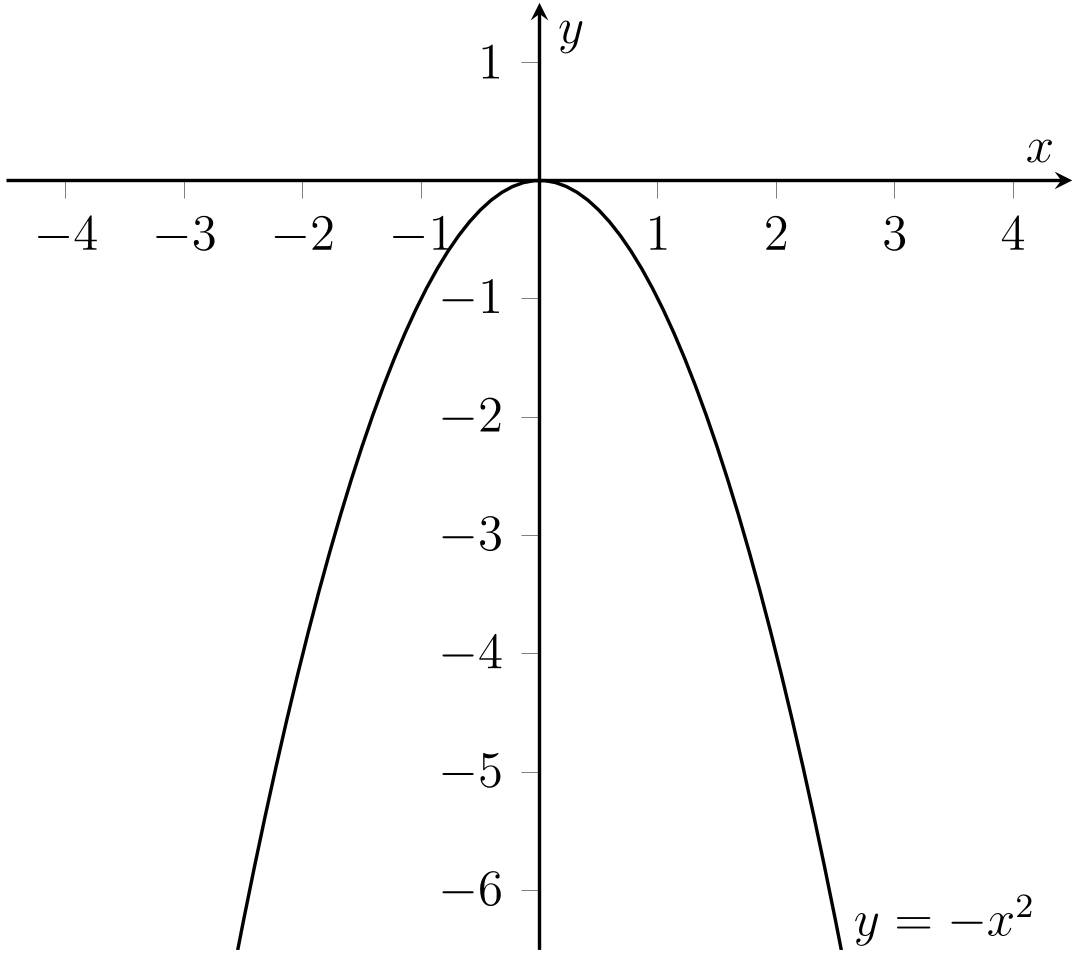
Fig. 2.3 Graph of \(y=-x^2\)#
We see that the graph of \(y=-x^2\) is the same as the graph of \(y = x^2\) {\em reflected in the \(x\)-axis}. Note that now there is a {\em maximum point} at \((0,0)\).
In a similar way we can consider the graph of \(y=2x^2\). Here, we once again get the parabola shape familiar from the graph of \(y=x^2\), but now the graph has been stretched by a factor of 2 in the \(y\)-direction.
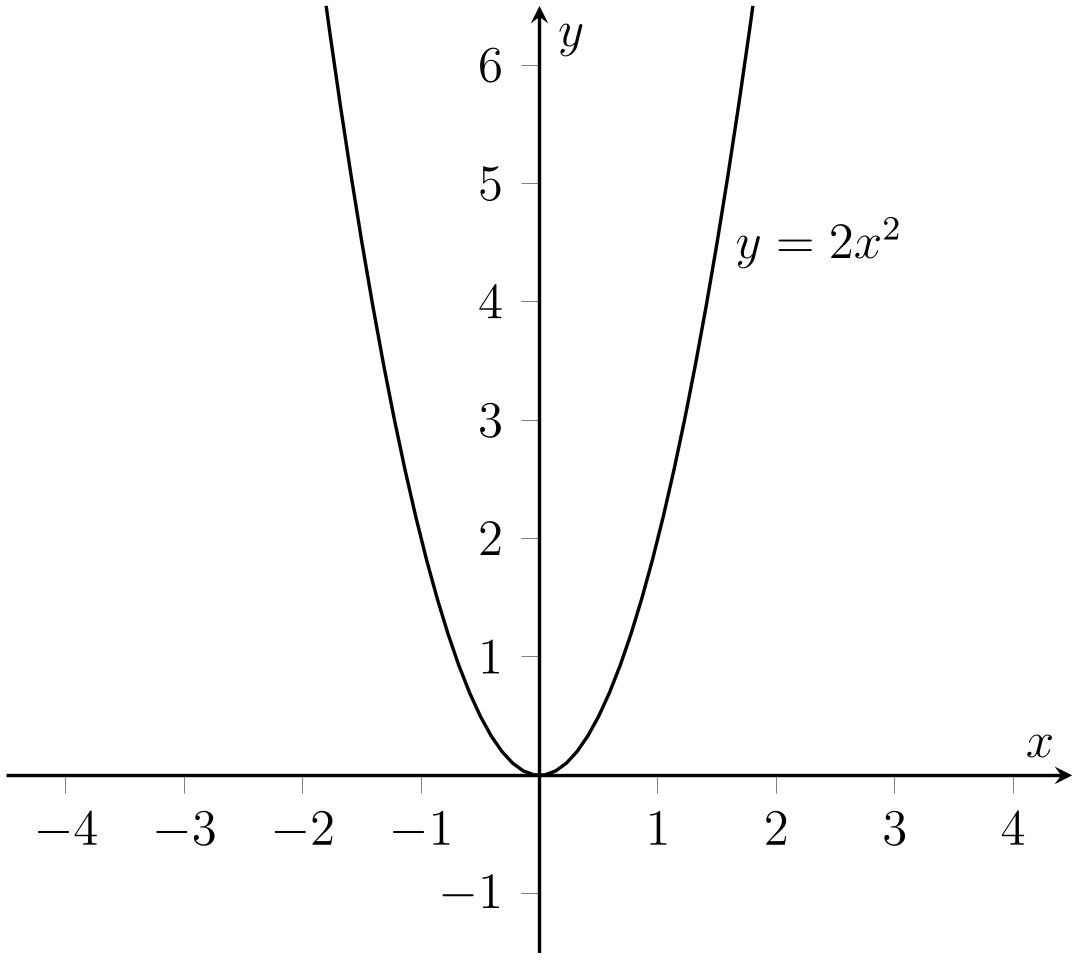
Fig. 2.4 Graph of \(y=2x^2\)#
Finally, we can combine the ideas of the previous parts to get the graph of \(y=-2x^2\).
So we first stretch the graph of \(y = x^2\) in the \(y\)-direction by a factor of \(2\), then reflect in the \(x\)-axis.
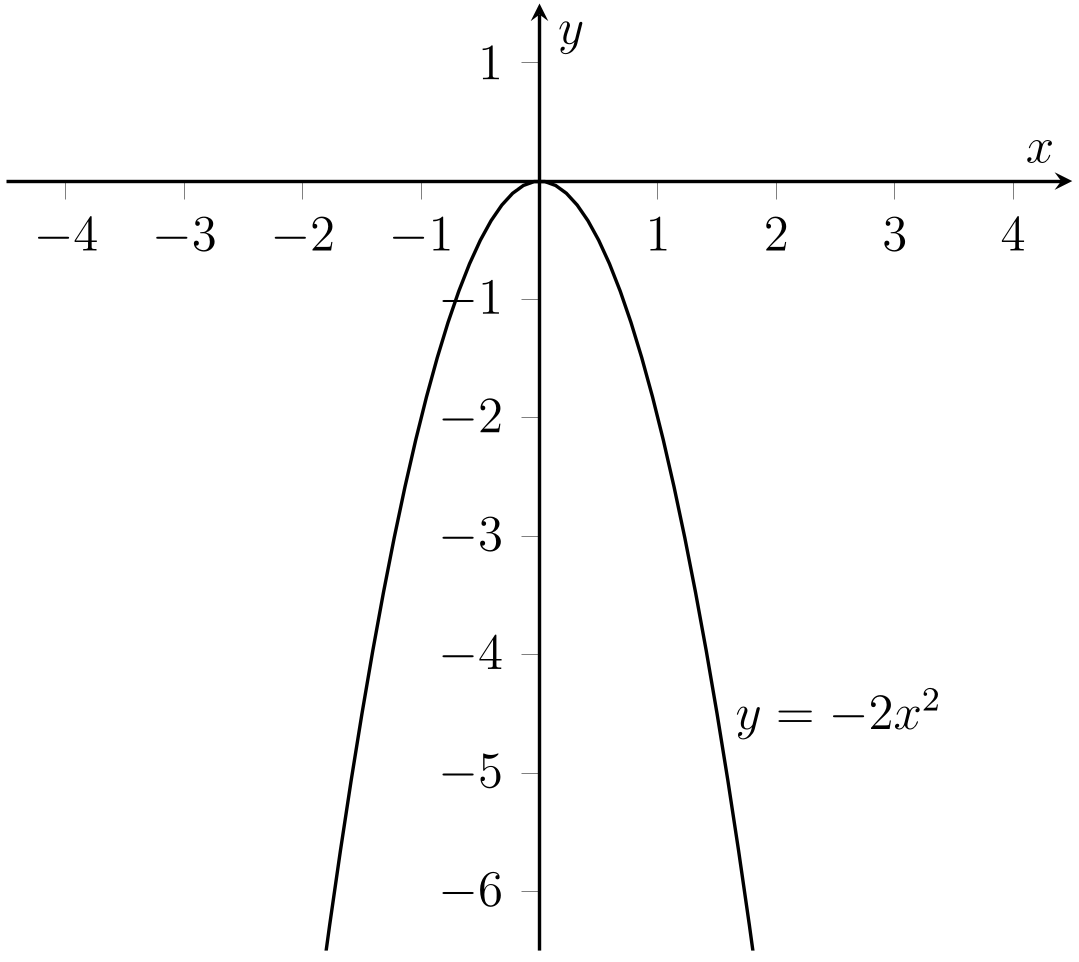
Fig. 2.5 Graph of \(y=-2x^2\)#
2.5.3. General quadratics#
We now develop techniques to allow us to draw graphs of general quadratics. The key idea is that we can start with the graph of \(y=x^2\) and make step-by-step changes to get to the graph we want.
Translations in the \(x\)-direction#
Example 2.16
Sketch the graph of \(y = (x - 2)^2\).
Solution.
How do we obtain the graph of \(y = (x-2)^2\) when we know the graph of \(y = x^2\)? We know that this graph will have the same general shape as \(y = x^2\), i.e.~it will be a parabola. It will have a minimum point as all our results will be at least 0.
So where is the minimum of this parabola? It occurs when \((x-2)^2 = 0\) as this is the smallest possible value the function can ever be. Now \((x-2)^2 = 0\) means that \(x-2 =0\) and so \(x = 2\).
Thus this parabola has a minimum at \((2,0)\). So we {\em shift} or {\em translate} the graph of \(y = x^2\) by 2 {\em opposite the sign in the bracket} to get the graph of \(y = (x-2)^2\).
2.png)
Fig. 2.6 Graph of \(y=(x-2)^2\).#
Exercise
Sketch the graph of \(y = (x+4)^2\).
Solution
To see where the minimum point of the parabola is, we need to solve \((x+4)^2 = 0\) which means that the \(x = -4\) and thus the minimum of the parabola is at \((-4,0)\).
This means that the graph of \(y=(x+4)^2\) is obtained from that of \(y=x^2\) by translating it by a distance of \(4\) in the negative \(x\)-direction, as shown below.
2.png)
Fig. 2.7 Graph of \(y = (x+4)^2\).#
This method works generally. That is, for any real number \(a\),
the graph of \(y=(x-a)^2\) is obtained from the graph of \(y=x^2\) by translating it by a distance of \(a\) in the positive \(x\)-direction.
Remark 2.2
You may find it difficult to remember which way the graph moves. An easy way to remember is to look for where the minimum point occurs. For example, the minimum point on \(y=(x+7)^2\) will occur when \(x=-7\) (which gives \(y=0\)). Therefore, the graph of \(y=(x+7)^2\) has been translated by \(7\) in the negative \(x\)-direction.
Translations in the \(y\)-direction#
Example 2.17
Sketch the graph of \(y = x^2 -2\).
Solution.
To get the graph of \(y = x^2 -2\) we take the graph of \(y = x^2\) and translate it by a distance of \(2\) in the negative \(y\)-direction.
This is because any value we worked out first for \(x^2\) needs now to have \(2\) subtracted. So the minimum point occurs when \(x^2 = 0\), i.e.~when \(x= 0\) and then the \(y\)-value will be \(y= 0^2-2 = -2\). Thus the graph has a minimum at \((0,-2)\).
The graph will cross the \(x\)-axis where \(x^2-2=0\), that is where \(x=\pm \sqrt{2}\).
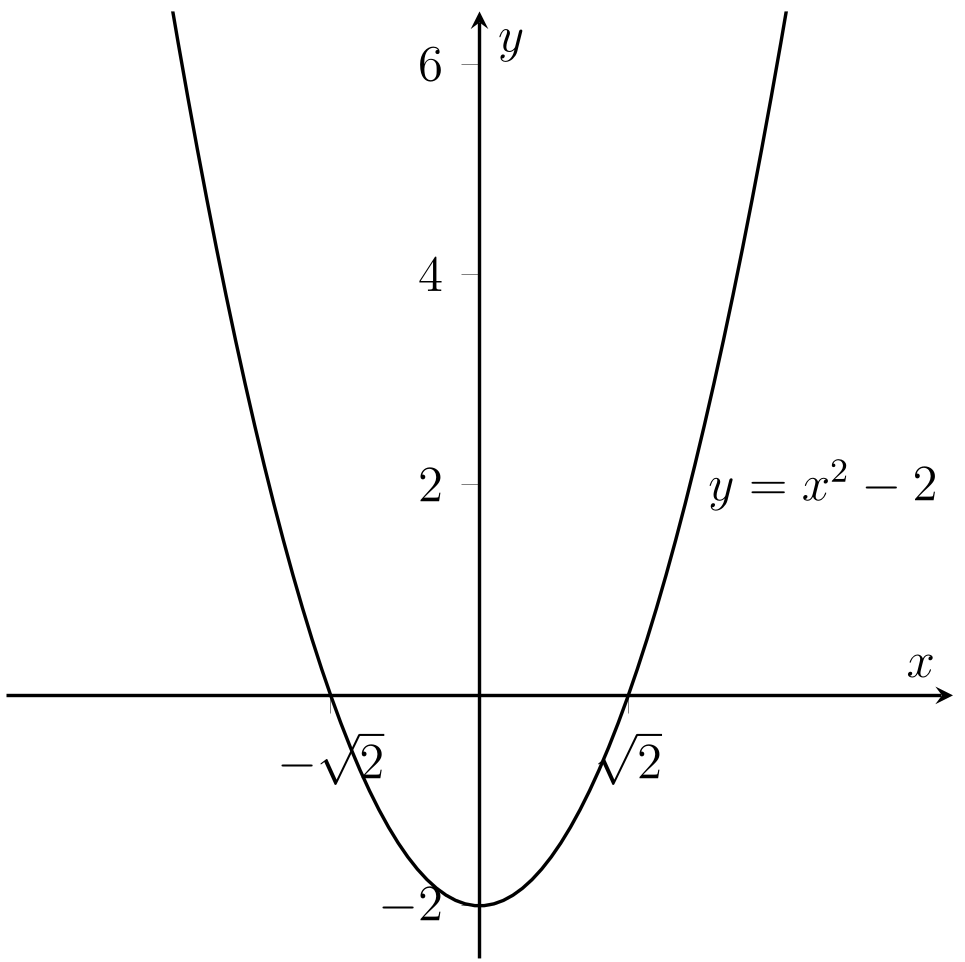
Fig. 2.8 Graph of \(y=x^2-2\)#
In a similar way, the graph of \(y=x^2+3\) is obtained by translating the graph of \(y=x^2\) by a distance of 3 in the positive \(y\)-direction.\
General Quadratics#
We are now able to cope with sketching the graphs of general quadratic functions.\
Example 2.18
Sketch the graph of \(y = x^2 + 4x +1\).
Solution.
We first complete the square to get \(y = (x +2)^2 - 2^2 + 1 = (x+2)^2 -3\). From this form, we see that we have to translate the graph of \(y = x^2\) a distance \(2\) in the negative \(x\)-direction and then translate it a distance \(3\) in the negative} \(y\)-direction.
To find the minimum point, all we need to do is solve \((x+2)^2 = 0\) which gives \(x= -2\). When \(x = -2\) we see directly from the completed square form that \(y = -3\). So the minimum point of the curve occurs at \((-2, -3)\).
We next look when the graph crosses the \(x\)- and \(y\)-axes. To find where the curve crosses the \(y\)-axis, we need to work out the \(y\)-value when \(x = 0\). For this, we use the original equation bsfore we completed the square to see that \(y = 0^2 +4(0) +1 = 1\).
The graph crosses the \(x\)-axis when \(y = 0\). Now, when \(y = 0\) we have \(0=(x+2)^2 -3\) and so \((x+2)^2 = 3\). Thus \(x + 2 = \pm \sqrt{3}\) and so \(x = -2 \pm \sqrt{3}\). To help with our sketch, we note that the crossings are given approximately by \(x \approx -0.3\) and \(x \approx -3.7\).
We now have all the information we need to sketch the graph, as shown below.
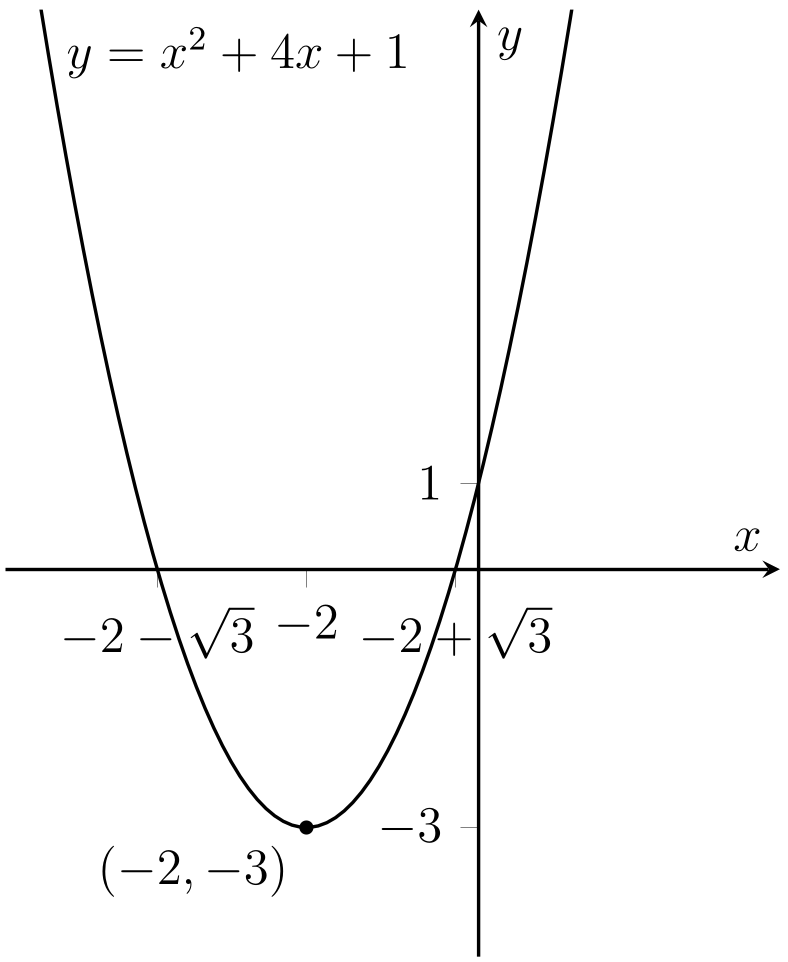
Fig. 2.9 Graph of the quadratic \(y=x^2+4x+1\), with minimum point at \((2,-3)\) labelled.#
We see that we can apply these kinds of transformations to enable us to sketch any quadratic graph. The main point is that the parabola shape will always be present. We use the following workflow.
Method
To sketch a quadratic graph
Check the coefficient of \(x^2\). If it is positive then the parabola will be the “right way up” (as for the graph of \(y=x^2\)). If it is negative then the parabola will be “upside-down” (as for the graph of \(y=-x^2\)).
Complete the square to get something of the form \(p(x+q)^2 + r\).
Find where the minimum/maximum occurs (which it is depends on which way up the parabola is). To do this, find the value of \(x\) that makes the bracket zero. For example, \(2(x+1)^2-3\) has a minimum when \(x=-1\), giving \(y=-3\); that is the minimum occurs at \((-1,-3)\).
Find where the graph crosses the \(x\)- and \(y\)-axes. That is, find the value of \(y\) when \(x=0\) and the equation \(y=0\) to find \(x\). Note that it is possible that the graph will not cross the \(x\)-axis, so you may find there is no solution to the equation \(y=0\). Note that this will happen precisely when the discriminant of the quadratic is negative.
Draw the graph, remembering to label the axes and the curve.
Exercise
Sketch the graph of \(y = -2x^2 + 6x -7\).
Solution
The coefficient of \(x^2\) is negative, so the parabola will be ``upside-down”. We complete the square to get
We see that the graph will have a maximum (because the parabola is upside-down) at \(x=\frac{3}{2}\) giving \(y=-\frac{5}{2}\). When \(x=0\) we have \(y=-2(0)^2 + 6(0) - 7 = -7\). If we try to solve \(y=0\) we have \(0 = -2(x-\frac 32)^2 - \frac 52\) so that \(2(x-\frac 32)^2 = -\frac 52\) and \((x-\frac{3}{2})^2=-\frac{5}{4}\) and since we can’t take the square root of a negative number there is no solution here. Thus the graph doesn’t cross the \(x\)-axis.
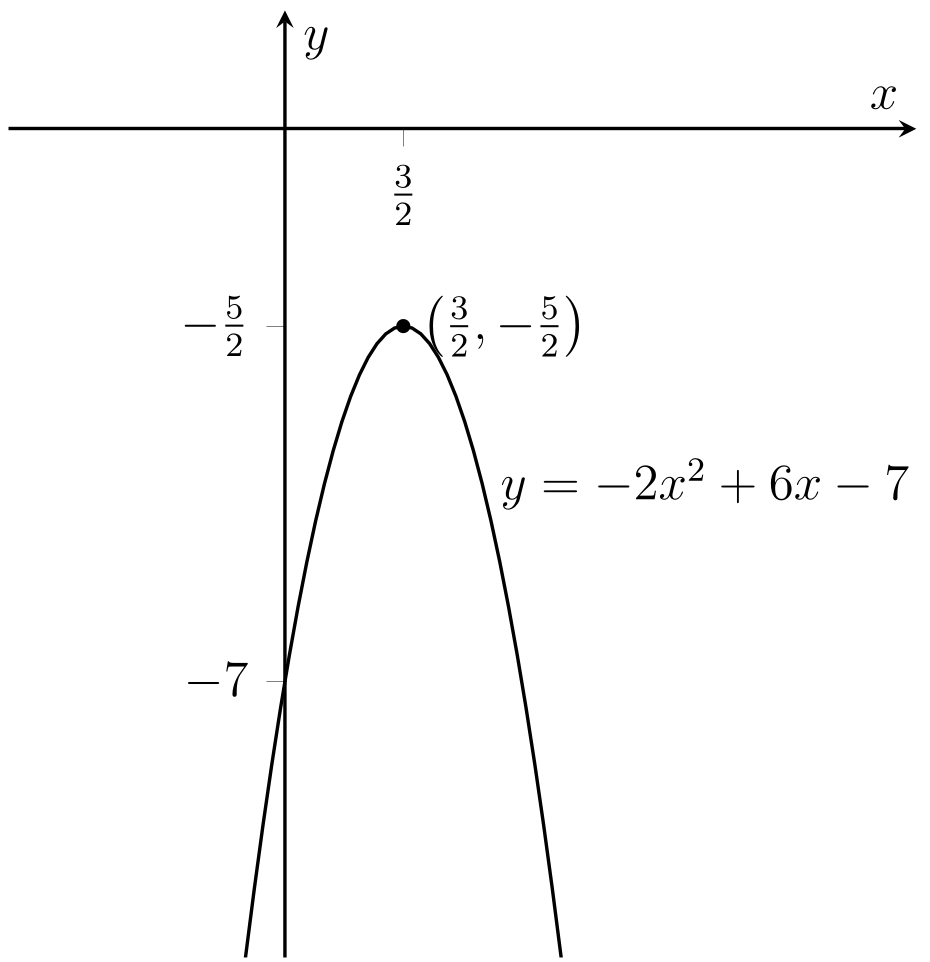
Fig. 2.10 Graph of \(y = -2x^2 + 6x -7\).#
Exercise
Sketch the graphs of
2.6. The Discriminant#
Consider the quadratic \(ax^2 + bx + c\) where \(a \neq 0\). We have already briefly seen the discriminant \(\Delta=b^2 - 4ac\). Its name comes from the fact that it discriminates between various cases, as discussed below.
2.6.1. Quadratics with \(\Delta >0\)#
In this case the equation \(ax^2 + bx + c = 0\) has two distinct real solutions, namely \(\displaystyle x = \frac{-b + \sqrt{b^2 - 4ac}}{2a}\) and \(\displaystyle x = \frac{-b - \sqrt{b^2 - 4ac}}{2a}\).
The quadratic factorises over the real numbers. That is, it is possible to write it in the form \((ax+b)(cx+d)\) where \(a,b,c\) and \(d\) are real numbers.
The graph of the function \(y = ax^2 + bx + c\) will cross the \(x\)-axis twice.
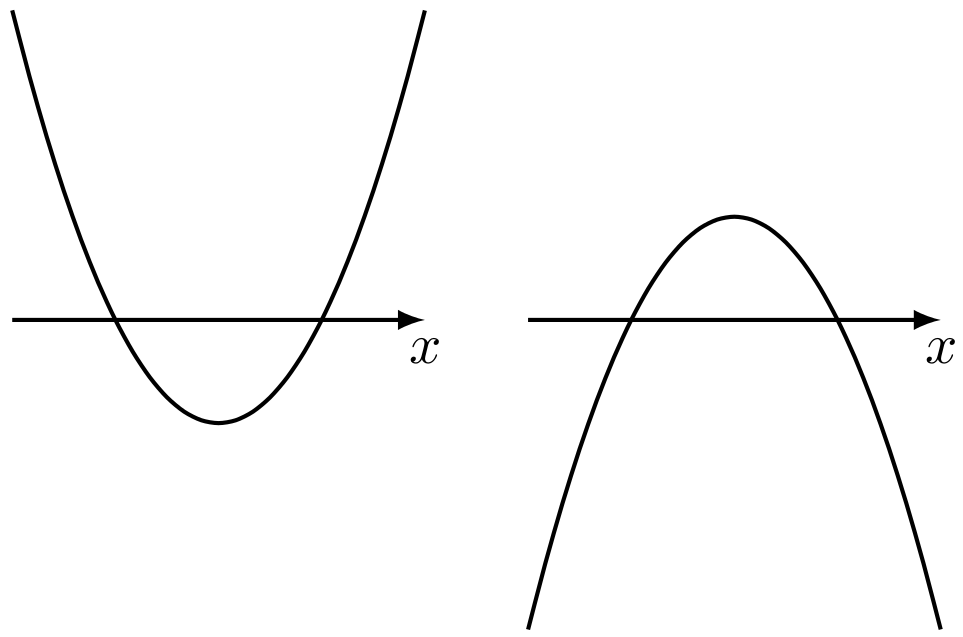
Fig. 2.11 Examples of quadratic graphs with \(\Delta > 0\).#
2.6.2. Quadratics with \(\Delta = 0\)#
In this case the equation \(ax^2 + bx + c = 0\) has one real solution, namely \(\displaystyle x = -\frac {b}{2a}\).
The factorised form of the quadratic will have a repeated factor; that is \(ax^2+bx+c\) will be equal to \(a(x + \frac b{2a})^2\).
The graph of the function \(y = ax^2 + bx + c\) will touch the \(x\)-axis in just one place.
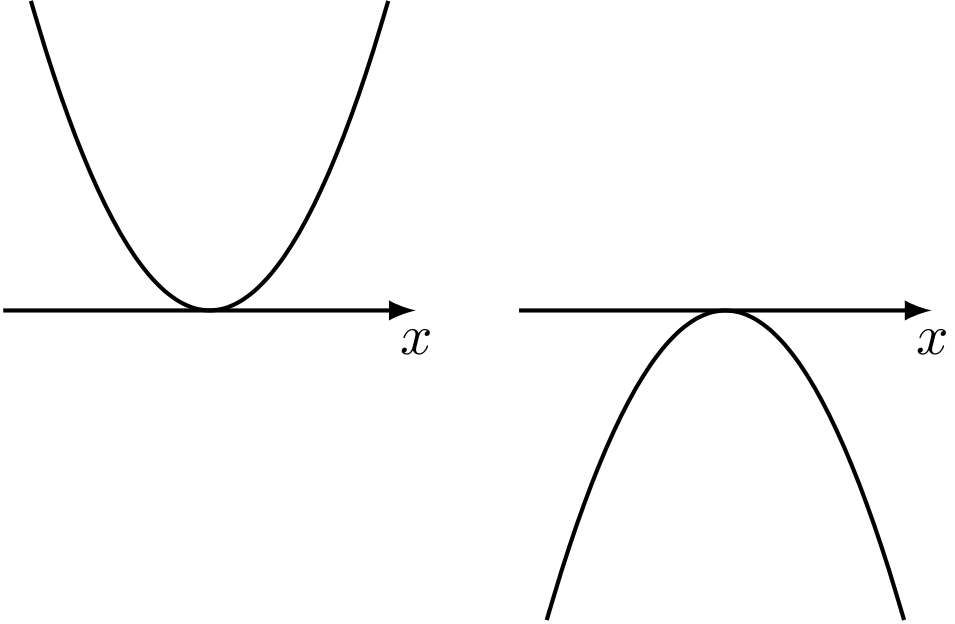
Fig. 2.12 Examples of quadratic graphs with \(\Delta = 0\).#
As in the picture, if \(a > 0\) then \(ax^2+bx+c \geq 0\) for all \(x\) where-as if \(a < 0\) then \(ax^2+bx+c \leq 0\) for all \(x\).
2.6.3. Quadratics with \(\Delta < 0\)#
The equation \(ax^2 + bx + c = 0\) has no real solutions.
The quadratic cannot be factorised over the real numbers.
The graph of the function \(y = ax^2 + bx + c\) does not cross, or even touch, the \(x\)-axis.
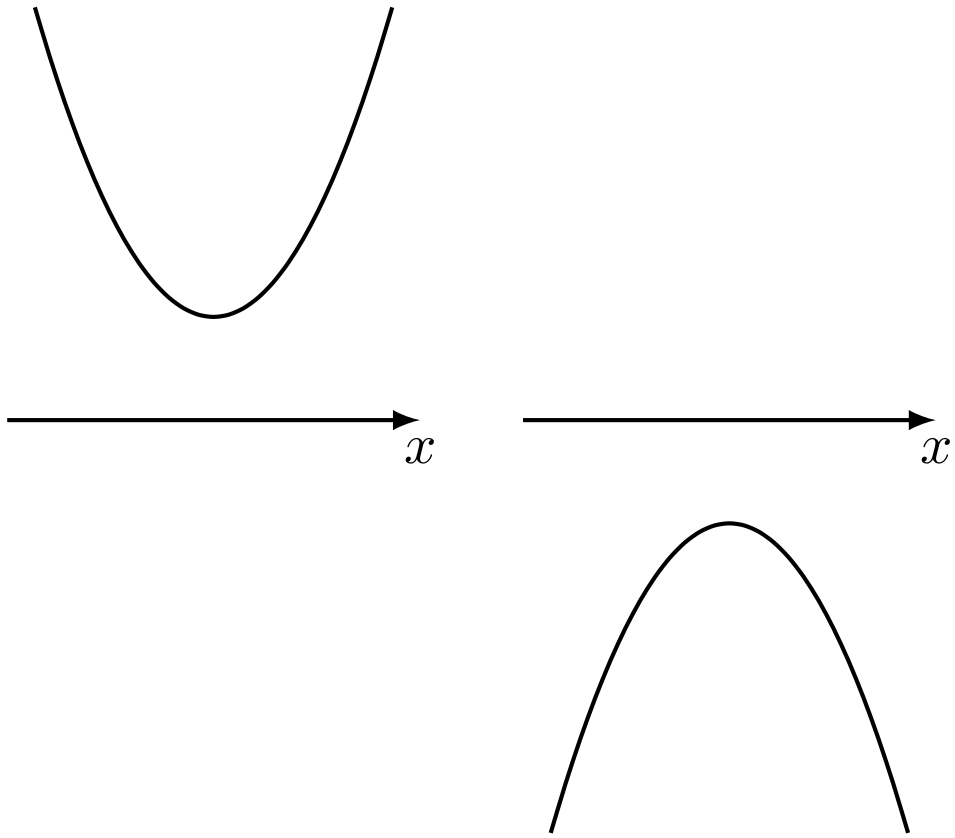
Fig. 2.13 Examples of quadratic graphs with \(\Delta < 0\).#
As in the picture, if \(a > 0\) then \(ax^2+bx+c > 0\) for all \(x\) where-as if \(a < 0\) then \(ax^2+bx+c < 0\) for all \(x\).
Example 2.19
Let \(f(x) = -3x^2 +4x -2\). Then
Also \(a = -3 < 0\). Thus \(-3x^2 +4x -2 = 0\) has no real solutions and the graph of \(y = -3x^2 +4x -2\) is an ``upside-down” parabola which doesn’t cross the \(x\)-axis, as shown.
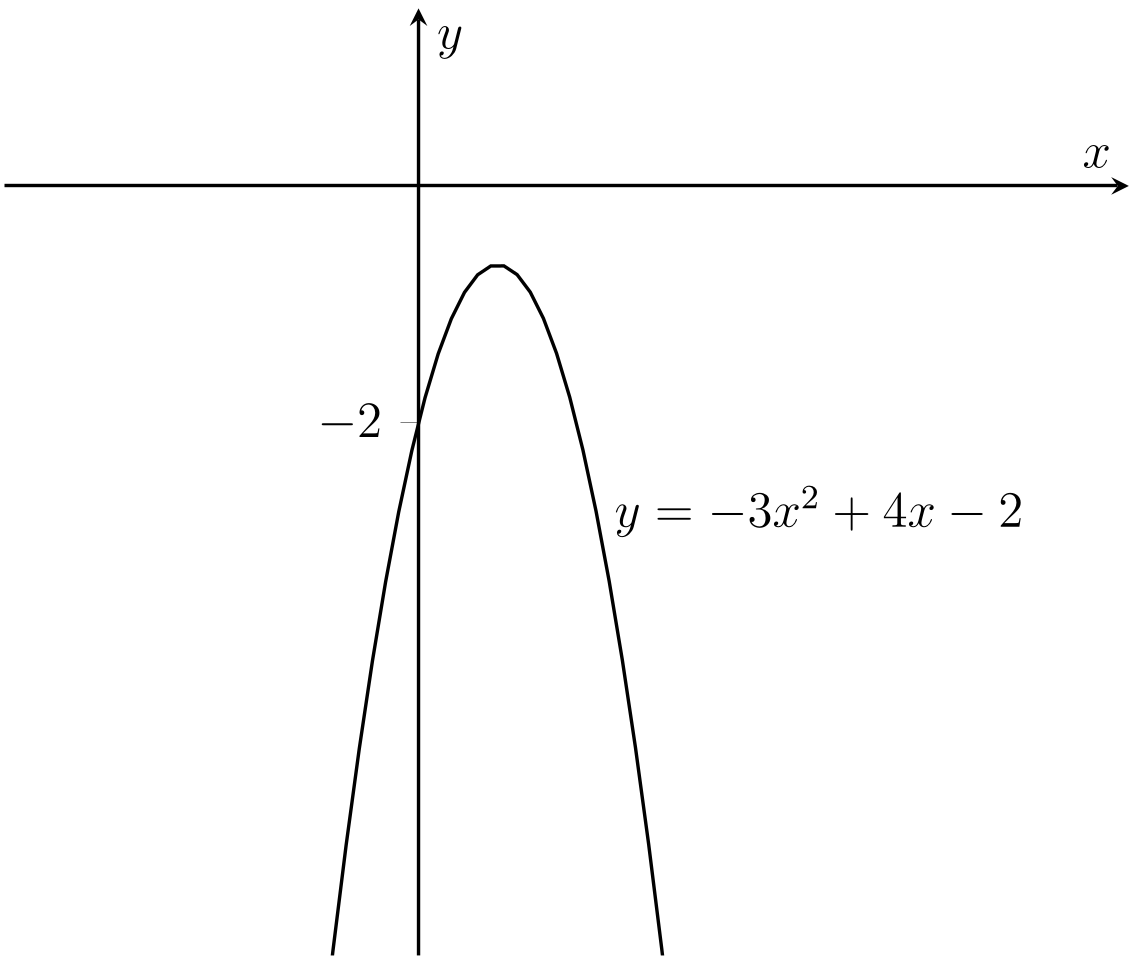
Fig. 2.14 Graph of \(y =-3x^2+4x-2\).#
Exercise
Find the discriminant of each of the following quadratics and state whether the equation has two distinct, exactly one real or no real solution.
(i) \(3x^2 +5x -1 = 0\);
(ii) \(49x^2 +42x +9= 0\);
(iii) \(2x^2 +8x +9 = 0\);
(iv) \(2x^2 +7x +4= 0\).
Given that \(3x^2 -kx +12\) is positive for all values of \(x,\) find the range of possible values for \(k\).
Given that \(\alpha\) \(\beta\) are roots of the quadratic equation \(x^2 -7x +3 = 0,\) find \(\alpha\) and \(\beta\) from the formula and verify that \(\alpha + \beta = 7\) and \(\alpha\beta = 3\).
By completing the square, find the greatest value of
(i) \(y =2-2x -x^2\);
(ii) \(y= -7+12x -3x^2\),
and the smallest value of each of
(iii) \(y = 13 +6x +3x^2\),
(iv) \(y=15 +8x + \frac 12x^2\).
2.7. Quadratic Simultaneous Equations#
We now move on to simultaneous equations involve quadratic terms. For simultaneous equations involving a quadratic, it is normally easier to solve one of the equations for one of the variables.
Example 2.20
Solve
Solution.
We use (2) to substitute \(4x +7\) for \(y\) in (1) to get \(4x +7 = x^2 +3x +5\). This is a quadratic equation and we solve it as follows.
So \(x = 2\) or \(x = -1\). If \(x = 2\) then, from (2),
If \(x = -1\) then, from (2),
Thus we have two solutions, namely \(x = 2,\) \(y = 15\) and \(x = -1,\) \(y = 3\).
We check each of these in equation (1). If \(x=2\) and \(y = 15\) then
If \(x=-1\) and \(y = 3\) then
Note that using the methods of the previous section we can draw the graphs of both \(y = x^2 + 3x + 5\) and \(y = 4x +7\), as shown below.
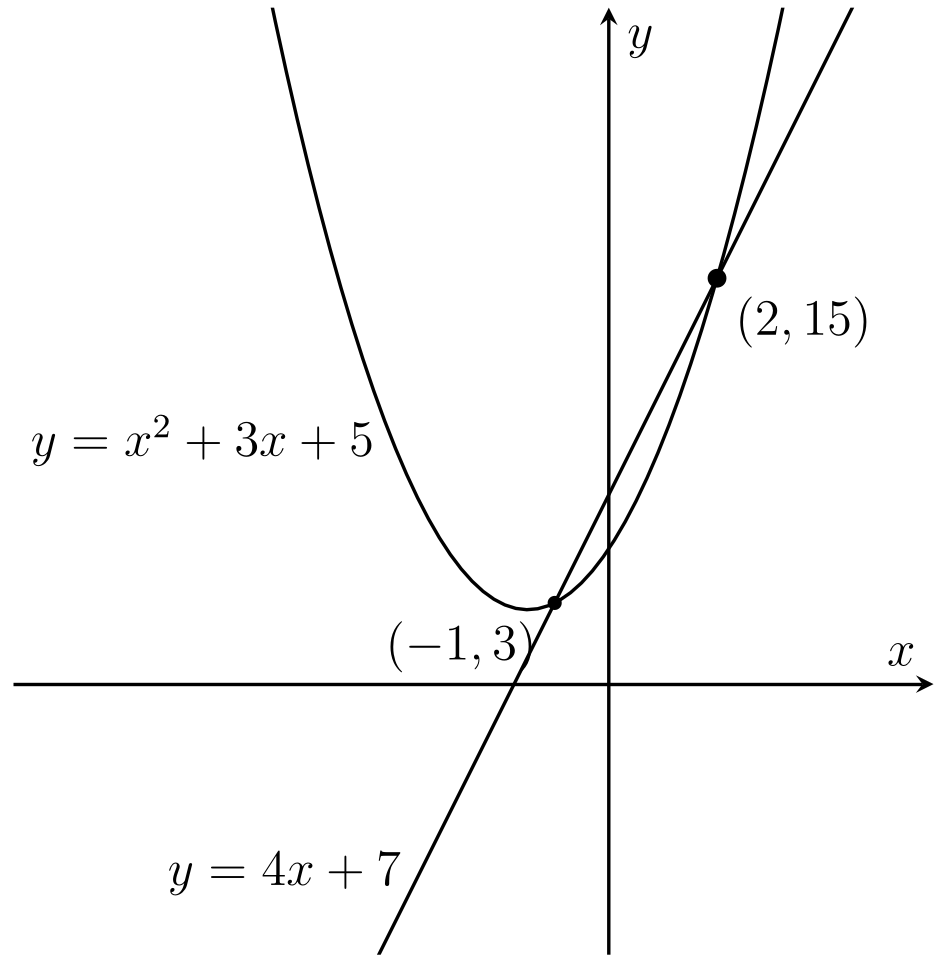
Fig. 2.15 Graph showing the intersection points of \(y =x^2+3x+5\) and \(y =4x+7\).#
We see that the solutions to the above system of equations are exactly the intersection points of the two graphs.
Note
The rules we had for simultaneous linear equations apply here too. So do not start your check with what you want to show and use the equation you have not used last for your check.
Exercise
Solve \(\left\{ \begin{array}{rclcc} x^2 + xy + y^2 &=&1 &\quad&(1)\\ x+ 2y + 1 &=& 0&&(2) \end{array}\right.\).
Solution
From (2) we get that \(x = - 2y -1\). So we substitute \(-2y -1\) for \(x\) in (1) to get:
This is a quadratic equation (in \(y\)) and we solve it.
So \(y = 0\) or \(y = -1\). If \(y = 0\) then (2) gives that \(x + 0 + 1 = 0\) and so \(x = -1\). If \(y = -1\) then (2) gives that \(x + 2\times(-1) + 1 = 0\) and so \(x = 1\).
Thus we have two solutions: \(x = -1,\) \(y = 0\) and \(x = 1,\) \(y = -1\).
Check: Using (1):
Note
We could have substituted \(y\) from equation (2) into equation (1). But \(y = \frac{-x-1}{2},\) a fraction. And if possible, we like to avoid fractions.
2.8. Quadratic inequalities#
2.8.1. The real line#
All the real numbers lie on the real line. We have met this before, for example as the \(x\)- and \(y\)-axes.

Fig. 2.16 The real line#
Note that the statement \(a < b\) (\(a\) is less than \(b\)) means that \(a\) is to the left of \(b\) on the real line. Similarly, \(a > b\) (\(a\) is greater than \(b\)) means that \(a\) is to the right of \(b\) on the real line.
2.8.2. Sets of numbers#
Example 2.21
We write \(\{ x\in \mathbb{R}\::\: -1 < x < 2 \}\) for the set containing all real numbers \(x\) such that \(-1 < x < 2\). We can illustrate this set on the real line by

Fig. 2.17 The set \(\{x\in \mathbb{R}\::\:-1<x<2\}\)#
Here the round brackets “(” and “)” indicate that the inequalities are strict; that is, that the end points are not included.
We write \(\{ x\in \mathbb{R}\::\: 1 \leq x \}\) for the set containing all real numbers \(x\) such that \(1 \leq x\). We can illustrate this set on the real line by

Fig. 2.18 The set \(\{x\in \mathbb{R}\::\:x\geq 1\}\)#
Here the square bracket “[” indicates that the end point is included.
The set \(\{ x\in \mathbb{R}\::\: x \leq \frac{1}{2} \mbox{ or } \frac{22}{5} < x\}\) consists of all real numbers \(x\) such that \(x \leq \frac{1}{2}\) or \(\frac{22}{5} < x\). We can illustrate this set on the real line by

Fig. 2.19 The set \(\{ x\in \mathbb{R}\::\: x \leq \frac{1}{2} \mbox{ or } \frac{22}{5} < x\}\)#
2.8.3. Some rules for inequalities#
First Rule for Inequalities#
This is very straightforward, namely for any real numbers \(a\) and \(b\),
Second Rule for Inequalities#
For any real numbers \(a\), \(b\) and \(k,\)
Example 2.22
For any real numbers \(a\) and \(b\) we have \(a < b \Longleftrightarrow a + 7 < b+7\) as the picture below illustrates.

Fig. 2.20 \(a < b \Longleftrightarrow a + 7 < b+7\)#
Similarly, \(a < b \Longleftrightarrow a - 5 < b-5\). As we can see, if we add or subtract the same number to both \(a\) and \(b\) all we do is to shift both \(a\) and \(b\) the same distance on the real line.\
Third Rule for Inequalities#
Let \(a\), \(b\) and \(k\) be any real numbers. Then, as long as \(k\) is positive, \(a < b \Longleftrightarrow ka < kb\). We can see this by realising that both \(a\) and \(b\) get stretched by a factor of \(k\) away from \(0\). (Note: there are 5 different possibilities to consider depending on whether \(a\) and \(b\) are positive, negative or zero. Try and figure them out!)
On the other hand, \(a < b \Longleftrightarrow (-a) > (-b)\) (note that the \(<\) sign has switched round to a \(>\) sign). To see this, remember that on the real line we get \(-a\) from \(a\) by reflecting across \(0\). Similarly, \(a < b \Longleftrightarrow (-3)a > (-3)b\) (note again that the \(<\) sign has switched round to a \(>\) sign). This is true because \(a < b \Longleftrightarrow 3a < 3b\) and \(3a < 3b \Longleftrightarrow -3a > -3b\). We are now ready to state the third rule.
For any real numbers \(a\), \(b\) and \(k\) (with \(k\) non-zero) we have
\(a < b \Longleftrightarrow kb < ka\) if \(k\) is positive
\(a < b \Longleftrightarrow kb > ka\) if \(k\) is negative.
Fourth Rule for Inequalities}#
The fourth rule relates to the fact that \(+ve \times +ve\) and \(-ve \times -ve\) are both positive, while \(+ve \times -ve\) and \(-ve \times +ve\) are both negative, namely
Summary: Four Rules for Inequalities
For \(a,b\in\mathbb{R}\),
Rule 1: \(a<b \;\Leftrightarrow \; b>a\)
Rule 2: For any \(k\in\mathbb{R},\) \(\;\; a<b \;\Leftrightarrow \; a+k<b+k\)
Rule 3: (i) If \(k>0\), \(\;\; a<b \;\Leftrightarrow \; ka<kb\)
(ii) If \(k<0\), \(\;\; a<b \;\Leftrightarrow \; ka>kb\)
Rule 4: (i) \(ab>0\;\Leftrightarrow \;\) (\(a>0\) and \(b>0\)) or (\(a<0\) and \(b<0\))
(ii) \(ab<0\;\Leftrightarrow \;\) (\(a>0\) and \(b<0\)) or (\(a<0\) and \(b>0\))
2.8.4. Solving linear inequalities#
With a little careful rearranging, these are quite straightforward.
Example 2.23
Solve \(4 - 2x < 7x -3\). (That is, find the values of \(x\) for which the inequality holds.)
Solution.
We have
So the solution is \(x>\frac{7}{9}\). We can write this in set notation as \(\{ x\in \mathbb{R}\::\: x > \frac 79\}\) (“the set of real numbers \(x\) such that \(x>\frac{7}{9}\)”).

Fig. 2.21 The set \(\{ x\in\mathbb{R} \::\: x > \frac 79\}\)#
Exercise
Find all the values of \(x\) for which \(3(x+4)+24 < - 5(x-6)\).
Solution
So the answer is all the \(x\) for which \(x < - \frac 34,\) that is \(\{ x \::\: x < -\frac 34\}\).
2.8.5. Solving quadratic inequalities#
Quadratic inequalities use the same ideas, but are a bit more subtle.
Example 2.24
Solve \(x^2 - 3x +2 < 0\).
Solution.
By factorising we have
So the solution is all real numbers \(x\) for which \(1< x <2\), that is \(\{ x\in\mathbb{R} \::\: 1< x < 2\}\).

Fig. 2.22 The set \(\{ x \::\: 1< x < 2\}\)#
(Note that if we sketch the graph of \(y = x^2 -3x +2 = (x -\frac 32)^2 -\frac 14\) we get
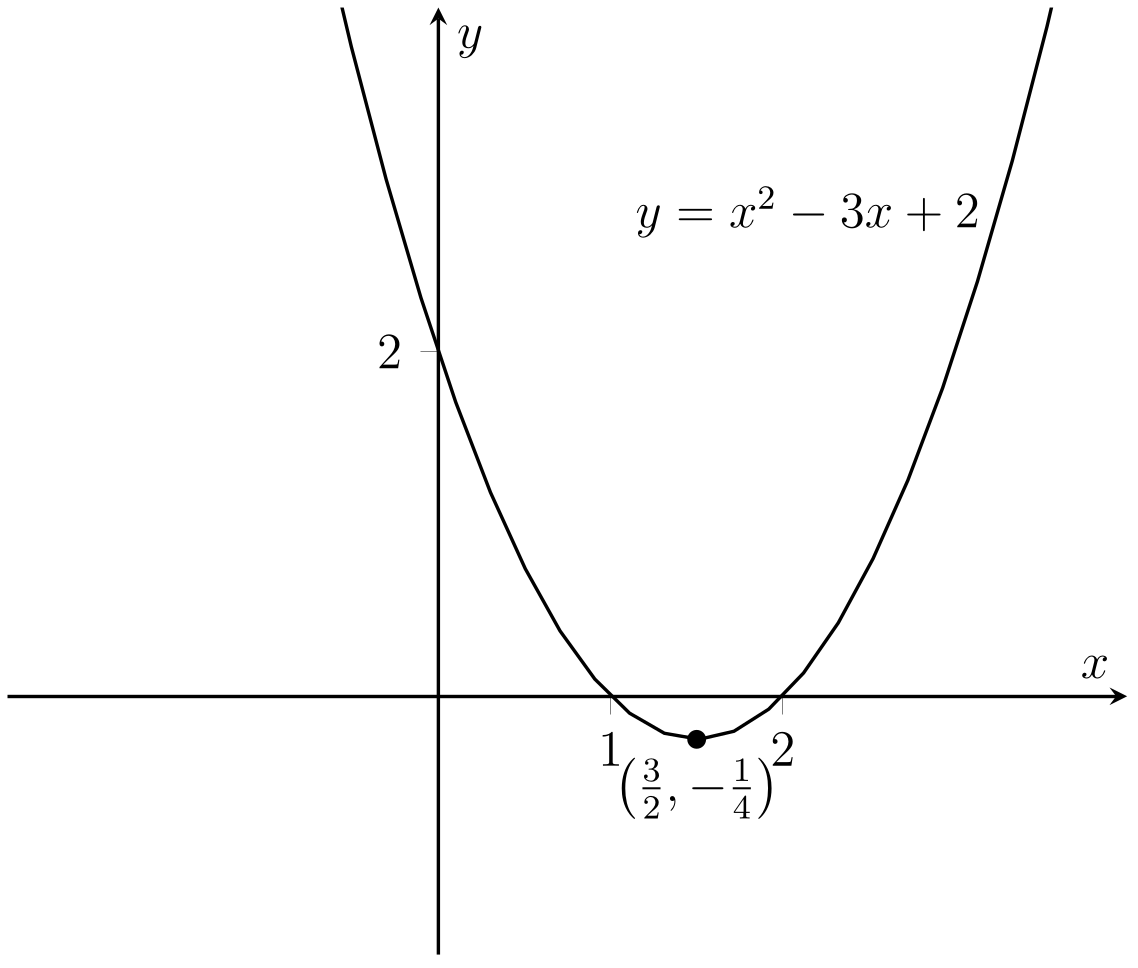
Fig. 2.23 The graph of \(y = x^2 -3x +2 = (x -\frac 32)^2 -\frac 14\)#
\noindent We have clearly found the points on the \(x\)-axis for which \(y < 0\).)
Exercise
Find all the values of \(x\) for which \(x^2 +x -12 >0\). Sketch the graph of \(y = x^2 +x -12\) and compare it with your answer.
Solution
By factorising we have
So the solution is all real numbers \(x\) for which \(x>3\) or \(x < -4,\) that is the set \(\{ x\in\mathbb{R} \::\: x > 3 \mbox{ or } x < -4\}\).

Fig. 2.24 The set \(\{ x\in\mathbb{R} \::\: x > 3 \mbox{ or } x < -4\}\)#
If we sketch the graph of \(y = x^2 +x -12 = (x -\frac12)^2 -\frac{49}4\) we get
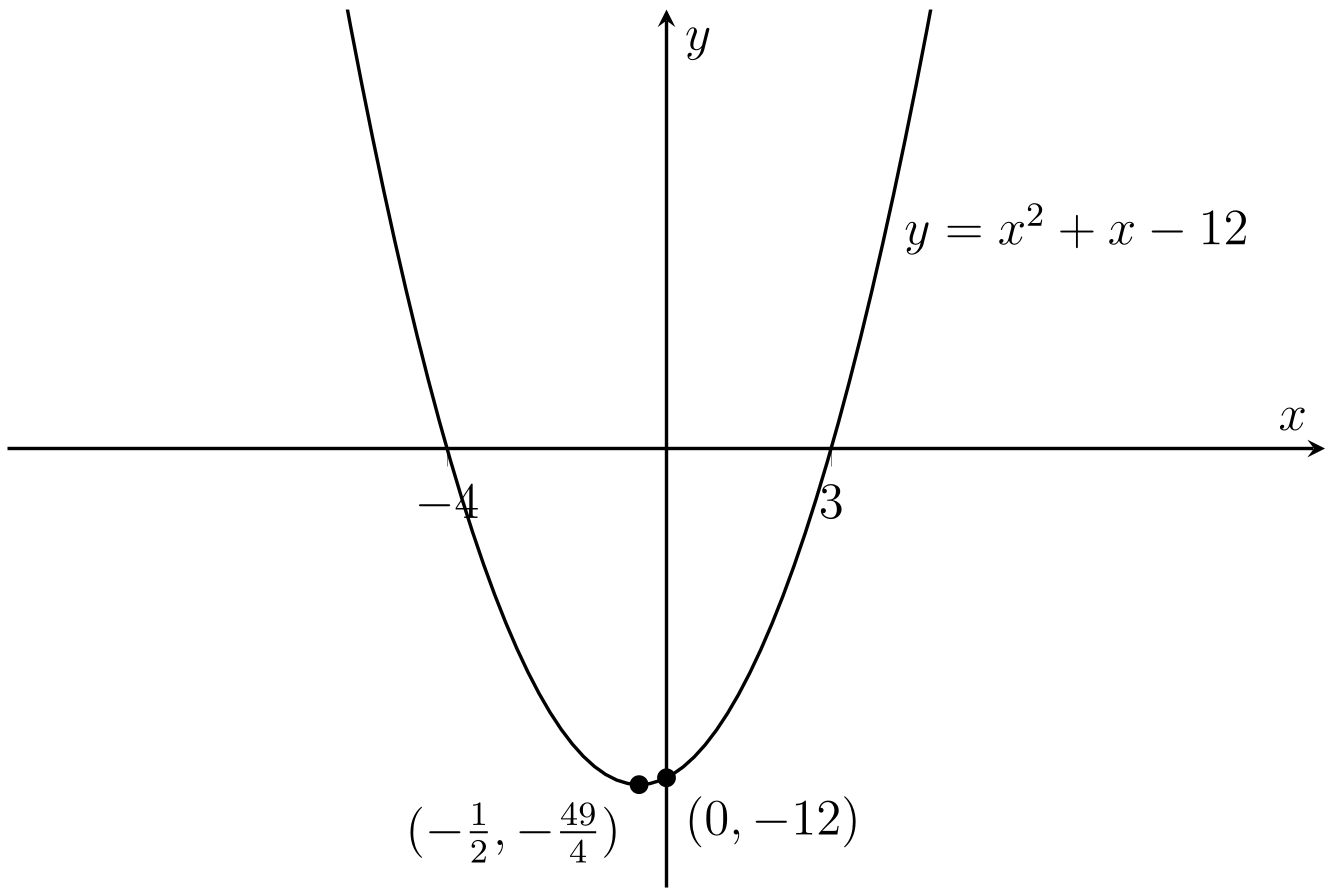
Fig. 2.25 The graph of \(y = x^2 +x -12 = (x -\frac12)^2 -\frac{49}4\)#
Again, we have found the points on the \(x\)-axis where \(y > 0\).
Exercise
Find all the values of \(x\) for which
(i) \(x^2 - 4x - 5 < 0\);
(ii) \(x^2 +7x +10 >0\).
Solution
(i) We have
So the answer to (i) is all the \(x\) for which \(-1 < x <5,\) that is \(\{ x \::\: -1 < x <5\}\).
(ii)
So the answer to (ii) is all the \(x\) for which \(x < -5\) or \(x >-2,\) that is \(\{ x \::\: x < -5 \mbox{ or } x > -2\}\).
Exercise
Solve the following inequalities: